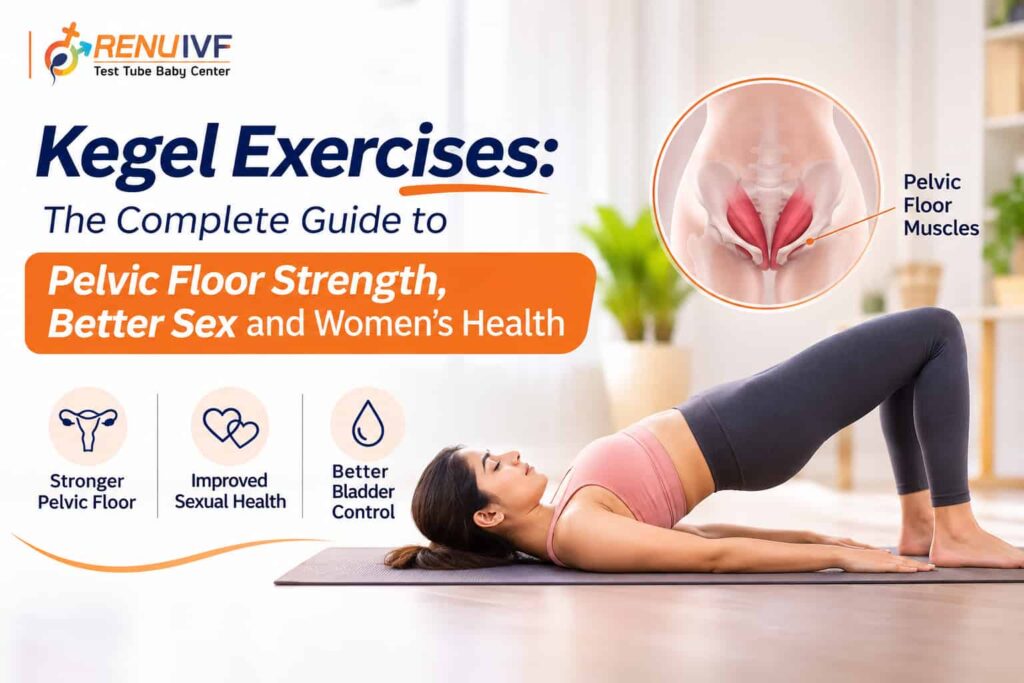


Pregnancy and childbirth are remarkable feats for the body, and they leave their mark. If you have noticed that your vagina feels looser than before, that you leak a few drops when you sneeze, or that intimacy does not feel the same, you are far from alone. Millions of new mothers quietly search the same question: how to tighten vagina after delivery?
The reassuring truth is that for most women this is a muscle-recovery issue, not a permanent change, and muscles can be retrained. This guide from Renu IVF explains what actually changes after birth, a phase-by-phase recovery plan, the exact pelvic floor exercise technique, what lasers, radiofrequency and surgery can and cannot do, the warning signs that need a doctor, and how to protect your body if you plan another pregnancy.
| The short answerThe most dependable way to tighten the vagina after delivery is to rebuild the pelvic floor muscles that support it. This means correctly done pelvic floor (Kegel) exercises, ideally taught by a doctor or pelvic floor physiotherapist, along with healing time, healthy bowel habits and a gradual return to exercise.Cleveland Clinic notes that pelvic floor physical therapy is usually the most effective option for vaginal laxity, while laser and radiofrequency treatments have limited proof for tightening vaginal muscles. |
What you will learn in this guide
• Why the vagina can feel loose after delivery, and what is really happening inside
• How to tell normal laxity from prolapse, leakage and other problems that need treatment
• A recovery timeline from day 1 to month 6 and beyond
• Step-by-step Kegel technique, a progression plan and the common mistakes to avoid
• Lifestyle habits that protect your pelvic floor
• An honest look at laser, radiofrequency, fillers and surgery
• Myths, red flags, sex and contraception after delivery, and planning your next pregnancy
• Answers to the most-asked questions, including C-section and breastfeeding
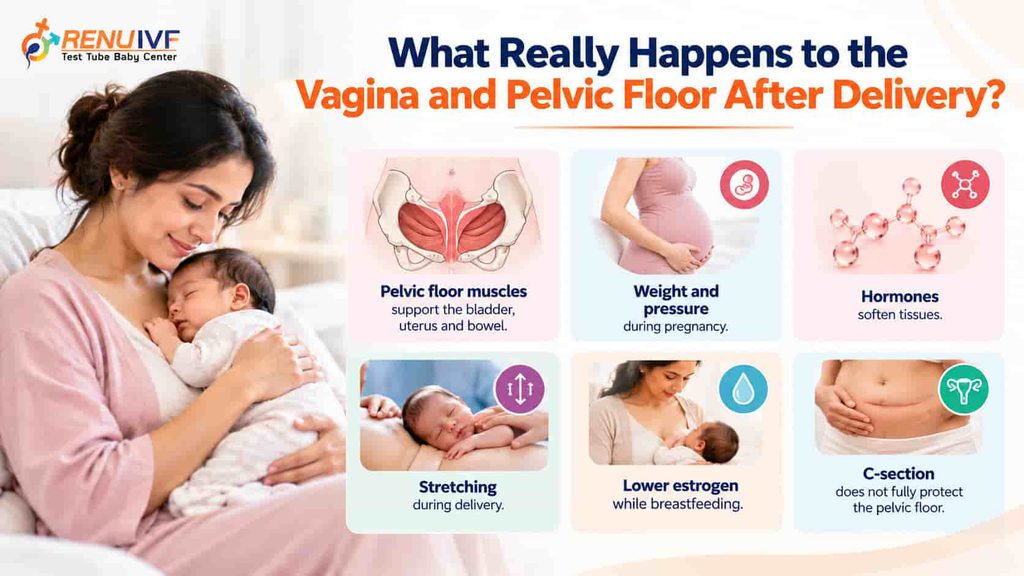
What Really Happens to the Vagina and Pelvic Floor After Delivery?
The vagina is built to stretch. During a vaginal birth its walls expand to let the baby pass, and in most women the tissue returns close to its usual size over the following weeks. So when a new mother says her vagina feels loose, the cause is usually not the vaginal canal alone.
explains that a loose feeling is usually due to weak pelvic floor muscles rather than the vagina itself. These muscles form a supportive sling at the base of the pelvis. They hold up the bladder, uterus and bowel, help you control urine and stool, and contribute to sexual sensation. You can read more about their role to the pelvic floor muscles.
During pregnancy and labour several things strain this sling at once:
• Weight and pressure. The growing uterus and baby press on the pelvic floor for nine months.
• Hormones. Pregnancy hormones soften ligaments and tissues so the body can prepare for birth.
• Stretching during delivery. The muscles and connective tissue stretch, and sometimes tear or need an episiotomy.
• Lower estrogen while breastfeeding. This can cause dryness and make tissues feel thinner and more sensitive.
Importantly, a C-section does not fully protect the pelvic floor. Carrying a pregnancy places load on these muscles even if you never labour, which is why pelvic floor exercises are advised after every type of delivery.
The good news is that a muscle responds to training. Just as an arm recovers strength with exercise after a plaster is removed, the pelvic floor can regain tone with the right programme.
Loose Vagina, Prolapse, Leakage or Tight Muscles: Know the Difference
Not every post-delivery pelvic complaint is the same, and the right treatment depends on what you actually have. Use this table to understand your symptoms, then confirm with a doctor.
| Condition | How it feels | What it needs |
| Vaginal laxity | A sense of looseness or reduced friction, a tampon feeling loose, lower sensation during sex. Laxity is a feeling, not something falling out. | Pelvic floor muscle training, time, and an examination to rule out other problems. |
| Pelvic organ prolapse | A bulge at or beyond the vaginal opening, a dragging or heavy feeling, backache, difficulty keeping a tampon in, or needing to press with fingers to pass stool. See Mayo Clinic on prolapse symptoms. | Medical evaluation is essential. Treatment ranges from exercises and a support device (pessary) to surgery. Read our Hindi guide on uterine prolapse (बच्चेदानी का बाहर आना). |
| Stress urinary incontinence | Leaking urine when you cough, sneeze, laugh, run or lift. | Pelvic floor training works well for many women. Persistent leakage needs assessment. |
| Overactive (too tight) pelvic floor | Pain or burning on penetration, difficulty inserting a tampon, a constant clenched feeling in the pelvis. | Relaxation-focused physiotherapy. More Kegels can make this worse. |
| Scar or tear pain | Tenderness, pulling or sharp pain at an episiotomy or tear site that lingers. | Medical review and gentle scar-care guidance once fully healed. |
If you are unsure which of these describes you, that is exactly why a proper examination matters. Treating the wrong problem wastes months, and money if you opt for a costly procedure.
Why Does the Vagina Feel Loose After Pregnancy?
Causes and Risk Factors
According to, the single most common reason pelvic support weakens is having a baby vaginally. The risk goes up with:
• More than one vaginal delivery, a high birth-weight baby, or a delivery that needed instruments such as forceps or vacuum
• Tears or an episiotomy during delivery
• Pelvic surgery in the past
• Long-term straining from chronic cough, constipation or heavy lifting
• Being overweight, or having a family history of prolapse or connective-tissue conditions
• Ageing and menopause, when estrogen falls further
Many of these factors are outside your control, which is why blaming yourself serves no purpose. What you can control is how well you rebuild afterwards.
Other pelvic concerns after delivery, such as unusual discharge, deserve their own attention. See our article on abnormal vaginal discharge and warning signs, and browse more in our Gynecological Health section.
Postpartum Recovery Timeline: What to Expect and What to Do
Healing is gradual and every woman’s timeline differs. Use this as a general map, and follow your own doctor’s advice, especially if you had stitches, a large tear, a forceps or vacuum delivery, or a C-section.
| Phase | What your body is doing | What helps |
| Days 1 to 14 | Bleeding (lochia), swelling and soreness; stitches or tears begin to heal; pelvic floor often feels weak or numb. | Rest, short gentle walks, pads rather than tampons (see pads vs tampons vs cups), gentle breathing, very light contractions if comfortable. Avoid straining on the toilet. |
| Weeks 2 to 6 | Tissues keep healing. For an uncomplicated vaginal birth, healing is typically around six weeks. | Build up gentle pelvic floor exercises, keep walking, avoid heavy lifting, and wait for your doctor’s go-ahead before sex. |
| Weeks 6 to 12 | Postnatal check-up. Pelvic floor and core can be assessed and structured strengthening can start. | Ask your doctor to check your pelvic floor strength. Consider a pelvic floor physiotherapist if symptoms persist. Increase exercise slowly. |
| Months 3 to 6 | Visible strength gains are common with regular training. Mayo Clinic says Kegel results usually appear within a few weeks to a few months. | Continue daily exercises. Many therapists advise waiting about 12 weeks before running or jumping, and longer if you leak or feel heaviness. |
| Beyond 6 months | Most women have noticeably improved. Persistent symptoms are a signal to get specialist help, not to wait. | Maintain exercises long term, reassess with your doctor, and consider the medical options below if needed. |
How to Tighten Vagina After Delivery Naturally:
The Pelvic Floor Programme
This is the core of the answer. Exercise is the first-line approach, it is free, private and has no side effects when done correctly.
Step 1: Find the right muscles
You cannot train what you cannot find. Mayo Clinic suggests a few ways to locate your pelvic floor muscles:
• Squeeze the muscles you would use to stop passing gas. You should feel a slight pulling in the vagina and rectum.
• Imagine stopping the flow of urine. Use this only once to identify the muscles, not as a regular exercise (see mistakes below).
• Once you have found them, practise lying down first because it is the easiest position, then sitting, then standing.
Step 2: Perfect the technique
1. Imagine you are sitting on a marble and gently lift it upward and inward.
2. Squeeze and lift for a count of three, then relax fully for a count of three.
3. Keep your thighs, buttocks and stomach relaxed. Only the pelvic floor should work.
4. Breathe normally throughout. Never hold your breath.
5. Feel the muscles let go completely at the end of each squeeze. Relaxing is as important as lifting.

Step 3: Follow a gradual progression
The schedule below blends the commonly recommended routine from Mayo Clinic (three sets a day, working up to 10 to 15 repeats) with the longer holds many hospital physiotherapy leaflets use. Treat it as a guide and let your doctor or physiotherapist adjust it.
| Phase | Hold | Rest | Repeats per set | Sets a day | Quick squeezes |
| Reconnect (first 2 weeks, if comfortable) | 3 sec | 3 sec | 5 to 8 | 3 | None |
| Build (weeks 3 to 6) | 5 sec | 5 sec | 8 to 10 | 3 | 5 per set |
| Strengthen (week 6 to month 3) | Up to 8 to 10 sec | Same as hold | 10 to 15 | 3 | 10 per set |
| Maintain (month 3 onward) | 5 to 10 sec | Same as hold | 10 | 1 to 2 | 10 per set |
Quick squeezes (also called fast contractions) train the muscles to react instantly when you cough, sneeze or jump. Squeeze hard and fast, then release completely. Do both slow-hold and fast versions for a complete workout.
Step 4: Use “the knack” in daily life
Gently tighten your pelvic floor just before you cough, sneeze, laugh, lift your baby or stand up from the floor. This simple habit protects against leakage and takes pressure off healing tissue.
Habit tips so you actually stay consistent
• Link each set to something you already do: feeding the baby, brushing your teeth, boiling the kettle.
• Set a phone reminder for the first month until it becomes automatic.
• Track your holds on a calendar. Seeing the hold time increase is motivating.
Common Kegel mistakes to avoid
• Squeezing the buttocks, thighs or abdomen instead of the pelvic floor
• Holding your breath or bearing down, which pushes the pelvic floor the wrong way
• Stopping urine mid-stream as a regular exercise. Mayo Clinic warns this can stop the bladder emptying fully and raise the risk of urinary tract infection
• Over-training without relaxing. A muscle that never fully relaxes becomes tight and painful
• Giving up too early. Results take weeks to months, so persistence matters
• Ignoring pain. Pain with Kegels is a reason to stop and ask a doctor
Supporting exercises once your doctor says you are ready
The pelvic floor works with the deep abdominal muscles, hips and glutes. After your six-week check, or earlier if your doctor approves, add these gradually:
1. Diaphragmatic breathing: Breathe in so your ribs and belly widen and the pelvic floor relaxes. As you breathe out, gently lift the pelvic floor and draw in your lower abdomen.
2. Heel slides: Lie on your back with knees bent, exhale and lift the pelvic floor, then slowly slide one heel away and back.
3. Glute bridges: Exhale, lift the pelvic floor and raise your hips. Lower slowly as you inhale.
4. Supported squats: Hold a chair for balance, exhale and lift the pelvic floor as you stand up.
5. Bird-dog (hands and knees): Keep the spine still while extending one arm or leg, with the pelvic floor gently engaged.
Walking is the best everyday exercise to start with. Hold off on running, skipping, jumping and heavy gym work until your pelvic floor feels strong and you have no leaking, heaviness or pain.
Lifestyle Habits That Protect Your Pelvic Floor
Exercises work best when daily habits are not undoing your efforts. Pay attention to these:
Keep your bowels soft
Chronic straining on the toilet is one of the biggest silent stressors on the pelvic floor. Eat fibre-rich foods such as whole grains, dal, vegetables and fruit, drink enough water, and do not delay the urge to go. Resting your feet on a small stool so your knees sit higher than your hips can make passing stool easier.
Lift smartly
Exhale and gently engage your pelvic floor before lifting your baby, a car seat or a bucket. Bring heavy objects close to your body and avoid repeated heavy lifting in the early months.
Reach a healthy weight gradually
Extra body weight adds pressure on the pelvic floor, so Mayo Clinic lists being overweight as a risk factor. Aim for slow, steady changes. Crash diets are a poor idea while recovering or breastfeeding.

Treat persistent cough
A long-standing cough from allergy, asthma or smoking repeatedly strains the pelvic floor. Get it treated.
Rest and ask for help
Recovery is physical, hormonal and emotional. Sharing night feeds and household load with family is not laziness, it is part of healing.
When Kegels Alone Are Not Enough: Physiotherapy and Devices
If you cannot feel the muscles working, if symptoms are not improving after about three months of consistent effort, or if you have leakage or heaviness, ask for a pelvic floor assessment. Mayo Clinic describes several supportive techniques that may be used along with Kegels:
• Pelvic floor physiotherapy: A trained therapist checks your technique and builds a personal plan. Cleveland Clinic describes this as usually the best treatment for vaginal laxity.
• Biofeedback: A small sensor and screen show you when you are contracting and relaxing correctly.
• Electrical stimulation: A gentle current helps muscles contract, useful if you struggle to feel them.
• Vaginal cones: Weighted cones held in place by squeezing, used for a set time while standing or walking.
These options are usually chosen after an examination, and availability varies by city. Your gynecologist can advise which is suitable for you.
Medical and Cosmetic Vaginal Tightening Options: What the Evidence Says
Clinics widely advertise “vaginal tightening”, so it helps to know what is proven and what is marketing. The American College of Obstetricians and Gynecologists points out that “vaginal rejuvenation” is a marketing term rather than a medical one, and recommends speaking to a gynecologist before any such procedure.
| Option | What it is | What the evidence and experts say |
| Pelvic floor muscle training and physiotherapy | Supervised exercise programme | First-line treatment. Cleveland Clinic calls it usually the most effective choice for vaginal laxity. |
| Vaginal lubricants or doctor-prescribed vaginal estrogen | Moisturisers or low-dose hormone creams | Help when dryness from low estrogen, common during breastfeeding or after menopause, is part of the problem. Needs a doctor’s advice. |
| CO2 laser | Heat energy delivered into the vaginal lining to stimulate collagen | Cleveland Clinic states energy-based treatments are not effective for tightening vaginal muscles, are expensive, and long-term studies are limited. |
| Radiofrequency (RF) | Radiofrequency heat to boost blood flow and collagen | Described by Cleveland Clinic as not a proven therapy and unlikely to help symptoms. |
| Fillers and PRP injections (such as the “O-shot”) | Injections into the vulva or vagina | Cleveland Clinic calls the O-shot experimental. High-quality evidence for fillers in tightening is lacking, and results are temporary. |
| Vaginoplasty or perineoplasty | Surgery to narrow the canal or strengthen the area near the anus | Cleveland Clinic says vaginoplasty is generally not recommended for laxity because it can cause painful sex. Surgery is mainly justified for structural problems such as prolapse. |
| Prolapse treatment | Pessary, supervised exercise, or surgery | Mayo Clinic notes nonsurgical treatment often helps, with surgery reserved for selected cases. |
A safety note on laser and radiofrequency devices
In 2018 the US Food and Drug Administration issued a safety communication warning that energy-based devices used for vaginal “rejuvenation” or cosmetic vaginal procedures may be associated with serious adverse events, and that their safety and effectiveness for these purposes had not been established. The FDA reported harms such as burns, scarring, pain during intercourse and chronic pain. New Zealand’s regulator also noted that no energy-based device had been cleared or approved for these uses.
This does not mean every patient will be harmed, but it is a strong reason to ask hard questions before paying for these procedures.
Questions to ask before any procedure
• What exactly is my diagnosis: laxity, prolapse, incontinence or something else?
• Have I tried a supervised pelvic floor programme for at least three months?
• What does independent research, not the company brochure, say about this treatment?
• What are the risks, and what happens if it goes wrong?
• How many sessions will I need, how much will it cost in total, and how long do results last?
• Who will perform it, and what are their qualifications?
A 2024 systematic review on treating vaginal laxity and a study examining what the symptom of vaginal laxity actually means are useful reading if you want to see the science behind these questions.
Caring for Tears, Stitches and the Perineum
Many women have a tear or episiotomy, and how well it heals shapes how comfortable your pelvic area feels later.
• Wash gently with clean warm water after using the toilet and pat dry, rather than rubbing.
• Change pads regularly and wear loose, breathable cotton underwear.
• Follow your doctor’s advice on pain relief and any prescribed medicines or ointments.
• Do not strain. Keep stool soft and support the area with a clean pad when you go if it feels tender.
• Avoid inserting anything into the vagina, including tampons, until your doctor confirms it has healed.

Contact your doctor promptly if you notice increasing pain, swelling, pus, a foul smell, fever, or a wound that seems to be opening. Once fully healed, a physiotherapist can teach gentle scar-care techniques if tightness or pain persists.
Sex After Delivery: When, How and What to Expect
There is no single correct date. Most doctors advise waiting until bleeding has settled, stitches have healed and you feel physically and emotionally ready, often around or after the six-week check-up.
• Go slowly. Start with non-penetrative intimacy and build up at your pace.
• Use lubricant. Lower estrogen during breastfeeding commonly causes dryness, and a good water-based lubricant makes a big difference.
• Talk openly with your partner. Feeling different is common and temporary for many couples.
• Pain is not normal. Persistent pain deserves a medical check, and may signal healing problems or a tight pelvic floor.
Do not forget contraception
You can become pregnant before your first period returns. ACOG explains that if you are not breastfeeding, ovulation may return within a few weeks, and if you are breastfeeding it usually returns by about six months. Choose a method with your doctor, and read more in our family planning and contraception articles. If your cycle is irregular after delivery, our guide on delayed periods may help.
Myths vs Facts About Vaginal Tightening After Childbirth
| Myth | Fact |
| Normal delivery ruins the vagina permanently. | The pelvic floor often recovers substantially with time and training. Even when changes persist, they are treatable. |
| A C-section keeps the pelvic floor safe. | Pregnancy itself strains the pelvic floor, so exercises help after every kind of delivery. |
| Surgery or laser is the only real fix. | Supervised pelvic floor training is the first-line option, and energy-based treatments lack strong evidence for tightening muscles. |
| Herbal pastes, alum (phitkari) or “tightening” gels work. | There is no scientific support for these. They can irritate or burn delicate tissue and disturb natural vaginal balance. |
| Vaginal steaming or hot herbal treatments help recovery. | No evidence supports this, and heat near delicate tissue risks burns. |
| The tighter, the better. | An over-tight, tense pelvic floor causes pain and difficult intercourse. The goal is strong, flexible muscles that can both contract and relax. |
| Only older women need pelvic floor care. | Young mothers can have leakage and laxity too. Early training prevents later problems. |
When to See a Doctor: Red Flags You Should Not Ignore
See a doctor soon if you notice any of the following:
• A bulge, dragging sensation or heaviness in the vagina, or difficulty keeping a tampon in (possible prolapse)
• Leaking urine, gas or stool that does not improve
• Pain during sex, or pain at a scar that does not settle
• Heavy bleeding, large clots, foul-smelling discharge or fever
• A wound that is red, swollen or opening
• No improvement after about three months of consistent exercises
Seek emergency care straight away for very heavy bleeding, severe pain, chest pain, breathlessness or a high fever after delivery.
Dr. Renu Singh Gahlaut, a laparoscopic surgeon and women’s health specialist at Renu IVF, and the team can examine you, identify what is behind your symptoms and guide you to the right treatment. For pelvic problems that may need a minimally invasive approach, see our Laparoscopy and Hysteroscopy services.
Planning Another Baby? Protect Your Pelvic Floor and Your Pregnancy
If a second child is on your mind, recovery now sets up a healthier next pregnancy.
• Space your pregnancies. ACOG notes that many experts recommend waiting at least 18 months between pregnancies.
• Keep up pelvic floor training before and throughout the next pregnancy to reduce cumulative strain.
• Tell your doctor about previous tears, instrument deliveries or C-sections. These details help plan safer care. Learn more about what makes a pregnancy high-risk and our high-risk pregnancy care.
• Do not delay help if conceiving is difficult. If you have been trying for about a year (or six months if you are over 35) without success, a fertility assessment is the right next step, and Renu IVF offers IVF and related treatments with personalised care.
Explore more guidance in our pregnancy care and complications articles.
How Renu IVF Can Support Your Postpartum Recovery
At Renu IVF in Kalyanpur, Kanpur, care is personal and unhurried. Led by Dr. Renu Singh Gahlaut (MS Gold Medalist, FICOG, trained in Germany and France, with over 20 years of experience), our team can help you:
• Understand whether your symptoms are laxity, prolapse, leakage or hormonal dryness
• Learn a safe, correct pelvic floor routine suited to your delivery and healing
• Plan contraception and spacing for your next pregnancy
• Get guidance on the right specialist care if a deeper problem needs treatment
• Prepare for future pregnancy, or begin fertility evaluation if conceiving again is difficult
Women visit us from Kanpur and nearby districts including Unnao, Kanpur Dehat, Fatehpur and Kannauj. Learn more about us or meet our team.
| Book a private consultation at Renu IVFPhone: +91 63935 77649 | +91 95170 88055Email: info@renuivf.comAddress: C-13, New Azad Nagar, Kalyanpur, Kanpur, Uttar Pradesh 208017Hours: Monday to Saturday 9 AM to 7 PM, Sunday 9 AM to 2 PMBook an appointment | Contact us |
Frequently Asked Questions
How long does it take to tighten the vagina after delivery?
Healing of an uncomplicated vaginal birth typically takes about six weeks, but muscle strength takes longer. With regular pelvic floor exercises, Mayo Clinic says results commonly appear within a few weeks to a few months, and many hospital leaflets quote three to six months for best results. Keep exercising long term to maintain gains.
Can the vagina tighten naturally after normal delivery?
Yes, to a large extent. The tissues recover over the weeks after birth, and the pelvic floor muscles can be strengthened with exercises. Some women need extra help from a physiotherapist or doctor.
When can I start Kegel exercises after delivery?
Many women can begin very gentle contractions within the first days if it is comfortable, after both vaginal delivery and C-section. If you had a significant tear, stitches or complications, ask your doctor first and build up slowly.
How many Kegels should I do in a day?
A common target is three sets a day, working up to 10 to 15 repeats per set, with each squeeze held for several seconds and followed by full relaxation. Quality matters more than quantity.
Do Kegel exercises really work?
For many women, yes. They strengthen the muscles supporting the bladder, uterus and bowel, and are the first-line recommendation for post-delivery laxity and leakage. They work best when the technique is correct, so ask for guidance if you are unsure.
Does a C-section prevent a loose vagina?
It may lower some risks linked to vaginal birth, but it does not remove the strain of pregnancy on the pelvic floor. Pelvic floor exercises are still recommended.
Are laser or radiofrequency treatments effective for tightening the vagina?
Evidence is limited. Cleveland Clinic states energy-based treatments are not effective for tightening vaginal muscles, and the FDA has warned about serious adverse events and unproven claims. Discuss alternatives with a gynecologist first.
Is vaginal tightening surgery safe?
Any surgery carries risks, and Cleveland Clinic notes vaginoplasty is generally not recommended for laxity because it may cause painful sex. Surgery is more appropriate for structural problems such as prolapse after proper assessment.
Can I use tightening creams, gels or home remedies?
These are not proven and some can irritate or burn tissue and upset natural vaginal balance. Avoid them and choose evidence-based care.
How do I know if it is prolapse and not just looseness?
Prolapse usually causes a visible or palpable bulge, heaviness or dragging, trouble keeping a tampon in, or difficulty emptying the bowel. Looseness alone is a feeling of reduced tightness. A doctor’s examination can tell the two apart.
Does a loose vagina affect my ability to get pregnant again?
Vaginal looseness by itself does not prevent conception. However, if you have difficulty conceiving, a fertility assessment can look for the real cause.
Can breastfeeding cause vaginal dryness and make things feel different?
Yes. Estrogen levels are lower while breastfeeding, which can cause dryness and thinner tissue. A good lubricant helps, and your doctor can advise further if it is troublesome.
When can I have sex after delivery?
There is no fixed date. Most doctors suggest waiting until bleeding has settled and any stitches have healed, commonly around the six-week check-up, and only when you feel ready. Use contraception, because pregnancy is possible before your first period returns.
Key Takeaways
• A loose feeling after delivery is common and usually reflects a weakened pelvic floor, not a permanent fault.
• Correctly done pelvic floor exercises, built up gradually and kept up, are the best first step.
• Healing time, soft stools, smart lifting and gradual return to exercise protect your progress.
• Laser, radiofrequency and fillers lack strong evidence, and surgery is not usually advised for laxity alone.
• A bulge, heaviness, ongoing leakage or pain needs a medical examination, not self-treatment.
• You do not have to cope silently. Help is available, and recovery is possible.
Your body has done something extraordinary. Give it time, give it the right exercise, and give yourself permission to ask for help. If you would like personal guidance, the team at Renu IVF is here for you. Book a consultation today.