


You opened your report, saw the word “low” next to your AMH, and your mind jumped to the worst. Maybe you have already typed “can I still get pregnant?” into Google late at night.
Here is what most people don’t hear when they need it most: one hormone number cannot decide whether you will conceive. But it is also not a number to shrug off, because for some women, waiting too long is the real risk. Let’s separate what is true from what is scary.
What Is AMH, and What Does Low AMH Really Mean for You?
AMH stands for Anti-Müllerian Hormone. It is made by the small follicles in your ovaries, so it gives doctors a rough idea of how many eggs you have left. This is called your ovarian reserve.
So what does a low AMH actually mean? Simply put, low AMH means fewer eggs are likely remaining compared with other women of your age. It does not measure egg quality. It also says nothing about whether you ovulate, whether your tubes are open, or how healthy your partner’s sperm is. Egg quality depends far more on age than on AMH.
That is why two women with the same number can be in completely different situations. A 29-year-old and a 39-year-old with an identical report do not have the same odds.
How Low Is Too Low? A Rough Guide
Labs use different units (ng/mL or pmol/L, where 1 ng/mL is roughly 7 pmol/L) and different tests, so always compare your result with your own lab’s range. As a general guide:
| AMH (ng/mL) | Usually described as |
| Above 3.5 | High (often seen in PCOS) |
| 1.0 to 3.5 | Normal |
| 0.5 to 1.0 | Low |
| Below 0.5 | Very low |
If you see low AMH levels on a single report, don’t panic yet. Hormonal contraceptives can temporarily lower the reading, and results can vary between labs. A borderline value is worth repeating and reading together with an ultrasound follicle count. Also note that when doctors say AMH low means reduced egg supply, they are describing quantity, not a final verdict on your fertility.
Why Did This Happen? The Causes Nobody Explains
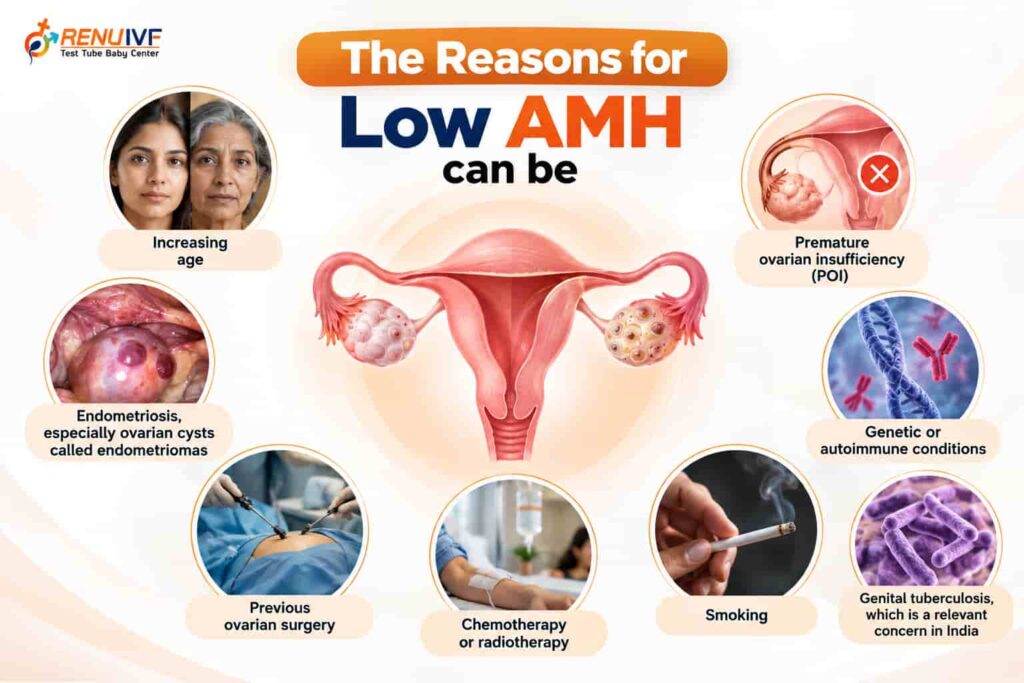
Age is the most common cause, since ovarian reserve falls gradually over the years. But it is not the only one. The reasons for low AMH can include:
- Increasing age
- Endometriosis, especially ovarian cysts called endometriomas
- Previous ovarian surgery
- Chemotherapy or radiotherapy
- Smoking
- Genital tuberculosis, which is a relevant concern in India
- Genetic or autoimmune conditions
- Premature ovarian insufficiency (POI)
If you are under 35 and your result is very low, ask your doctor whether a deeper check for POI or genetic causes makes sense. A report showing anti mullerian hormone low at a young age deserves a proper look, not just reassurance.
Will You Feel Anything? The Honest Answer
This part frustrates many women. The symptoms of low AMH are essentially none. You can have perfectly regular periods and still have a low reserve. You can also have irregular periods with a normal AMH. Most women find out only when they are tested during a fertility check-up.
Irregular cycles or difficulty conceiving are good reasons to get evaluated, but they are not signs of low AMH by themselves. They can have many other causes.
So, Can You Still Conceive Without IVF?
Yes, it is possible. Large studies of women with no earlier infertility, who had just started trying, found that women with low AMH conceived at similar rates to those with normal levels. On its own, AMH is a weak predictor of natural fertility.
Now the part most blogs skip. Those studies mostly involved women who had not yet struggled to conceive. If you are 38, your AMH is low and you have been trying for eight months, that reassuring headline may not fully apply to you. Your chances depend on:
| Factor | Why it matters |
| Age | The strongest factor for both egg quality and quantity |
| Ovulation | You need to release an egg regularly |
| Fallopian tubes | At least one healthy, open tube is needed |
| Sperm health | Count, movement and shape all matter |
| Time spent trying | Longer without success needs evaluation |
| Other conditions | Endometriosis, fibroids, PCOS |
Dr. Renu Singh Ghalaut explains that an AMH report should never be read on its own. Age, menstrual history, ovulation, antral follicle count, tubes, sperm and previous pregnancies must all be looked at together before any treatment decision is made. You can also watch Dr. Renu Singh Ghalaut’s video on this topic to hear it in her own words.
The Clock Question: How Long Is Too Long to Wait?
This is where a low result becomes time-sensitive. The standard guidance is:
- Under 35: see a doctor after 12 months of trying
- 35 to 39: see a doctor after 6 months
- 40 or above: get evaluated straight away
If you already know your AMH is low, it is reasonable to come in even earlier. Waiting “just a few more months” feels comfortable, but it can quietly use up the years that matter most.
Not sure where you stand? Your age, AMH and how long you’ve been trying decide how much time you can safely wait. Book a consultation to get a personalised plan instead of guessing.
Two Roads: Which One Fits You?
Many women assume a low result means IVF is the only route. Not necessarily. The IUI vs IVF question depends on your age, tubes, your partner’s sperm and how long you have been trying.
- IUI may be considered when tubes are open, sperm parameters are reasonable, and age and reserve are still favourable. It is less invasive and less expensive.
- IVF may be advised earlier when there are tubal problems, male-factor infertility, endometriosis, advancing age or repeated IUI failures.
The honest catch: IUI success per cycle drops with age and with lower reserve. So the choice is not only about cost. For some women, spending several months on IUI cycles that are unlikely to work uses up valuable time.
What Happens in an IVF Cycle When Egg Numbers Are Low?
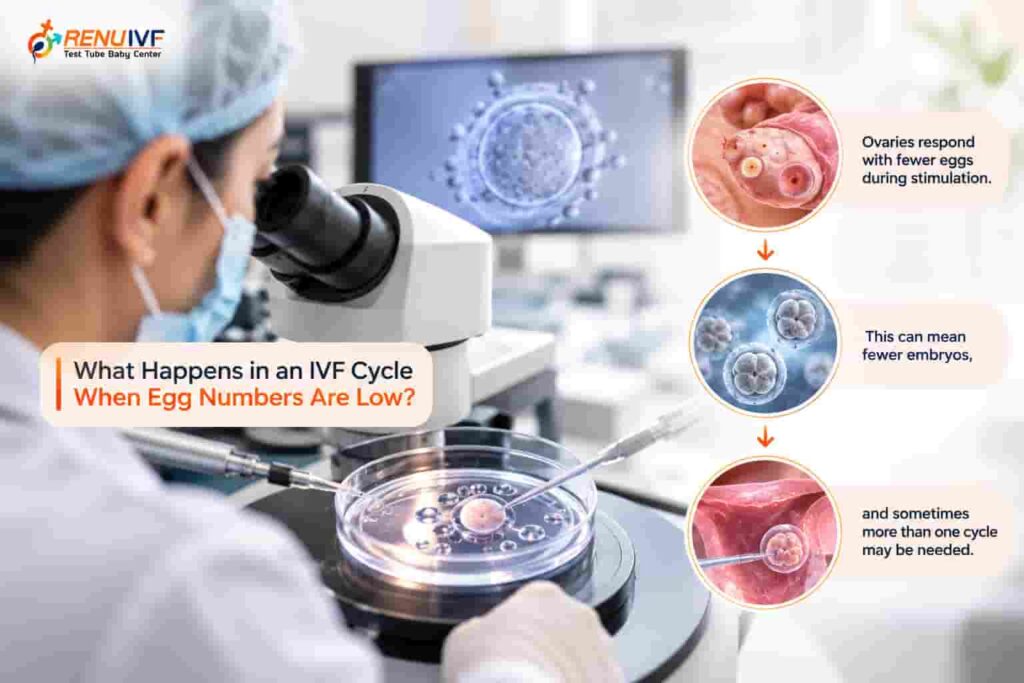
With a smaller reserve, the ovaries usually respond with fewer eggs during stimulation. That can mean fewer embryos, and sometimes more than one cycle. But fewer eggs does not mean zero chance.
The IVF success rate depends on your age, embryo quality, sperm factors, the stimulation protocol and lab quality. AMH alone has only a weak link with live birth, and professional guidance says a low value should not by itself be used to refuse treatment. Two women with the same AMH can have very different results, mostly because of age.
The Social Media Fix You Should Question First
You may have seen ovarian PRP (platelet-rich plasma) promoted online as a way to raise AMH. Be careful. PRP therapy for low AMH is still investigational. Studies are small, and it is not part of standard fertility guidelines. It should never be presented as a guaranteed fix or a replacement for proven treatment.
If a clinic offers it, ask plainly: what is the evidence, what are the realistic chances, and what happens if it doesn’t work? A good specialist will answer honestly.
Thinking Ahead: Should You Freeze Your Eggs?
For younger women who are not ready for pregnancy, egg freezing and fertility preservation can be worth discussing. With a low reserve, though, fewer eggs are collected per cycle, so more than one cycle may be needed, and freezing never guarantees a future pregnancy.
A low result alone should not push you into a rushed decision. Age and your life plans matter just as much. An early consultation gives you options while you still have time.
Tests That Complete the Picture
| Test | What it tells you |
| Antral follicle count (ultrasound) | Number of small follicles visible in the ovaries |
| FSH and estradiol | Ovarian function early in the cycle |
| Ovulation assessment | Whether you release an egg regularly |
| Tubal evaluation | Whether the fallopian tubes are open |
| Semen analysis | Your partner’s fertility factors |
AMH can be tested on any day of your cycle, unlike some other hormone tests. Not everyone needs every test, and your doctor will choose based on your history.
When Is It Time to Book a Consultation?
Meet an IVF specialist if:
- You are 35 or older and have been trying for 6 months
- You are 40 or older and planning pregnancy
- Your AMH is low and you are worried
- You have had ovarian surgery, endometriosis or a poor response in a previous cycle
- Your periods are irregular
- Your partner’s semen analysis is abnormal
- You want to understand egg freezing
The goal of a consultation isn’t to push you into IVF. It is to find out why pregnancy hasn’t happened and what is realistic for you. As Dr. Renu Singh Ghalaut explains, the right decision comes from the complete fertility picture, not from one hormone value.

Final Thoughts: A Signal, Not a Verdict
A low AMH doesn’t mean the door is closed, and it doesn’t mean you should wait indefinitely either. It means your timeline deserves attention. At Renu IVF, treatment planning is built around your age, ovarian reserve, reproductive history and your partner’s health, not around a single number.
If you are searching for an IVF hospital in Kanpur, bring your AMH report and earlier test results to your consultation. The team at Renu IVF can help you understand whether to keep trying naturally, consider IUI, or plan IVF.
Have your AMH report in hand? Bring it along with your earlier test results and get it explained in plain language. Call us or book your appointment online today.
Frequently Asked Questions
1. Can I get pregnant naturally with low AMH?
Yes, it is possible. AMH reflects egg quantity, not whether you will conceive. Age, ovulation, tubal health and sperm quality matter as much or more. If you are 35 or older, or have been trying for a while, get evaluated instead of waiting.
2. Do I need IVF if my AMH is low?
Not always. Some women conceive naturally or with IUI. IVF is recommended when age, tubal factors, male-factor infertility or a previous treatment failure make waiting less sensible.
3. Which supplements can improve low AMH?
Here’s the surprising part: none has been proven to raise the AMH number itself. Some, like CoQ10 or vitamin D (if you’re deficient), are studied for egg quality, but the evidence is limited. The bigger risk is spending months on supplements while time-sensitive fertility decisions wait. Talk to your fertility specialist before starting anything.
4. Should I freeze my eggs if my AMH is low?
It depends on your age and plans. Freezing works best when done earlier, but a low reserve may mean multiple cycles for fewer eggs. Discuss it early with a fertility specialist instead of making a rushed decision.
5. Does low AMH mean I am close to menopause?
Not necessarily. Low AMH means fewer eggs remain, but you can still ovulate and conceive. Menopause is confirmed only after 12 months without periods, not by an AMH report. If your periods are becoming irregular, ask your doctor about FSH and estradiol tests.


