

Preloader

Genetic Testing

Comprehensive Genetic Screening for Informed Healthcare Decisions

Genetic testing is a powerful diagnostic tool that analyzes your DNA to identify genetic variations associated with inherited disorders, disease risks, and reproductive health. At Renu IVF, a trusted IVF centre in Kanpur, we combine advanced genetic testing technology, expert genetic counseling, and compassionate care to help you make informed decisions about your health and family planning.

This page explains what genetic testing involves, the different types available, who should undergo testing, and what to expect during the process—so you can make informed decisions that align with your medical needs and personal circumstances.

Understanding Genetic Testing

What Is Genetic Testing?

Genetic testing is a medical examination that analyzes chromosomes, genes, or proteins to detect genetic variations, mutations, or abnormalities. These tests examine your DNA—the instruction manual for your body—to identify changes that may cause disease, increase health risks, or affect your children’s health.

Unlike routine blood tests that measure current health markers, genetic testing provides information about your genetic makeup that remains constant throughout life. This information can guide medical decisions, family planning choices, and preventive healthcare strategies.

At Renu IVF, genetic testing prioritizes accuracy, confidentiality, and ethical practices at every step. Our experienced team ensures you understand test results and their implications for you and your family.

Why Is Genetic Testing Important?

Genetic testing serves multiple crucial purposes in modern healthcare:

Disease Prevention and Early Detection
  • Identifies increased risk for certain cancers, heart disease, or other conditions
  • Enables early monitoring and preventive interventions
  • Guides personalized screening schedules
  • Informs lifestyle modifications to reduce risk
Family Planning and Reproductive Health
  • Detects carrier status for inherited genetic disorders
  • Assesses risk of passing conditions to children
  • Guides IVF treatment with preimplantation genetic testing
  • Enables informed reproductive decisions
Diagnosis and Treatment
  • Confirms suspected genetic conditions
  • Explains unexplained symptoms or developmental delays
  • Guides targeted treatment approaches
  • Predicts medication response (pharmacogenomics)
Family Health Information
  • Provides insights for blood relatives
  • Identifies hereditary patterns in families
  • Enables cascade testing for at-risk family members
  • Supports extended family health planning

Types of Genetic Tests

Understanding the different types of genetic tests helps you know which test is appropriate for your situation. Each test serves specific purposes and examines different aspects of your genetic material.

Carrier Screening

Carrier screening identifies whether you carry a gene mutation for recessive genetic disorders. Carriers typically don’t have symptoms but can pass the mutation to their children.

Common Conditions Screened:
  • Thalassemia (blood disorder)
  • Sickle cell disease
  • Cystic fibrosis
  • Spinal muscular atrophy (SMA)
  • Fragile X syndrome
  • Tay-Sachs disease
How It Works:

Carrier screening examines specific genes known to cause inherited conditions. If both partners carry mutations in the same gene, each pregnancy has a 25% risk of the child being affected with the condition.

Who Benefits:
  • Couples planning pregnancy
  • Individuals with family history of genetic conditions
  • Ethnic groups with higher carrier rates for specific disorders
  • Anyone seeking comprehensive reproductive planning

Carrier screening is ideally performed before pregnancy, allowing couples to understand risks and explore options including IVF with preimplantation genetic testing, prenatal diagnosis, or using donor eggs/sperm.

Preimplantation Genetic Testing (PGT)

Preimplantation genetic testing examines embryos created through IVF before transfer to the uterus. This advanced testing identifies genetic abnormalities, allowing selection of healthy embryos.

Types of PGT:

PGT-A (Aneuploidy Screening)
  • Screens for abnormal chromosome numbers
  • Identifies conditions like Down syndrome, Turner syndrome, or Klinefelter syndrome
  • Improves IVF success rates by selecting chromosomally normal embryos
  • Reduces miscarriage risk
PGT-M (Monogenic Disorders)
  • Tests for specific single-gene disorders
  • Used when parents carry mutations for conditions like cystic fibrosis, sickle cell disease, or Huntington’s disease
  • Prevents transmission of known genetic conditions
  • Enables healthy pregnancy without affected children
PGT-SR (Structural Rearrangements)
  • Identifies chromosomal structural problems
  • Used when parents have balanced translocations or inversions
  • Reduces miscarriage risk from unbalanced chromosomal arrangements
  • Improves chances of successful pregnancy
The PGT Process:

Embryos are biopsied at day 5 or 6 of development, removing a few cells for genetic analysis while the embryo continues developing. Results typically take 1-2 weeks. Only embryos without detected genetic abnormalities are selected for transfer.

Benefits:
  • Significantly reduces risk of genetic disease in offspring
  • Improves IVF success rates
  • Decreases miscarriage rates
  • Reduces need for difficult pregnancy decisions
  • Provides peace of mind

Prenatal Genetic Testing

Prenatal testing examines the fetus during pregnancy to detect genetic abnormalities or chromosomal conditions.

Non-Invasive Prenatal Testing (NIPT)
  • Blood test analyzing fetal DNA in mother’s bloodstream
  • Performed from 10 weeks of pregnancy
  • Screens for Down syndrome, Edwards syndrome, Patau syndrome
  • Highly accurate with low false-positive rates
  • No risk to pregnancy
Invasive Prenatal Testing:
Chorionic Villus Sampling (CVS)
  • Performed at 11-14 weeks of pregnancy
  • Samples placental tissue for genetic analysis
  • Diagnoses chromosomal abnormalities and single-gene disorders
  • Small risk of miscarriage (0.5-1%)
Amniocentesis
  • Performed at 15-20 weeks of pregnancy
  • Samples amniotic fluid containing fetal cells
  • Provides comprehensive chromosomal and genetic information
  • Small risk of miscarriage (0.1-0.5%)

Prenatal testing helps parents understand fetal health, prepare for special medical needs, or make informed decisions about pregnancy continuation.

Diagnostic Genetic Testing

Diagnostic testing confirms or rules out suspected genetic conditions when symptoms are present or family history suggests specific disorders.

Used For:
  • Confirming clinical diagnosis
  • Explaining unexplained symptoms
  • Investigating developmental delays
  • Evaluating intellectual disabilities
  • Assessing recurrent miscarriages
Common Diagnostic Tests:
Karyotyping
  • Examines chromosome number and structure
  • Identifies large chromosomal abnormalities
  • Diagnoses conditions like Down syndrome or Turner syndrome
Chromosomal Microarray
  • Detects small chromosomal deletions or duplications
  • More detailed than karyotyping
  • Identifies causes of developmental delays
Single Gene Testing
  • Examines specific genes for known mutations
  • Confirms suspected conditions like hemophilia or muscular dystrophy
Whole Exome Sequencing (WES)
  • Analyzes all protein-coding genes
  • Used when condition cause is unknown
  • Identifies rare or novel genetic variants

Predictive and Presymptomatic Testing

This testing identifies genetic mutations that increase disease risk before symptoms appear.

Cancer Susceptibility Testing:
  • BRCA1/BRCA2 mutations (breast and ovarian cancer risk)
  • Lynch syndrome genes (colorectal cancer risk)
  • Other hereditary cancer syndromes
Adult-Onset Conditions:
  • Huntington’s disease
  • Familial Alzheimer’s disease
  • Hereditary heart conditions
  • Polycystic kidney disease
Benefits:
  • Enables enhanced surveillance and early detection
  • Guides preventive measures (prophylactic surgery, medications)
  • Informs family planning decisions
  • Provides psychological preparation
Considerations:

Predictive testing requires careful counseling as results can have significant psychological and social implications. Not everyone at risk chooses testing, and this decision is deeply personal.

Pharmacogenomic Testing

Pharmacogenomic testing examines how your genes affect medication response, enabling personalized treatment approaches.

Applications:
  • Predicting drug effectiveness
  • Identifying risk of adverse reactions
  • Optimizing medication dosing
  • Selecting most appropriate medications
Commonly Tested Areas:
  • Cardiovascular medications
  • Cancer treatments
  • Mental health medications
  • Pain management drugs

This emerging field of personalized medicine improves treatment outcomes and reduces trial-and-error in medication selection.

The Genetic Testing Process at Renu IVF

Initial Consultation and Counseling

Your journey begins with comprehensive genetic counseling where our specialists:

  • Review your medical and family history
  • Discuss testing options appropriate for your situation
  • Explain what tests can and cannot reveal
  • Address concerns and answer questions
  • Ensure informed decision-making

Sample Collection

Sample collection is simple and varies by test type:

Blood Sample:
  • Most common method
  • Quick, simple blood draw
  • Usually 5-10 ml required
Saliva Sample:
  • Non-invasive option for some tests
  • Collection kit provided
  • Simple at-home collection
Tissue Biopsy:
  • For embryo testing (PGT)
  • Specialized IVF laboratory procedure
Amniocentesis or CVS:
  • For prenatal testing
  • Performed by maternal-fetal medicine specialist

Laboratory Analysis

Samples are sent to accredited genetic laboratories where:

  • DNA is extracted and analyzed
  • Specific genes or chromosomes are examined
  • Quality controls ensure accuracy
  • Results are generated and verified

Analysis time varies from 1-2 weeks for carrier screening to 4-6 weeks for comprehensive genetic panels.

Results and Post-Test Counseling

Once results are available, you’ll meet with our genetic counselor to:

  • Explain findings in understandable terms
  • Discuss implications for your health
  • Outline recommendations for medical management
  • Address emotional reactions
  • Provide resources and support
  • Discuss family implications if relevant

Understanding Genetic Test Results

Results typically fall into categories:
Positive Result:
  • Mutation or abnormality identified
  • Indicates increased risk or confirms diagnosis
  • Requires further discussion about implications
Negative Result:
  • No mutations detected in tested genes
  • Reduces but doesn’t eliminate risk completely
  • May provide reassurance
Variant of Uncertain Significance (VUS):
  • Change detected but unclear if disease-causing
  • Requires careful interpretation
  • May need family testing or future reclassification
Indeterminate Result:
  • Testing unable to provide clear answer
  • May require different testing approach

Our genetic counselors ensure you fully understand results and their meaning for you and your family.


Benefits and Limitations

genetic-testing-in-kanpur

Benefits:

  • Empowers informed healthcare decisions
  • Enables disease prevention and early detection
  • Guides family planning choices
  • Provides answers for unexplained conditions
  • Reduces uncertainty

Limitations:

  • Cannot predict all health outcomes
  • Some results are uncertain or unclear
  • Positive results may cause anxiety
  • Not all conditions have available treatments
  • Insurance and discrimination concerns exist


Privacy and Ethical Considerations

genetic-testing-in-kanpur

At Renu IVF, we maintain strict confidentiality:

  • Results shared only with your consent
  • Secure storage of genetic information
  • Ethical handling of sensitive data
  • Clear communication about potential implications
  • Support for emotional aspects


Who Should Undergo Genetic Testing?

Understanding who benefits from genetic testing helps determine if testing is appropriate for your situation. While genetic testing offers valuable insights, it’s not necessary for everyone.

Individuals and Couples Planning Pregnancy
Carrier Screening Recommended For:
  • All couples planning pregnancy, regardless of family history
  • Individuals from ethnic groups with higher carrier rates (Mediterranean, Southeast Asian, Ashkenazi Jewish populations)
  • Couples with consanguineous relationships (related by blood)
  • Anyone with family history of genetic conditions

Early carrier screening allows couples to understand reproductive risks and explore options before pregnancy occurs.

Those Considering IVF:

Couples undergoing IVF may benefit from preimplantation genetic testing, especially when:

  • Advanced maternal age (35 or older)
  • Recurrent miscarriages
  • Previous IVF failures
  • Known genetic mutations in either partner
  • Family history of genetic conditions
Individuals with Family History of Genetic Conditions
Strong Indicators for Testing:
  • Multiple family members with the same condition
  • Early-onset disease (cancer before age 50, heart disease before age 45)
  • Rare or unusual conditions in family
  • Multiple primary cancers in one individual
  • Family member with known genetic mutation
Examples:
  • Parent or sibling with BRCA mutation
  • Family history of Huntington’s disease
  • Multiple relatives with early-onset colon cancer
  • Family pattern suggesting hereditary condition

Genetic testing in these situations can clarify your personal risk and guide preventive care.

Women with Recurrent Pregnancy Loss

Women experiencing two or more miscarriages should consider genetic testing for:

Parental Chromosomal Analysis:
  • Identifies balanced translocations or inversions
  • Explains recurrent miscarriage patterns
  • Guides future pregnancy planning
Products of Conception Testing:
  • Analyzes miscarried tissue when available
  • Determines if chromosomal abnormality caused loss
  • Informs future pregnancy approach

Understanding causes of pregnancy loss helps guide treatment strategies and improves chances of successful pregnancy.

Individuals with Personal or Family Cancer History
Cancer Genetic Testing Recommended For:
  • Breast or ovarian cancer before age 50
  • Multiple primary cancers
  • Triple-negative breast cancer before age 60
  • Male breast cancer
  • Pancreatic cancer with family history
  • Colorectal cancer before age 50
  • Ten or more colon polyps

Identifying hereditary cancer syndromes enables:

  • Enhanced screening protocols
  • Preventive interventions
  • Informed decisions about risk-reducing surgeries
  • Testing of at-risk family members
Couples with Unexplained Infertility

When standard fertility tests don’t reveal causes, genetic testing may identify:

  • Chromosomal abnormalities affecting fertility
  • Y chromosome microdeletions in men
  • Fragile X premutation in women
  • Other genetic factors affecting reproduction
Individuals from High-Risk Ethnic Backgrounds

Certain genetic conditions occur more frequently in specific ethnic populations:

Thalassemia:
  • Mediterranean, Middle Eastern, Southeast Asian, and Indian populations
Sickle Cell Disease:
  • African, Mediterranean, Middle Eastern populations
Tay-Sachs Disease:
  • Ashkenazi Jewish, French Canadian populations
Cystic Fibrosis:
  • Northern European descent

Individuals from these backgrounds benefit from carrier screening even without family history.

Those with Unexplained Health Symptoms

Genetic testing helps diagnose conditions causing:

  • Developmental delays
  • Intellectual disabilities
  • Multiple congenital anomalies
  • Unusual symptom combinations
  • Conditions not explained by standard testing
Individuals Seeking Personalized Healthcare

Some people choose genetic testing to:
  • Understand disease risks
  • Guide preventive healthcare decisions
  • Optimize lifestyle choices
  • Plan for future health needs
  • Provide information for children and family

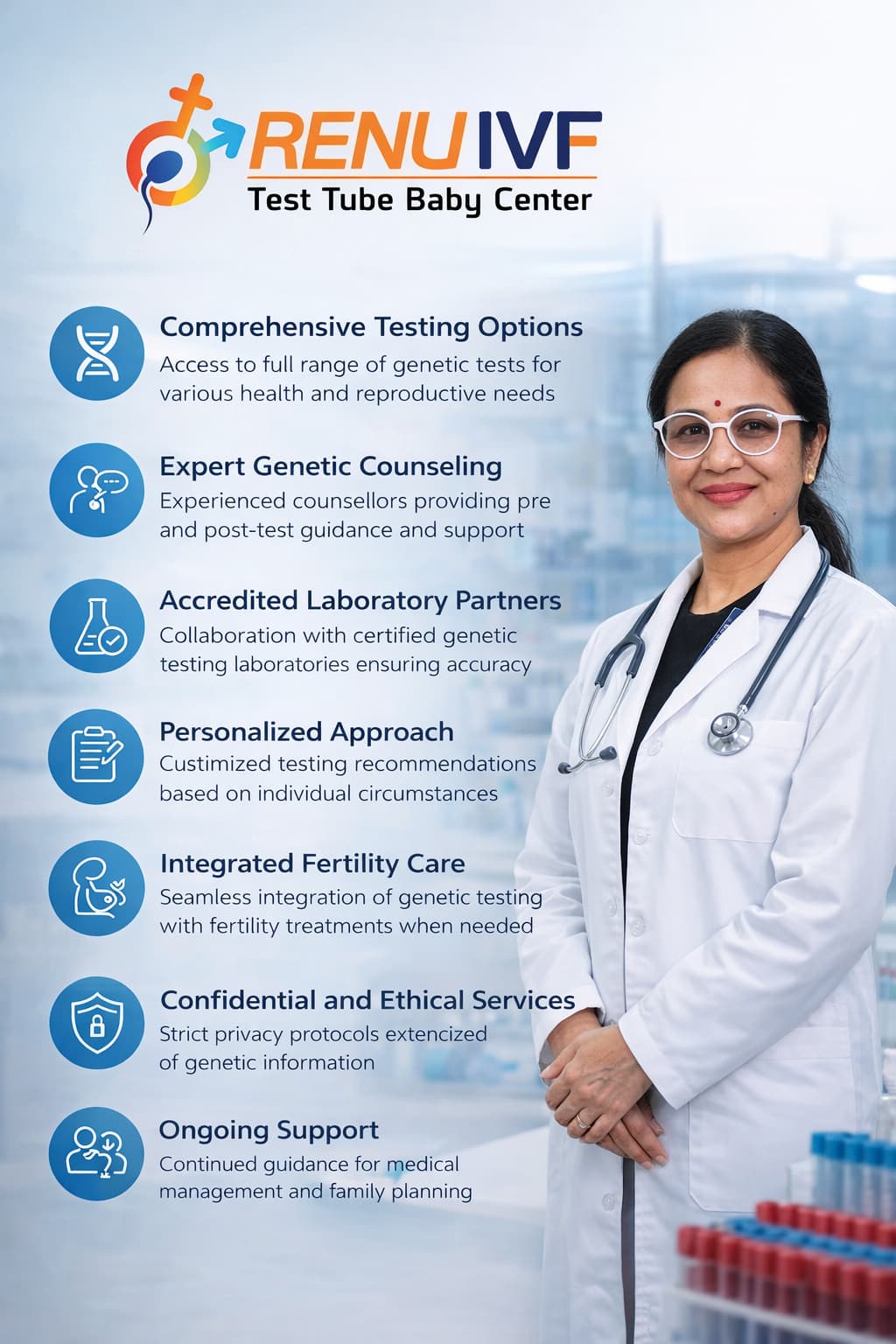
Why Choose Renu IVF for Genetic Testing in Kanpur?

  • Comprehensive Testing Options Access to full range of genetic tests for various health and reproductive needs
  • Expert Genetic Counseling Experienced counselors providing pre and post-test guidance and support
  • Accredited Laboratory Partners Collaboration with certified genetic testing laboratories ensuring accuracy
  • Personalized Approach Customized testing recommendations based on individual circumstances
  • Integrated Fertility Care Seamless integration of genetic testing with fertility treatments when needed
  • Confidential and Ethical Services Strict privacy protocols and ethical handling of genetic information
  • Ongoing Support Continued guidance for medical management and family planning decisions

Taking the Next Step

Understanding your genetic makeup is an important step toward informed healthcare and family planning. At Renu IVF, we provide the expertise, technology, and compassionate support you need to navigate genetic testing confidently.

Whether you’re planning a pregnancy, concerned about family health history, seeking answers for unexplained symptoms, or wanting personalized health insights, our team is here to guide you through every step of genetic testing and interpretation.

Contact Renu IVF today to schedule your genetic counseling consultation and take the first step toward informed health decisions.

Frequently asked question

During an IVF cycle, after fertilisation and embryo culture, we perform preimplantation genetic testing (PGT). A few cells are biopsied (usually from the trophectoderm), analysed for chromosomal abnormalities (PGT‑A) or specific gene mutations (PGT‑M). A chromosomally normal embryo is then selected for transfer.

Pre‑implantation Genetic Diagnosis (PGD) is a term historically used to describe testing embryos for specific known gene disorders (e.g., cystic fibrosis) before implantation. The broader term Preimplantation Genetic Testing (PGT) includes PGD but also covers chromosomal screening (PGT‑A) and structural rearrangement testing (PGT‑SR).

Costs vary depending on the clinic, number of embryos tested, technology used (e.g., next generation sequencing). For example, in India PGT may cost in the range of ₹40,000‑₹60,000 per embryo in some labs. At Renu IVF we provide detailed cost breakdowns and tailored packages based on your case.

No. Genetic testing (both embryo testing and screening) helps reduce risk but does not guarantee a healthy baby. Prenatal diagnostics (amniocentesis, CVS, foetal genetic testing) may still be recommended, especially when risk factors exist.

Couples may particularly benefit if:

  • They are older (maternal age > 35) or have had repeated miscarriages.
  • They have a family history of genetic disorders.
  • They have had previous failed IVF cycles or implantation failure.
  • They are carriers of known gene mutations.
    Genetic counselling at Renu IVF helps determine if you should pursue these tests.

Your Parenthood Journey Starts Here

Book Your Consultation Now