

That moment when you walk out of a lab holding a folder full of “normal” reports, makes you wonder
why I ‘am not getting pregnant, well you’re not alone.
Many couples have been in the same loop:
- Blood tests – normal
- Ultrasound – nothing serious
- Semen test – “little on the lower side but nothing alarming”
- Doctor says – “Let’s just wait and try a bit more.”
Months pass. Nothing changes.
This cannot be a norm and at some point, you got to ask:
“Is there something that is not coming up in my regular tests?
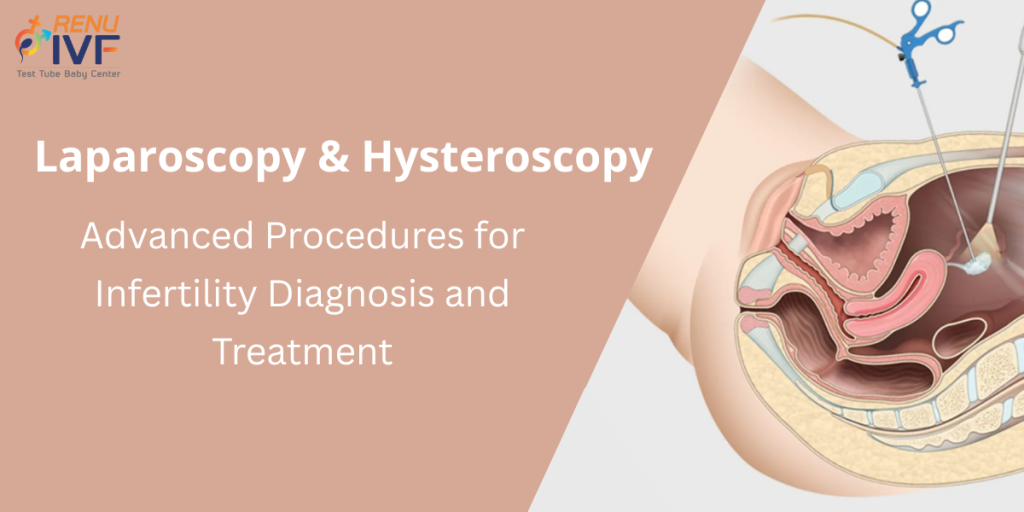
This is the time when your fertility specialist has to go beyond the regular tests and dig deeper to know the cause behind the delay in pregnancy, this is where laparoscopy and hysteroscopy come into the picture two minimally invasive procedures that allow the doctor to actually look inside the uterus and pelvis.
In cities like Kanpur, clinics such as Renu IVF often use these tools when everything else looks fine on paper but pregnancy still isn’t happening.
What is hysteroscopy?
Don’t get nervous because of the medical jargon for a moment.
To understand this procedure just imagine the uterus as a small room. Ultrasound is like looking at that room through a blurry window, which works most of the time. But diagnosis hysteroscopy is different as this procedure is more like quietly opening the door and switching on a torch as this enables clear and better picture.
How it is done:
- A thin camera (hysteroscope) is passed through the vagina and cervix
- No cuts are made on the outside
- Fluid is used to gently open the cavity so the doctor can see the walls clearly
Inside that space, the doctor is looking for things like:
- Tiny polyps
- Fibroids bulging into the cavity
- Scar tissue (adhesions)
- A wall or “septum” dividing the uterus
You’d be surprised how often a scan looks “okay”, but a diagnosis hysteroscopy reveals a small polyp or fibroid exactly where an embryo would want to implant.
In many centres (including Renu IVF Kanpur), if the finding is small and safe to handle, it usually gets treated in the same sitting.
What is laparoscopy?
Here focus moves out of the cavity.
During laparoscopic surgery for infertility, the doctor looks at:
- Fallopian tubes
- Ovaries
- The outer surface of the uterus
- The pelvic area around them
To do that, they:
- Make tiny keyhole cuts on the abdomen
- Fill the belly with gas so there’s space to see
- Put in a thin camera (laparoscope)
- Use fine instruments through other small cuts
This way, they can pick up things like:
- Endometriosis (spots of tissue growing where it shouldn’t)
- Ovarian cysts
- Tubes that are blocked or stuck
- Old infection-related adhesions
- Hydrosalpinx (fluid-filled tubes that can reduce IVF success)
The best thing? Laparoscopic surgery for infertility isn’t just about looking. If the surgeon finds a cyst, scar tissue, or mild block, they can often treat it straight away.
Why do doctors often suggest both together?
Doctors usually say:
“We’ll do a combined laparoscopy hysteroscopy.”
Think of it as a combo pack: one camera is focused inside the uterus; the other looks around it.
Why combine them?
In medical procedure they are combine because fertility problems are often a mix of small issues:
- A polyp inside the uterine cavity
- Plus, a bit of endometriosis behind the uterus
- Maybe a slightly damaged tube
So, if specialist is only focused on hysteroscopy, they would see the inside but they will miss what’s happening around the tubes and ovaries.
If they do only laparoscopy, they miss small cavity issues.
Hence, a diagnostic laparoscopy hysteroscopy in one sitting gives a full inside–outside picture. This is especially considered when:
- All reports are “normal”, but pregnancy isn’t happening
- There are repeated IUI/IVF failures
- There’s significant pelvic pain or very painful periods
- Endometriosis or tubal damage is suspected
In Kanpur, many couples land up at centres like Renu IVF at exactly this stage – nothing clearly wrong in reports, but still no baby – and are advised a combined laparoscopy and hysteroscopy procedure, so they can have the real answers.
What actually happens on the day?
On the day of procedure things go like this-
You are asked to come while fasting. Experts will go through your old reports and will check the vitals. The anaesthetist talks to you, listens to any health issues, explains how you’ll be put to sleep.
Once you’re in the OT:
- A small IV line is put in your hand
- Anaesthesia medicine goes in
- Within a minute or so, you’re asleep – you don’t see or feel the laparoscopy and hysteroscopy
First comes the hysteroscopy part:
- The camera goes through the cervix
- The cavity is gently opened with fluid
- The doctor looks at the lining, corners, and shape of the uterus
If there’s a small polyp or scar band, it may be removed in that same diagnosis hysteroscopy session.
Then comes the laparoscopy:
- A tiny cut is made near the navel
- Gas is used to inflate the belly
- The laparoscope is inserted
- One or two more tiny cuts are used for instruments
Now the surgeon can check the tubes, ovaries, uterus, and pelvis. If something treatable is seen – like a cyst or adhesions – it is often handled during the same laparoscopy and hysteroscopy procedure.
When it’s done, the gas is let out as much as possible, the instruments are removed, and the small cuts are closed. You’re shifted to recovery and later to your room.
For many people, it’s a day-care or overnight stay, depending on how extensive the laparoscopy hysteroscopy was and how they feel afterward.
The Real Recovery Experience: Not Just “Minimal Pain”
As per the expert’s recovery after laparoscopy and hysteroscopy is quick – which is mostly true, but totally depends on person to person. Here’s what people usually describe:
- A pulling or sore feeling in the tummy
- Gas/bloating for a day or two
- Sometimes shoulder pain because of the gas used during laparoscopy
- Light spotting from the hysteroscopy part
Most women can:
- Sit up within a few hours
- Walk to the washroom the same day or next day
- Get back to light work within 3–5 days, depending on how big the surgery part was
Before sending you home, doctors will give you clear instructions about:
- Painkillers and other medicines
- Taking care of the small stitches
- When you can bend, lift things, or exercise
- When intercourse is safe again
- When to start trying naturally or begin IUI/IVF after diagnostic laparoscopy hysteroscopy
How does this help with getting pregnant?
To conceive is a natural process and the whole point is to remove hindrances if any.
With the help of laparoscopy and hysteroscopy, a specialist can:
- Clear the uterine cavity by removing polyps or fibroids
- Treat endometriosis that might be affecting tubes or ovaries
- Release scar tissue so organs move freely
- Manage mild tube problems or hydrosalpinx
After that, depending on age and other factors, some couples try naturally for a few months. Others move to IUI or IVF with better odds because the “ground” (uterus and pelvis) has been cleaned up.
At Renu IVF they don’t use laparoscopy and hysteroscopy procedure for everyone, but used it when genuine answers are required.
Fast FAQs You Actually Need
1. Does every infertile couple need laparoscopy hysteroscopy?
No. It’s usually suggested when standard tests don’t explain the problem, or there are strong symptoms or repeated failures.
2. Is laparoscopic surgery for infertility very risky?
There are risks, as with any surgery, but in trained hands serious complications are uncommon. Your doctor should explain them clearly before you sign anything.
3. Will my stomach look bad after this?
The cuts for laparoscopy and hysteroscopy are small. Over time, they usually fade a lot. Hysteroscopy leaves no visible scar at all.
4. Can this really improve pregnancy chances?
For many people, yes. Treating endometriosis, fibroids, polyps, or tubal issues found during diagnostic laparoscopy hysteroscopy can improve natural and treatment-based success.
5. When can I start IVF after the procedure?
If only minor work was done, sometimes from the very next cycle. After major surgery, doctors often wait 1–3 cycles. The exact plan depends on your case.
Conclusion:
Achieving pregnancy can be hard on couples, but not knowing the cause behind the delay is frustration at its peak. Hence, to get the reason behind the delay after the barrage of normal test is essential. laparoscopy and hysteroscopy are more often than not hit the target and never usually miss.
If you or your loved ones are trying to conceive with no luck and usual tests are not able to explain the cause diagnostic laparoscopy hysteroscopy is the right choice, so don’t keep the guesswork going and book your appointment at Renu IVF