

If you’ve ever tried to figure out your fertility window, you probably realized very quickly that it isn’t as simple as tracking dates on a calendar. Many women who walk into Renu IVF Kanpur share the same confusion: “Everyone tells me to monitor ovulation, but honestly I don’t know what signs I should look for.” And seriously, who teaches us this stuff growing up? Most of us hear about periods, but ovulation is treated like a mystery topic you’re expected to suddenly understand once you start planning a pregnancy.
This guide is meant to feel like someone sitting with you, talking it through, not a textbook-style explanation. Think of it as a practical approach — real, relatable information that actually helps you understand what your body is doing during the ovulation period and what your personal signs might look like.
Ovulation: What Really Happens?
Ovulation is a short but important moment in your monthly cycle. Your ovary releases a mature egg, the egg travels to the fallopian tube, and this becomes your prime opportunity for conception. The process itself is quiet — you can’t feel the exact instant the egg is released — but your body often sends you indirect messages.
Some women describe a brief sharpness in their lower abdomen. Others notice a sudden burst of energy, or changes in their cervical mucus. And some women, surprisingly, notice absolutely nothing and only find out through tests or tracking later. All of these experiences are completely normal.
What’s interesting is how differently women interpret the ovulation cycle once they really start paying attention. Some enjoy feeling “in sync” with their body. Others find it overwhelming or stressful at first. But understanding it truly does make a difference, especially when trying to conceive.
Understanding Your Cycle Without Overcomplicating It
Forget the rigid 28-day cycle concept. It’s a general guideline, not a rule. Real women’s cycles vary — 25 days, 29 days, 35 days… and sometimes cycles fluctuate month to month.
Here’s a simple, more realistic way to think about your monthly rhythm:
- You have your period.
- Your body prepares an egg.
- You enter the ovulation period, even if you don’t feel it.
- Then your body waits to see if fertilization happened.
That’s it. It’s a pattern, not a fixed timeline. And once you see this pattern in your own monthly life, spotting the first sign of ovulation becomes easier and less confusing.
Many women discover that once they stop obsessively counting days and instead start watching how they feel, ovulation becomes much easier to identify. It becomes intuitive — like knowing when you’re tired or hungry.
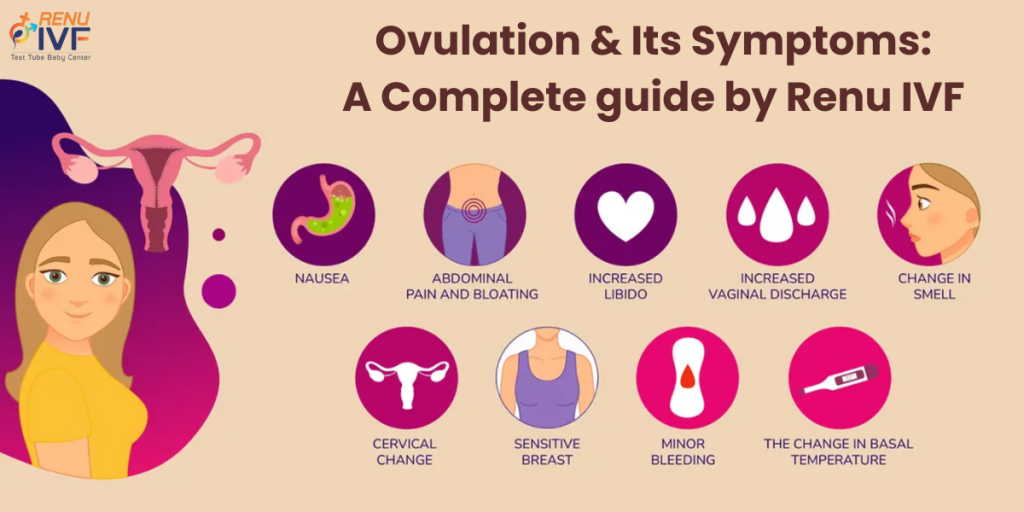
Ovulation Symptoms Women Commonly Notice
Women often come to our clinic describing ovulation differently. Some say it feels like a tiny cramp. Others describe it as a dull heaviness. Some get emotional, some get irritable, and some feel surprisingly cheerful. It’s amazing how the same hormones can affect each of us uniquely.
Below are the symptoms that tend to show up most often, though not everyone will experience all — or any — of them.
• A one-sided twinge in the lower abdomen
Sometimes it’s sharp, sometimes it’s dull. You may feel it on one side one month and the other side the next, depending on which ovary is releasing the egg.
• Clearer, stretchy cervical mucus
This is the biggest giveaway. Many women only realize its importance once they start tracking their cycles.
• Breast soreness or heaviness
For some women this happens every single month, for others rarely. Hormones influence breast tissue quite a bit during this time.
• Slight increase in libido
This is nature’s way of aligning timing with fertility.
• Mood variations
Some women feel uplifted, while others feel slightly emotional or irritable — both can be linked to ovulation.
• Heightened sense of smell
It sounds strange but is very real for many women.
• Light spotting
This is not very common but is harmless if it appears.
• Slight temperature changes
Your basal body temperature typically rises after ovulation, which helps with long-term cycle mapping.
Tracking these for a few months creates a pattern. And it’s that pattern — not any single symptom — that helps you learn your body’s natural signals.
Signs That Ovulation Is Approaching
A few days before ovulation actually happens, subtle signs start showing up. Many women miss these completely until they know what to look for. For example:
- You might find more cervical mucus than usual.
- Your lower belly might feel slightly fuller or more sensitive.
- Your mood may swing a bit — sometimes in a good way, sometimes not.
- A small shift in energy can occur.
- You may suddenly feel more romantically or physically drawn to your partner.
Some of these sound vague, but once you track them for a couple of months, they become surprisingly consistent. These small hints are often the first signs of ovulation coming, even before obvious symptoms appear.
How Long Does Ovulation Last?
Ovulation — the actual release of the egg — is short. It lasts around 12 to 24 hours. But the fertile window is much longer because sperm can survive in your reproductive tract for up to five days. This means intercourse before ovulation is often just as effective as intercourse during ovulation.
This is one of the biggest misunderstandings we see at Renu IVF Kanpur. Many couples’ time intercourse on only the “ovulation day” and feel disappointed when conception doesn’t happen. But the days leading up to ovulation matter just as much, if not more.
Symptoms During Ovulation: What You Might Experience
When the ovulation period is in full swing, many women notice:
- One-sided pelvic discomfort
- A noticeable change in cervical mucus
- Breast tenderness
- Spotting
- Mood shifts
- A spark of sexual desire
- A sense of emotional or physical sensitivity
These symptoms during ovulation can range from very mild to quite noticeable. Some women feel enough discomfort to know something is happening. Others only recognize their fertile window through tracking tools.
The important thing is not to compare your symptoms with someone else’s. Everybody cycles differently.
How to Track Your Ovulation Period Without Stressing Yourself
Some women only need basic signs. Others need tracking tools. And some prefer professional monitoring. It all depends on your cycle’s regularity and your fertility goals.
1. Ovulation prediction kits (OPKs)
These detect the LH surge that triggers ovulation and are very user-friendly.
2. Monitoring cervical mucus
A simple and surprisingly accurate method once you get used to observing changes.
3. Basal temperature charting
This is more about confirming ovulation and noticing your long-term patterns.
4. Tracking apps
Helpful for logging symptoms and dates, though not always precise on their own.
5. Follicular ultrasound monitoring
At Renu IVF Kanpur, follicular tracking is one of the most accurate ways to know exactly when ovulation is near — especially for women with irregular cycles, PCOS, or difficulty conceiving.
Women going through IVF often learn how IVF injections help stimulate controlled ovulation and how trigger shots time egg release.
Many women feel empowered once they understand how their bodies work instead of relying solely on apps and assumptions.
Why Knowing Your Ovulation Matters
A large number of couples who visit us are not infertile — they are simply mistiming intercourse due to misunderstanding the ovulation cycle. Once they learn how to identify the fertile window, many conceive naturally without further intervention.
Ovulation tracking matters especially for women who:
- Have irregular cycles
- Have PCOS
- Are over 30
- Have recently stopped birth control
- Experience hormonal imbalance
- Have been trying to conceive for several months without success
Understanding the ovulation pattern reduces stress and helps you feel more in control of your fertility journey.
FAQs
1. How many days does ovulation last for?
Ovulation lasts around 12–24 hours, though your fertility window extends over several days due to sperm survival.
2. Which ovulation tests are more accurate?
Ovulation predictor kits are accurate for home use, but ultrasound follicular tracking is the most precise option.
3. Can you feel pregnant during ovulation?
Some ovulation symptoms mimic early pregnancy feelings, but true pregnancy signs appear only after implantation.
4. What symptoms do you feel during ovulation?
Common symptoms include pelvic discomfort, stretchy mucus, breast tenderness, increased libido, spotting, or sensitivity to smells.
5. What are the signs of ovulation coming?
More cervical mucus, slight bloating, pelvic sensitivity, mood changes, and increased energy often indicate ovulation is approaching.
Final Thoughts
Understanding your ovulation cycle isn’t just about trying to get pregnant — it’s also about understanding your body better. When you start paying attention, the monthly changes that once felt random begin to make sense. You begin to recognize your own patterns, and that awareness brings confidence.
And if at any point you feel confused or overwhelmed, remember that the team at Renu IVF Kanpur is always here to help. You can also learn more about our care approach through our guide on our fertility centre in Kanpur and the advanced treatments we provide. Whether you need guidance, monitoring, or professional fertility support, you’re never navigating this journey alone.