
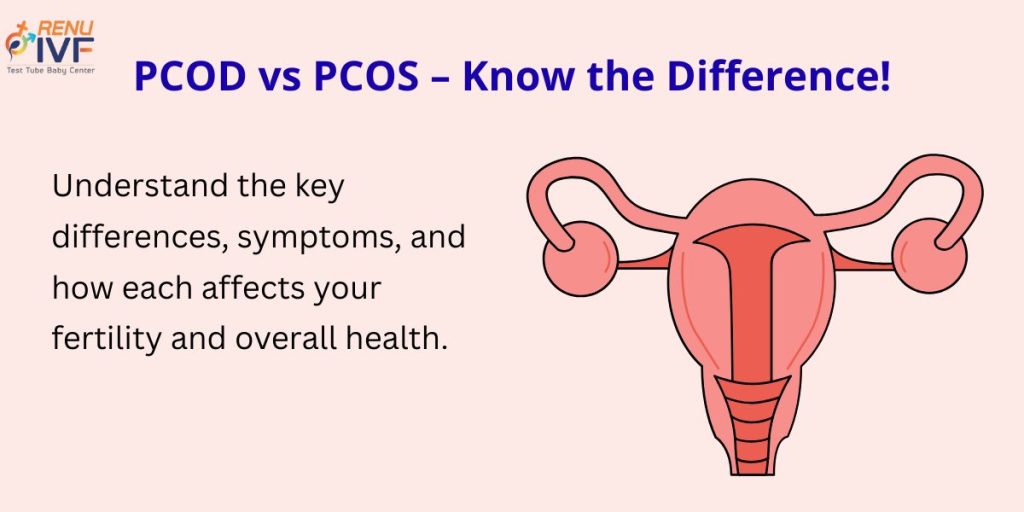
Irregular periods, random weight gain, chin hair, mood all over the place… and then one day a doctor casually drops words like PCOD problem, Polycystic Ovarian Disease or PCOS.
Most of us nod like we understand, then immediately google it outside the clinic.
This blog is for that moment. A straight, real-world explanation of what’s going on, what PCOD problem look like, and the actual PCOD and PCOS difference, without sounding like a textbook. Renu IVF in Kanpur sees a lot of women with these concerns, but the experiences described here are ones you’ll hear in any waiting room.
What does a PCOD problem actually mean?
Think of your ovaries as a little workshop. Each month they’re supposed to grow one egg properly and then release it.
In a PCOD problem:
- The ovaries start growing many eggs at once
- Most of them don’t fully mature
- They stay inside as tiny cysts
Because of this, hormones get a bit confused and your cycle stops behaving normally.
Common things that push you towards a PCOD problem:
- Long hours of sitting, very little movement
- Lots of sugar, refined flour and fried food
- Stress, late nights, irregular sleep
- Family tendency to hormonal issues
The hopeful part: for many women, Polycystic Ovarian Disease improves a lot with better routine, food, activity and the right treatment.
Spotting PCOD problem symptoms
Most women don’t say “I think I have Polycystic Ovarian Disease”.
They say, “My periods are weird,” or “I’m getting acne like a teenager again.”
Typical PCOD symptoms include:
- Irregular periods
- Long gaps between cycles
- Skipped months
- Dates that are never predictable
- Flow changes
- Very light spotting
- Or periods that are too heavy and drag on
- Stubborn acne and oily skin
- Especially along the jawline, chin, chest or back
- Weight gain around the tummy
- And that “stuck” feeling where nothing seems to work
- Extra hair + hair fall
- Unwanted hair on the chin, upper lip, chest or stomach
- Thinning or more hair fall from the scalp
- Bloating or dull pelvic pain
- Trouble conceiving
- Because ovulation is irregular
You don’t need all of these PCOD problem symptoms. Even a few together are enough reason to check in with a gynaecologist.
Where does PCOS come into this?
Now, PCOS – Polycystic Ovary Syndrome – is related, but bigger.
You can think of it like this:
- A PCOD problem mainly affects the ovaries
- PCOS affects the ovaries and your whole hormone and metabolism system
With PCOS, doctors usually see:
- Irregular or missing ovulation
- Higher levels of male-type hormones (androgens)
- Ovaries that look polycystic on scan
On top of that, PCOS is often linked with:
- Insulin resistance (your body not handling sugar well)
- Higher risk of diabetes over time
- Increased cholesterol and blood pressure if ignored
To you, it may all show up as the same mix: irregular cycles, fat around the belly, acne, hair growth, mood swings. That’s why the PCOD and PCOS difference can feel so confusing.
The PCOD and PCOS difference in simple words
Here’s the plain version, the way you’d explain it to a friend:
- PCOD problem / Polycystic Ovarian Disease
- Mainly an ovarian issue
- Eggs don’t mature and release properly
- Lots of small cysts on the ovaries
- Often milder and strongly linked to lifestyle
- PCOS
- A full hormonal and metabolic syndrome
- Ovaries + hormones + insulin are all involved
- Higher long-term risk for diabetes and heart issues
Another way to see the PCOD and PCOS difference:
| Point | PCOD | PCOS |
| Focus | Ovaries | Whole body |
| Type | Disease of egg development | Syndrome (cluster of problems) |
| Severity | Often milder | Usually more complex |
| Fertility | Many conceive with lifestyle + simple meds | May need more active treatment |
| Long-term risk | Easier to control if managed early | Higher if ignored for years |
They sit on the same spectrum. Not every PCOD problem case is very serious, but it mustn’t be ignored either.
Fertility: What happens if you want a baby?
This is when both Polycystic Ovarian Disease and PCOS suddenly feel very real.
With a PCOD problem
- Your body may still release eggs, just not regularly
- Once weight, food and routine improve, ovulation often becomes more predictable
- Many women with a PCOD problem conceive naturally or with minimal help
With PCOS
- Ovulation can be very irregular or stop for months
- You may need medicines to help your body handle insulin
- Tablets or injections might be used to trigger ovulation
- Sometimes, treatments like IUI or IVF are suggested
Places like Renu IVF in Kanpur often see couples who’ve been trying for a while and only then discover one of them has PCOS or PCOD. The key point: it can be harder, but it’s rarely “impossible”.
How doctors figure out what you have
Because PCOD symptoms and PCOS overlap, you really can’t diagnose yourself by reading blogs.
A typical check-up includes:
- Talking about your cycles, skin, hair, weight and family history
- Examining weight, BMI, waist, and signs like acne or extra hair
- Blood tests to check hormones, sugar, insulin, thyroid, etc.
- Pelvic ultrasound to see how your ovaries actually look
After that, the doctor can say whether you’re dealing with Polycystic Ovarian Disease, PCOD, or something else entirely (like thyroid issues).
Managing life with PCOD problem or PCOS
Whichever side of the PCOD and PCOS difference you fall on, some basics help almost everyone:
- Move more than you sit – walking, yoga, light workouts
- Eat more home-cooked, less-processed food
- Go softer on sugar and refined carbs
- Sleep at a regular time, as much as you can
- Track your periods in an app or notebook
On top of that, doctors may add:
- Tablets to regularise periods
- Medicines to reduce androgens (for acne and hair)
- Drugs that improve insulin response
- Ovulation-inducing treatment if you’re trying to conceive
Think of it as a long game: small, steady changes rather than extreme diets or sudden gym obsessions.
Quick Q&A
1. Can a mild PCOD problem turn into full-blown PCOS?
Not automatically. But if you ignore a PCOD problem for years and keep unhealthy habits, your body can drift toward a more PCOS-type picture.
2. Are all PCOD problem symptoms forever?
No. Many women see big improvements in periods, skin and weight after gradual lifestyle changes and proper treatment.
3. Is pregnancy possible with PCOS?
Yes. It may take more planning, medicines and monitoring, but lots of women with PCOS have healthy pregnancies.
4. Do I have to take medicine for life?
Not always. Some need long-term support, others only during certain phases. Your plan changes as your body responds.
5. When should I actually see a doctor?
If periods are irregular for more than six months, you notice several PCOD problem symptoms, or you’ve been trying for a year without conceiving, it’s time to get checked.
Parting Words
You don’t need to become an expert in hormones overnight. Understanding the PCOD problem and how Polycystic Ovarian Disease (PCOD) differs from PCOS can help you take control of your health early. Knowing the PCOD problem symptoms—such as irregular periods, weight gain, and hormonal imbalance—and learning the PCOD and PCOS difference empowers you to ask the right questions and make informed, confident choices.
Whether you visit a nearby clinic or a specialized fertility centre in Kanpur, recognizing the signs of PCOD problem and seeking timely guidance for PCOS management is the most important step toward better reproductive health. Remember, understanding your body and caring for it is the first and most powerful step toward long-term wellness