

Trying to conceive and not succeeding month after month is exhausting physically and emotionally. If you’ve started researching fertility treatments, you’ve probably run into three terms again and again: IUI, IVF, and ICSI. They all fall under the umbrella of assisted reproductive technology, but they work in very different ways, cost different amounts, and suit different people.
This guide breaks down IUI vs IVF vs ICSI in plain language how each one works, expected success rates, costs, and how to figure out which one might be right for you.
What Is Assisted Reproductive Technology?
Assisted reproductive technology (commonly shortened to ART) is a broad term for any medical treatment that helps sperm and egg meet and grow into a pregnancy when it isn’t happening naturally. IUI, IVF, and ICSI are three of the most common ART options, ranked roughly from simplest to most advanced.
None of them guarantee pregnancy. What they do is improve the odds, depending on why you’re struggling to conceive in the first place.
What Is IUI?
IUI stands for Intrauterine Insemination. It’s the simplest of the three treatments and is often tried first.
How it works:
- The male partner provides a semen sample.
- The lab washes and concentrates the sample to isolate the healthiest, most active sperm.
- Around the time of ovulation, a doctor places this sperm directly into the uterus using a thin catheter.
- Fertilisation still happens naturally, inside the body IUI just gives the sperm a head start by placing them closer to the egg.
There’s no surgery, no anaesthesia, and it usually takes just a few minutes.
Who should choose IUI?
IUI tends to work best for couples with mild, specific problems rather than major structural issues. You may be a good candidate if:
- You have mild male infertility (slightly low sperm count or motility)
- You’ve been diagnosed with unexplained infertility
- You have ovulation irregularities that respond to medication
- You have mild cervical mucus issues
- You’re using donor sperm
- Your fallopian tubes are open and healthy
Advantages of IUI
IUI’s biggest appeal is how little it asks of you, both physically and financially, compared to IVF or ICSI. There’s no surgery, no lab-based embryo work, and no weeks of hormone injections just a short procedure with almost no downtime. That makes it a practical starting point for couples who don’t yet need more advanced intervention.
- Least invasive of the three options
- Lowest cost
- No surgery required
- Quick procedure, fast recovery
- Can be combined with ovulation-stimulating medication
Limitations of IUI
The trade-off for that simplicity is a noticeably lower success rate, and it doesn’t suit every diagnosis. Because it still relies on the egg and sperm meeting naturally inside the body, it can’t overcome certain physical barriers, and couples often need more than one attempt before it works if it works at all.
- Lowest success rate of the three treatments
- Doesn’t work if fallopian tubes are blocked
- Less effective for moderate-to-severe male infertility
- Often needs 2–3 cycles before success, if it works at all
What Is IVF?
IVF, or In Vitro Fertilisation, is the most well-known fertility treatment and for more complex cases, it’s usually more effective than IUI.
How it works:
- Fertility medications stimulate the ovaries to produce multiple eggs (instead of the usual one per cycle).
- Once mature, the eggs are retrieved through a minor procedure.
- A sperm sample is collected from the male partner (or a donor).
- Eggs and sperm are combined in a lab dish, where fertilisation happens outside the body.
- The resulting embryos are monitored for several days.
- One or more healthy embryos are transferred into the uterus.
Because fertilisation happens under controlled lab conditions, doctors have far more visibility into what’s working and what isn’t which is a big part of why IVF success rate figures tend to be higher than IUI.
When is IVF recommended?
IVF is usually the next step when IUI isn’t suitable or hasn’t worked, or when there’s a clear structural or biological barrier to conception. Common reasons include:
- Blocked or damaged fallopian tubes
- Endometriosis
- Advanced maternal age
- Failed IUI cycles
- Low ovarian reserve
- Moderate male infertility
- Unexplained infertility that hasn’t responded to IUI
Advantages of IVF
IVF’s edge comes from moving fertilisation into a controlled lab environment, where doctors can actually see what’s happening instead of leaving it to chance inside the body. That control translates into better outcomes for a much wider range of fertility problems than IUI can address, plus options like freezing embryos for later or genetically testing them before transfer.
- Higher pregnancy success than IUI for most diagnoses
- Works for a wider range of fertility problems
- Embryos can be frozen for future use
- Genetic testing of embryos is possible before transfer
- Much greater control over fertilisation and embryo quality
Limitations of IVF
That higher success rate comes at a real cost financially, physically, and in terms of time. Unlike IUI, IVF involves weeks of daily hormone injections, a minor surgical procedure to retrieve the eggs, and repeated clinic visits for monitoring throughout the cycle. It’s a heavier commitment, both practically and emotionally, than IUI.
- More expensive than IUI
- Requires daily hormone injections for a period of weeks
- Egg retrieval is a minor surgical procedure
- Physically and emotionally demanding
- Multiple clinic visits for monitoring
What Is ICSI?
ICSI, or Intracytoplasmic Sperm Injection, isn’t a separate treatment from IVF it’s a specialised technique used within an IVF cycle.
How it works:
Instead of placing eggs and sperm together and letting fertilisation happen on its own (as in standard IVF), an embryologist selects a single healthy sperm and injects it directly into the centre of a mature egg using a fine needle under a microscope. Everything else egg retrieval, embryo culture, embryo transfer is identical to a regular IVF cycle.
This is specifically designed to solve one problem: sperm that can’t fertilise an egg on their own.
Who ICSI is for — low sperm count treatment and more:
- Very low sperm count (this is the main low sperm count treatment option within ART)
- Poor sperm motility
- Abnormal sperm shape (morphology)
- Sperm surgically retrieved from the testicle
- A previous IVF cycle where fertilisation failed
Advantages of ICSI
ICSI exists to solve one specific problem: sperm that can’t fertilise an egg on their own. By injecting a single sperm directly into the egg, it sidesteps the natural fertilisation barrier entirely, which makes it the most reliable option when severe male infertility is the diagnosis. It also acts as a safety net after a standard IVF cycle where fertilisation didn’t happen.
- The most effective option for severe male infertility
- Needs only one healthy sperm per egg
- Can rescue a cycle after a prior IVF fertilisation failure
Limitations of ICSI
That precision comes with added cost and complexity, and it isn’t a universal upgrade over IVF. It demands skilled embryologists and specialised lab equipment, which pushes the price above standard IVF, and it offers no real benefit if male fertility isn’t the underlying issue. Egg quality and the woman’s age still drive the outcome just as much as they do with regular IVF.
- Requires highly skilled embryologists and equipment
- Costs more than standard IVF
- Not needed for every IVF patient it doesn’t improve outcomes if male fertility isn’t the issue
- Success still depends heavily on egg quality and the woman’s age
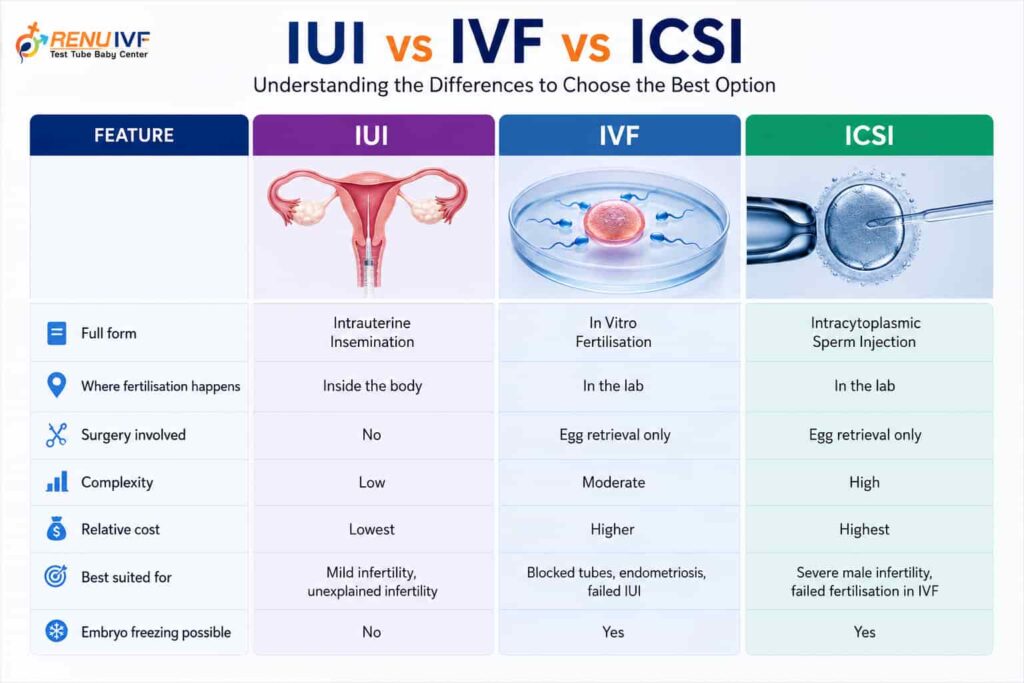
IUI vs IVF vs ICSI: Quick Comparison
IUI Success Rate, IVF Success Rate, and ICSI Success Rate
This is the question almost everyone asks first and it’s worth being upfront: published success-rate ranges are general estimates, not guarantees, and they vary significantly by clinic, lab quality, and reporting method. Your actual chances depend on your specific diagnosis, age, and health history a fertility specialist can only give you a realistic number after reviewing your reports.
With that caveat, here’s the general pattern seen across most published data:
| Treatment | Typical Success Range Per Cycle | Why |
| IUI success rate | Roughly 10–20% | Fertilisation still happens naturally, with less control |
| IVF success rate | Roughly 40–60%, and declines with age | Fertilisation and embryo growth are monitored in a lab |
| ICSI success rate | Broadly comparable to IVF once fertilisation is achieved | Solves the sperm-related barrier; doesn’t change egg quality or age-related factors |
A few important qualifiers:
- ICSI doesn’t automatically beat IVF. It improves the chance of fertilisation in male-infertility cases — it doesn’t raise pregnancy rates for couples who don’t need it.
- Age affects all three treatments more than the treatment choice itself. A younger woman with healthy eggs may do well with IUI; an older woman may see lower success even with IVF or ICSI.
- Multiple cycles are common. Very few people succeed on the first attempt with any of these treatments, and that’s normal, not a sign something is wrong.
How age affects success rate
| Woman’s Age | General Trend |
| Below 35 | Highest success rates across all treatments |
| 35–37 | Good success, especially with timely treatment |
| 38–40 | Moderate success, depends on ovarian reserve |
| Above 40 | Lower success due to declining egg quality |
What Affects Your Personal Success Rate
The treatment is only one piece of the puzzle. These factors matter just as much:
- Age — the single strongest predictor of outcome for any ART treatment
- Egg quality — declines gradually with age, and no treatment can fully compensate for it
- Sperm quality — count, motility, and shape all affect natural fertilisation and may point toward ICSI
- Uterine health — fibroids, polyps, or scarring can affect implantation even with a healthy embryo
- Ovarian reserve — how many eggs remain, which affects how many can be retrieved during IVF/ICSI
- Underlying cause of infertility — blocked tubes point toward IVF; severe male infertility points toward ICSI; mild, unexplained cases often start with IUI
- Lifestyle factors — maintaining a healthy weight, eating well, sleeping enough, managing stress, and avoiding smoking and excess alcohol all support treatment outcomes, though they can’t override a medical diagnosis on their own
IUI vs IVF vs ICSI: Cost Comparison
Cost matters, but it shouldn’t be the only factor — choosing a cheaper treatment that’s unlikely to work for your specific diagnosis often ends up costing more in repeated cycles.
| Treatment | Relative Cost | Lab Involvement | Complexity |
| IUI | Low | Minimal | Simple |
| IVF | Moderate to high | High | Advanced |
| ICSI | Highest | Very high | Highly advanced |
Costs vary between clinics based on medications, diagnostic tests, and lab technology, so always ask for a detailed, itemised estimate before starting treatment — and be wary of any clinic that promises a guaranteed outcome for a fixed price.
How Doctors Actually Decide Between IUI, IVF, and ICSI
Doctors don’t start with the most advanced treatment by default they start with what’s medically appropriate. A fertility specialist will typically review:
- Your age and your partner’s age
- How long you’ve been trying to conceive
- AMH levels and ovarian reserve
- Ovulation pattern
- Fallopian tube health (via HSG or similar test)
- Semen analysis results
- Any previous pregnancies, miscarriages, or fertility treatments
Simple Decision Guide
You may start with IUI if:
- You’re younger with open fallopian tubes
- Sperm quality is only mildly affected
- You have unexplained or ovulation-related infertility
You may need IVF if:
- Your fallopian tubes are blocked
- You have moderate-to-severe endometriosis
- IUI hasn’t worked after a few cycles
- Your ovarian reserve is reduced
You may need ICSI if:
- Sperm count or motility is very low
- Sperm were surgically retrieved
- A previous IVF cycle had fertilisation failure
Female Infertility Treatment: Where IUI, IVF, and ICSI Fit In
Female infertility treatment isn’t one-size-fits-all, and the right ART option often depends on the specific diagnosis:
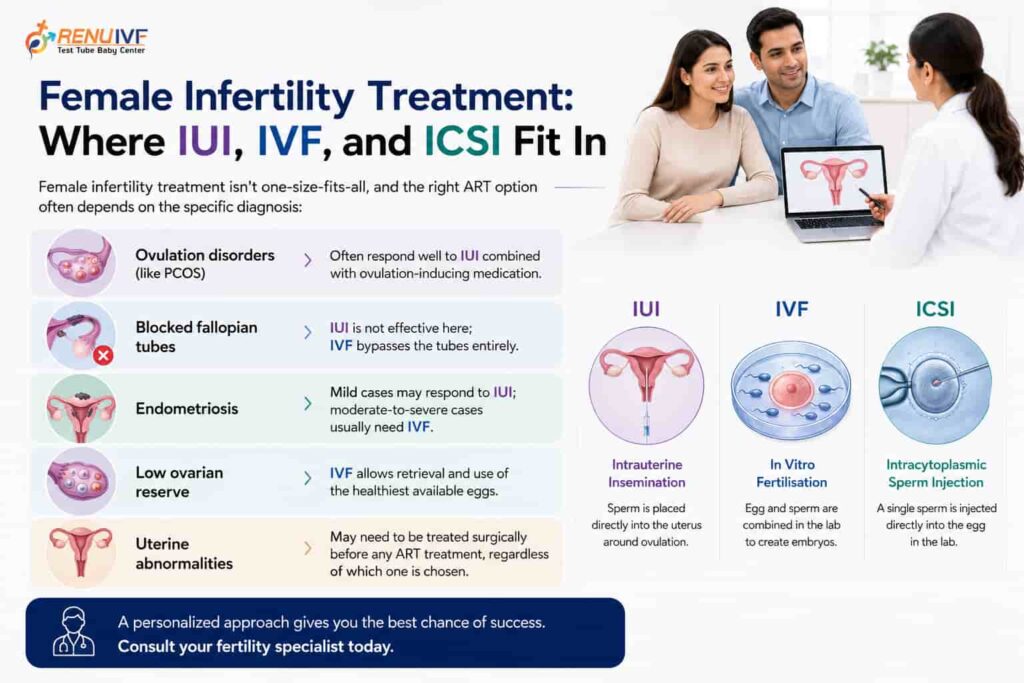
- Ovulation disorders (like PCOS): often respond well to IUI combined with ovulation-inducing medication
- Blocked fallopian tubes: IUI is not effective here; IVF bypasses the tubes entirely
- Endometriosis: mild cases may respond to IUI; moderate-to-severe cases usually need IVF
- Low ovarian reserve: IVF allows retrieval and use of the healthiest available eggs
- Uterine abnormalities: may need to be treated surgically before any ART treatment, regardless of which one is chosen
Common Myths About IUI, IVF, and ICSI
Myth: IVF is always the best fertility treatment.
Not true for everyone. Some couples with mild issues conceive successfully with IUI, at a fraction of the cost and physical demand.
Myth: ICSI always has a higher success rate than IVF.
ICSI mainly solves fertilisation problems caused by sperm quality. If male infertility isn’t the issue, plain IVF works just as well.
Myth: Fertility treatment guarantees a baby.
No treatment IUI, IVF, or ICSI can promise pregnancy. They improve your odds; they don’t eliminate the biology involved.
Myth: Young couples never need IVF or ICSI.
Age helps, but structural problems like blocked tubes or severe male infertility can affect couples at any age.
Finding the Right Fertility Specialist
Because so much depends on an accurate diagnosis, the specialist you choose matters as much as the treatment itself. If you’re in Uttar Pradesh, look for an infertility specialist in Kanpur who takes time to review your full history age, cycle patterns, past treatments, semen analysis before recommending a treatment, rather than pushing the most expensive option first.
When evaluating an IVF doctor in Kanpur, it’s worth asking:
- How many years of experience do they have with IVF and ICSI specifically?
- What lab technology and embryology support does the clinic have?
- Will they walk you through cost, timeline, and expected outcomes in writing?
- Do they offer a genuinely affordable IVF centre in Kanpur experience meaning transparent pricing with no hidden charges — rather than just a low headline number that grows once treatment starts?
A good specialist will also be honest when a treatment isn’t likely to work for you, rather than recommending it anyway.
When Should You See a Fertility Specialist?
Don’t wait years hoping things resolve on their own. Consider a consultation if:
- You’re under 35 and have been trying for over a year without success
- You’re over 35 and have been trying for six months or more
- You have irregular or absent periods
- You’ve had repeated miscarriages
- You’ve been diagnosed with PCOS, endometriosis, fibroids, or blocked tubes
- Your partner has a low sperm count or poor sperm quality
- You’ve already tried treatment before without success and want a second opinion
Earlier evaluation generally means more treatment options and better-informed decisions not necessarily a rush into IVF or ICSI.
Frequently Asked Questions
1. What’s the main difference between IUI, IVF, and ICSI?
The difference is where and how fertilisation happens. In IUI, sperm are placed in the uterus and fertilisation happens naturally inside the body. In IVF, eggs and sperm are combined in a lab dish. In ICSI, a single sperm is injected directly into the egg — usually for cases of severe male infertility.
2. Which has the highest success rate — IUI, IVF, or ICSI?
Generally, IVF and ICSI have higher success rates than IUI, but the “best” treatment depends entirely on your specific diagnosis, age, and reproductive health. A treatment with a higher average success rate isn’t necessarily the right one for you.
3. Is ICSI better than regular IVF?
Not automatically. ICSI is a technique used within IVF specifically for male infertility or previous fertilisation failure. If sperm quality isn’t the problem, standard IVF typically works just as well.
4. How do I know if I need IUI, IVF, or ICSI?
You can’t know from symptoms alone it requires a proper fertility evaluation, including blood tests, ultrasound, and semen analysis. A fertility specialist will match the treatment to your specific diagnosis rather than guessing.
Conclusion
There’s no universal answer to IUI vs IVF vs ICSI the right choice depends on your age, diagnosis, and medical history, not on which treatment sounds the most advanced. IUI works well for mild, specific issues. IVF opens up options for more complex cases. ICSI solves fertilisation problems tied to sperm quality. Understanding the differences helps you ask better questions and make a more informed decision with your doctor.
At Renu IVF, we focus on getting the diagnosis right before recommending a treatment plan with transparent guidance on cost, timelines, and realistic expectations at every step. If you’re exploring IUI, IVF, or ICSI and want a personalised evaluation, our team is here to help you take the next step toward parenthood.