

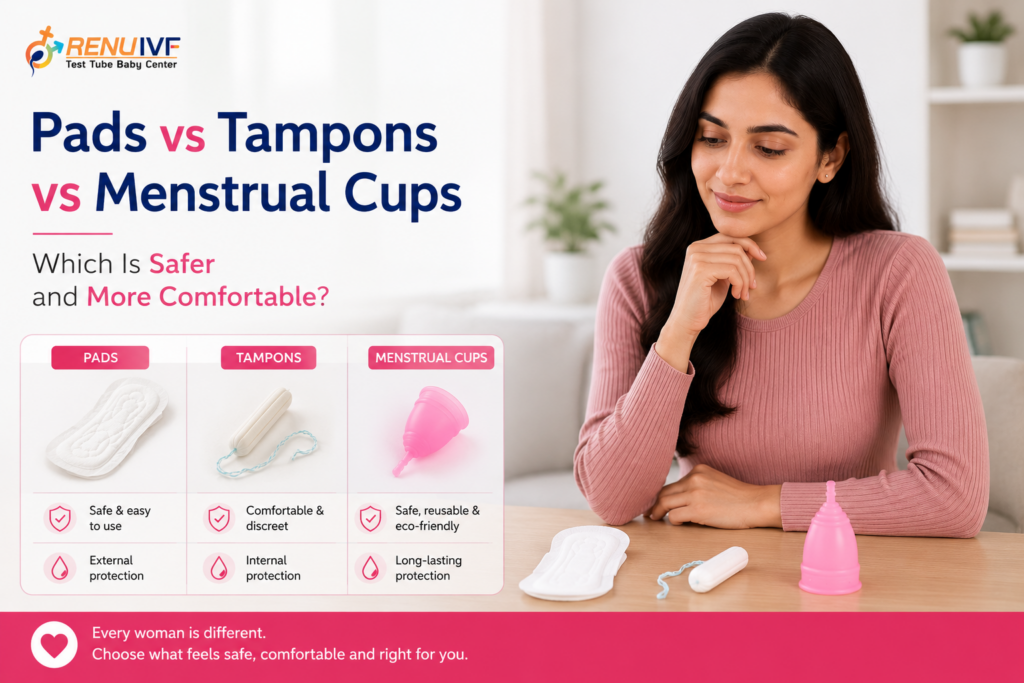
Every month, millions of women across India quietly make a very personal decision which menstrual product should I use today? For many women, especially in smaller cities and towns, this decision is still driven by what their mother used, what is cheapest at the local medical store, or what feels least embarrassing to ask for. Very rarely is it based on what is actually safest and most comfortable for their own body.
The conversation around Pads vs Tampons vs Menstrual Cups has grown significantly in recent years, especially among younger women who are more open to exploring different options. But despite more awareness, confusion still remains. Are tampons really dangerous? Can a menstrual cup get lost inside the body? Are pads the only truly safe option? Do internal menstrual products affect virginity or fertility? These are real questions that real women ask, and they deserve clear, honest, and medically sound answers.
The truth is there is no single perfect menstrual product that works for every woman. What works beautifully for one person may feel uncomfortable or impractical for another. The right choice depends on your body type, your lifestyle, your flow, your age, your comfort with internal products, and your personal hygiene routine. Once you understand each option properly, the decision becomes much easier.
This blog will walk you through everything you need to know about pads, tampons, and menstrual cups how they work, how safe they are, how comfortable they feel, what risks to watch out for, and which option suits different types of women and lifestyles.
Understanding Each Menstrual Product First
Before jumping into comparisons, it helps to understand exactly how each of these products works.
Sanitary Pads are the most familiar option for most Indian women. A pad is an absorbent layer worn inside your underwear that collects menstrual blood from outside the body. Pads come in many varieties regular, XL, overnight, ultra-thin, cotton-based, and organic. They require no insertion and are straightforward to use, which is why they are almost always the first product a girl uses when her period begins. They are widely available across India, from pharmacies to local grocery stores, and come at a range of price points.
Tampons are small cylindrical absorbent products that are inserted inside the vagina to absorb menstrual blood before it leaves the body. They come with or without applicators and are available in different absorbency levels — light, regular, super, and super plus. Tampons are particularly popular among women who swim, exercise heavily, or travel frequently, because they allow complete freedom of movement and remain invisible under clothing. They require some practice to insert correctly, and they must be changed every four to eight hours without fail.
Menstrual Cups are reusable, flexible cups made from medical-grade silicone, latex, or rubber. Unlike pads and tampons, they do not absorb blood they collect it. The cup is folded and inserted into the vagina, where it opens up and forms a gentle seal against the vaginal walls. It can hold significantly more fluid than a regular tampon or pad and can safely remain in place for up to twelve hours, making it ideal for women with busy schedules or heavy flow. One cup can last anywhere from five to ten years, making it the most economical and environmentally friendly option in the long run.
Pads vs Tampons vs Menstrual Cups — Detailed Comparison Table
| Feature | Pads | Tampons | Menstrual Cups |
| Type of Use | External | Internal | Internal |
| Reusable | No | No | Yes |
| Maximum Wear Time | 4–6 hours | 4–8 hours | Up to 12 hours |
| Leakage Risk | Moderate | Low | Very Low (if inserted correctly) |
| Suitable for Swimming | No | Yes | Yes |
| Eco-Friendly | No | No | Yes |
| Cost Over Time | High | High | Very Low |
| Ease of Use for Beginners | Very Easy | Moderate | Requires Practice |
| Odor Control | Less Effective | Better | Better |
| Skin Irritation Risk | Possible | Low | Low |
| Infection Risk | Low with good hygiene | Moderate if worn too long | Low with proper cleaning |
| Comfort During Exercise | Moderate | High | High |
| Best For | Beginners, postpartum | Active women, swimmers | Heavy flow, travel, eco-conscious |

How Safe Are Pads?
Pads are generally considered the safest starting point for most women because they work externally and do not require any insertion. However, being external does not automatically make them risk-free. The most common problems with pads arise not from the product itself but from how it is used and more specifically, how long it is worn.
When a pad is worn for too many hours, especially in India’s hot and humid climate, it creates a warm, moist environment against the skin. This is ideal for bacterial and fungal growth, which can lead to itching, rashes, unpleasant odor, and in some cases, vaginal infections. Synthetic pads that contain artificial fragrances or chemical gels are particularly harsh on women with sensitive skin. Many women do not realize that those added fragrances marketed as freshness boosters are actually one of the most common causes of irritation and allergic reactions.
To use pads safely:
- Change your pad every four to six hours, even on lighter flow days
- Always wash the intimate area with plain water during changes
- Choose fragrance-free, cotton-based, or organic pads if you have sensitive skin
- Wear breathable cotton underwear to reduce moisture buildup
- Never leave one pad on for an entire day, no matter how light your flow feels
- Dispose of used pads hygienically and wash your hands before and after changing
Women who experience frequent rashes or itching during their periods should consider switching to organic cotton pads or exploring other options like menstrual cups, which do not create the same external moisture problem.
How Safe Are Tampons?
Tampons are safe for most healthy adult women when used correctly and changed on time. The key phrase there is “changed on time.” The biggest safety concern with tampons is a rare but serious condition called Toxic Shock Syndrome (TSS) a bacterial infection that can develop when a tampon is left inside for too long, creating conditions that allow harmful bacteria to grow rapidly.
TSS is not common, but it is dangerous, and every tampon user should be aware of its signs:
- Sudden high fever
- Vomiting or nausea
- A sunburn-like rash, particularly on the palms and soles
- Dizziness or fainting
- Muscle aches
- Drop in blood pressure
If you experience these symptoms while using a tampon, remove it immediately and seek medical help. It is important to note that TSS can also occur without tampon use, but the risk increases significantly with prolonged tampon wear.
To use tampons safely:
- Always wash your hands thoroughly before insertion and removal
- Change your tampon every four to eight hours — never leave one in overnight for extended periods
- Use the lowest absorbency level that meets your needs — using a super absorbency tampon on a light flow day increases risk
- If you experience dryness or discomfort during insertion, it may mean your flow is lighter than the tampon’s absorbency — switch to a lower level
- Never use two tampons at the same time
- If you struggle with recurrent vaginal infections or dryness, consult a gynecologist before using tampons regularly
Tampons are generally not recommended for women recovering from childbirth, pelvic surgery, or those with active vaginal infections.
How Safe Are Menstrual Cups?
Menstrual cups have an excellent safety record when used correctly. Unlike tampons, they do not absorb vaginal moisture they simply collect fluid. This means they are far less likely to disturb the natural pH balance and moisture levels inside the vagina, which is one of the main reasons many gynecologists consider them a healthier long-term option.
The primary safety concern with menstrual cups is cleanliness. If a cup is not properly sterilized between cycles or not washed thoroughly during use, bacteria can accumulate on its surface and potentially cause infections. But this is entirely preventable with a simple hygiene routine.
To use menstrual cups safely:
- Before your first use of each cycle, boil the cup in water for five to seven minutes to fully sterilize it
- During your period, empty and rinse the cup with clean water every eight to twelve hours
- Always wash your hands before insertion and removal
- If you are in a public restroom without access to a sink, you can wipe the cup with a clean tissue and reinsert rinsing it properly at the next opportunity
- After your period ends, sterilize the cup again before storing it in the breathable pouch it comes with
- Inspect the cup regularly for cracks, discoloration, or material deterioration replace it if you notice any of these signs
- Ensure you are using the correct size most brands offer a smaller size for women who have not given birth vaginally and a larger size for those who have
Women with IUDs should consult their gynecologist before using a menstrual cup, as there is a small possibility of interaction between the cup’s suction and the IUD strings.
Which Menstrual Product Is Most Comfortable?
Comfort is deeply personal and cannot be measured the same way for every woman. However, understanding what each product feels like can help you make a more informed choice.
Pads feel comfortable for most women in the beginning of a period, but their comfort level can drop significantly during longer wear, physical activity, or hot weather. Because they sit outside the body, pads can shift, bunch up, or create friction against the inner thighs during walking or exercise. The feeling of wetness after blood is absorbed is something many women find unpleasant, and this is an unavoidable feature of how pads work.
Tampons, when inserted correctly, are not felt at all inside the body. If a tampon causes discomfort or pressure, it usually means it has not been inserted far enough into the vaginal canal. With proper insertion, most women describe wearing a tampon as feeling like wearing nothing at all. This invisibility makes tampons highly comfortable for exercise, sports, dancing, and swimming. The discomfort that some women experience is almost always related to technique rather than the product itself.
Menstrual cups have a learning curve, and the first one or two cycles of using a cup can feel confusing and sometimes frustrating. Finding the right fold, getting the cup to open fully inside the vagina, and learning how to break the seal properly during removal all take practice. However, once a woman becomes comfortable with her cup which usually happens by the third cycle — most describe it as the most comfortable option they have ever used. It holds more, needs less frequent changing, creates no external wetness, and allows complete freedom of movement.
Which Is Best for Heavy Periods?
Women who experience heavy menstrual flow often find that standard pads soak through too quickly and tampons need constant changing. This is where menstrual cups tend to shine.
- Menstrual cups can hold significantly more fluid than a tampon or pad approximately three to four times more and can safely remain in place for up to twelve hours even on heavier days
- XL or overnight pads are a good option for women with heavy flow who prefer external products
- Using a tampon together with a thin pad as a backup is a common strategy for very heavy days or overnight use
- Women with consistently very heavy periods should speak to a gynecologist, as heavy bleeding can sometimes indicate an underlying condition such as fibroids, PCOS, or endometriosis
Which Product Suits Which Lifestyle?
| Lifestyle | Best Menstrual Product |
| School and college beginners | Pads |
| Women who exercise and go to the gym | Tampons or Menstrual Cups |
| Swimmers | Tampons or Menstrual Cups |
| Frequent travellers | Menstrual Cups |
| Women with heavy flow | Menstrual Cups |
| Women with sensitive skin | Organic Pads or Menstrual Cups |
| Office-going women | Tampons or Cups |
| Eco-conscious women | Menstrual Cups |
| Postpartum women | Pads (internal products should be avoided initially) |
| Women who prefer budget-friendly options | Menstrual Cups (long-term) |
Cost Comparison — What Does Each Option Actually Cost Over Time?
| Product | Approximate Monthly Cost | Approximate 5-Year Cost |
| Sanitary Pads | ₹80 – ₹200 per month | ₹4,800 – ₹12,000 |
| Tampons | ₹150 – ₹300 per month | ₹9,000 – ₹18,000 |
| Menstrual Cup | One-time ₹300 – ₹800 | ₹300 – ₹800 total |
The long-term savings with menstrual cups are significant. While the upfront cost may feel higher compared to buying a pack of pads, the cup pays for itself within the first two to three months of use.
Common Myths That Need to Be Addressed
There is a great deal of misinformation around menstrual products in India, and some of these myths genuinely prevent women from making choices that could improve their comfort and health.
Myth: Tampons and menstrual cups break your virginity. This is completely false. Virginity is not a medical concept, and it is certainly not determined by whether something has entered the vagina. The hymen is a thin, flexible tissue that stretches naturally through everyday physical activities like cycling, sports, dancing, or even walking briskly. Using a tampon or menstrual cup does not change a woman’s physical state in any way that is medically meaningful.
Myth: Menstrual cups can get lost inside the body. This cannot happen. The vagina is a closed muscular canal it has an end. A cup cannot travel beyond the cervix, and there is nowhere for it to disappear. If a cup feels difficult to reach, simply bear down gently as if having a bowel movement this lowers the cup and makes it easier to grasp.
Myth: Pads are always safer than internal products. Pads carry their own risks, particularly around skin irritation, rashes, fungal infections, and odor when worn too long. No product is automatically safer than another safety comes from correct use and proper hygiene.
Myth: Menstrual cups cause infertility. There is absolutely no scientific evidence for this claim. Menstrual cups do not enter the uterus, do not affect the reproductive organs, and have no impact on a woman’s ability to conceive.
Myth: You should feel something if a tampon is inserted correctly. If a tampon is positioned properly, you should feel nothing at all. Discomfort means the tampon needs to be pushed a little further into the canal.
How to Choose the Right Product for Yourself
Choosing the right menstrual product is ultimately a personal decision, but these questions can help you think it through clearly:
- Do you feel physically comfortable using internal products, or does the idea feel uncomfortable?
- Is your menstrual flow light, moderate, or heavy?
- Do you exercise frequently, swim, or have a physically active lifestyle?
- Do you travel often and need a low-maintenance, long-lasting option?
- Does your skin react badly to synthetic materials or fragrances?
- Are you comfortable with cleaning and sterilizing a reusable product?
- Are you looking for the most economical option over time?
- Do you want to reduce plastic waste and choose a more sustainable option?
There are no wrong answers. Some women find that using a combination works best for them a cup or tampon during the day for freedom of movement, and a pad at night for added security. Some women switch between products depending on how heavy their flow is on a particular day. This flexibility is completely fine and entirely healthy.
A Note from Renu IVF Centre
At Renu IVF , we believe that menstrual health is an important and often overlooked part of a woman’s overall reproductive wellbeing. Many women come to us with questions about period-related discomfort, recurrent infections, heavy bleeding, or confusion about which menstrual products are safe for their specific health conditions.
Dr Renu Singh Gahlaut, our lead specialist, regularly addresses these concerns with patience and without judgment. Whether you are a teenager navigating your first periods, a woman managing heavy flow, or someone trying to understand which product works best after a recent delivery or surgery personalized guidance makes all the difference.
You do not need to figure this out alone. Your menstrual health deserves the same attention and care as every other aspect of your health.
Book a consultation with Dr Renu Singh Gahlaut at Renu IVF Centre today and get expert, personalized advice on menstrual health, reproductive wellness, and women’s healthcare.
Frequently Asked Questions
1. Which is safer — pads, tampons, or menstrual cups? All three are safe when used with proper hygiene and changed or cleaned on time. The product matters less than how you use it.
2. Can I sleep with a menstrual cup at night? Yes. Menstrual cups can be worn for up to eight to twelve hours, making them suitable for overnight use for most women.
3. Kya tampon use karne se virginity khatam hoti hai? Bilkul nahi. Virginity ka sambandh tampon use se nahi hai. Hymen naturally stretch ho sakta hai sports, cycling, ya physical activity se bhi.
4. Menstrual cup pehli baar use karne mein dard hota hai? Pehle do teen cycles mein thodi difficulty ho sakti hai, lekin sahi size aur sahi technique ke saath dard nahi hota. Practice ke saath yeh bahut aasaan ho jaata hai.
5. Pads se rashes aur itching kyun hoti hai? Zyada der tak same pad pehenna, synthetic material, fragrance, aur sweating yeh sab milke skin irritation aur rashes create kar sakte hain.
6. Kya unmarried women menstrual cup use kar sakti hain? Haan, bilkul. Marital status ka cup use se koi relation nahi hai.
7. Which product is best for very heavy periods? Menstrual cups are generally the best option for heavy flow because they hold more fluid and need less frequent changing.
8. Kya menstrual cup fertility ko affect karta hai? Nahi. Scientifically koi evidence nahi hai jo yeh prove kare ki menstrual cups fertility ko affect karte hain.
9. Swimming ke liye best period product kaunsa hai? Tampons aur menstrual cups dono swimming ke liye suitable hain kyunki yeh internally kaam karte hain.
10. Can I use a menstrual cup if I have an IUD? It is best to consult your gynecologist first. There is a small risk of interaction between the cup’s suction and the IUD strings, and your doctor can guide you based on your specific situation.