


By the pregnancy and fertility care team at Renu IVF, Kanpur | Medically reviewed by Dr. Renu Singh Gahlaut,
If you have noticed a new or stronger smell down there since becoming pregnant, you are far from alone. Almost every pregnant woman sees more vaginal discharge, and many quietly wonder whether the odour is normal or a sign that something is wrong. Most of the time the answer is reassuring. But a strong fishy vaginal smell, a pungent odour that reminds you of onions, or any foul-smelling discharge that arrives with itching, burning, pain or a change in colour deserves a proper check, because several of the infections behind it are easy to treat in pregnancy and are best treated early.
This guide explains in plain language what a normal pregnancy smell is, what each type of odour usually means, which treatments are considered safe, what you can do at home, what you must avoid, and exactly when to call a doctor. It draws on guidance from the CDC, the NHS, the US Preventive Services Task Force (USPSTF), ACOG-referenced clinical summaries and Mayo Clinic, and it adds practical points for women in North India and for women whose pregnancy began with IVF, ICSI or IUI.
| Quick answerA mild, musky or slightly tangy smell with thin, clear-to-milky discharge is normal in pregnancy. A strong fishy smell (often with thin grey-white discharge), an onion-like or foul odour, or any smell with itching, burning, green-yellow colour, pain, bleeding or fever is not normal. It usually points to bacterial vaginosis, trichomoniasis, a forgotten tampon or other retained object, or another infection that needs an examination.Do not douche and do not self-treat. Pregnancy-safe treatment is available and usually works well. |
Is Vaginal Odour During Pregnancy Normal?
Yes, some change is normal, and the reason is hormonal. As estrogen and blood flow to the pelvic area rise, the vagina produces more of the clear-to-white fluid doctors call leukorrhea. The NHS explains that this extra discharge helps stop infections travelling up from the vagina to the womb, and that it increases further towards the end of pregnancy. In the last week or so you may also see sticky, jelly-like pink mucus, known as a “show”, which means the body is preparing for birth.
Healthy discharge is thin, clear or milky white and either has no smell or only a mild, slightly musky or tangy one. The vagina is naturally acidic, because friendly lactobacilli bacteria keep the pH low. Mayo Clinic notes that a vaginal pH of 4.5 or higher is a sign of bacterial vaginosis, which is why doctors measure it. Sweat also plays a part. Pregnancy increases sweating and warmth around the groin, and Mayo Clinic lists normal sweating as one reason odour can change from day to day.
The three-question check
1. Is the smell strong, fishy, foul or “off”? A mild smell that you only notice when close is usually fine. A smell you notice through clothes, or that makes you self-conscious, is worth checking.
2. Has the colour or texture changed? Green, yellow, grey, frothy, cottage-cheese-like or blood-streaked discharge is a change to report.
3. Is there itching, burning, soreness, pain when passing urine or pain during sex? The NHS says any of these with unpleasant-smelling discharge could be a vaginal infection, and advises calling your midwife.
If the answer to all three is “no”, you are very likely seeing normal pregnancy discharge. If the answer to any one is “yes”, read on and arrange a check.
| Terms women use in IndiaIn everyday Indian conversation, discharge is often called “safed pani”, “white discharge” or “leucorrhoea”, and a bad smell is “badbu”. Doctors use the same clinical terms throughout this guide, so if you describe your symptoms to your doctor in Hindi, Hinglish or English, they will map them to the right causes. |
Smell Decoder: What Different Vaginal Odours Usually Mean
Smell alone cannot diagnose an infection (doctors do not diagnose vaginal odour by smell alone), but it gives useful clues. Use this table to understand the likely cause and how quickly to act, then confirm with a doctor.
| What you notice | Most likely cause | How soon to act | What to do |
| Mild, musky or tangy smell; thin clear or milky discharge | Normal pregnancy discharge (leukorrhea) | No action needed | Cotton underwear, unscented liner if needed, keep routine antenatal visits |
| Strong fishy smell, thin white or grey discharge, often worse after sex | Bacterial vaginosis (BV) | Within a few days; same day if pain, fever or bleeding | Swab and pH test, pregnancy-safe prescription |
| Fishy or foul smell with frothy yellow-green discharge, itching, burning, painful urination or sex | Trichomoniasis (a sexually transmitted infection) | Within 24 to 48 hours | Test and treat; partner treated too |
| Onion-like, pungent or sweaty smell | BV, trapped sweat or moisture, retained tampon or object, trichomoniasis, urine or hygiene-related odour | If it persists after washing and changing underwear, or comes with discharge or pain, see a doctor within a day or two | Examination; do not insert anything at home |
| Yeasty or bread-like smell, or no smell; thick white “cottage cheese” discharge; strong itching | Yeast infection (candidiasis) | Non-urgent but treat soon | Doctor confirms, then a 7-day topical azole |
| Smell of urine or ammonia | Urine leakage (common as the baby presses on the bladder) or a urinary infection | Same day if burning, fever or back pain | Urine test; pelvic floor exercises for leaks |
| Rotten, very foul smell with brown or bloody discharge | Forgotten tampon or other retained object, or a more serious infection | Same day | Medical examination and removal |
| Metallic smell with pink or brown spotting | Blood (spotting) | Same day; immediately if heavy or painful | Call your doctor or go to the maternity unit |
| Watery fluid that keeps trickling or gushes | Possible leaking amniotic fluid | Emergency | Go to the maternity unit now |
Fishy Vaginal Smell in Pregnancy: Bacterial Vaginosis Explained
A fishy vaginal smell is the classic sign of bacterial vaginosis. BV is not caused by poor hygiene. It happens when the vagina’s natural balance tips: protective lactobacilli fall, and anaerobic bacteria that are normally present in small numbers overgrow (Mayo Clinic). These bacteria release chemicals called amines, which are responsible for the fishy smell. Doctors can even reproduce it in the clinic: adding a drop of potassium hydroxide to the discharge releases the odour, which is called the “whiff test”.
Symptoms of BV in pregnancy
• An unusual discharge with a strong fishy smell, particularly after sex (NHS).
• Thin, watery discharge that may be white or grey.
• Usually little or no itching or soreness, which helps separate BV from yeast.
• No symptoms at all in about half of women, according to the NHS, which is why antenatal check-ups matter.
White discharge with fishy odor: is it always BV?
Not always. White or grey discharge with a fishy odour is most often BV, but trichomoniasis can look similar, and both can occur together with other infections. Because the treatments differ (BV is treated with antibiotics, yeast with antifungals), a swab and microscopy are far safer than guessing. ACOG-referenced guidance states plainly that a patient’s own diagnosis of vaginitis is not reliable.
Why BV becomes more likely in pregnancy
Hormonal shifts change the vaginal environment. In the United States, the USPSTF reports that BV affects roughly 5.8% to 19.3% of pregnant women. Known triggers include douching, scented soaps and washes, strong detergents on underwear, a new or multiple sexual partners and smoking. BV is not classed as an STI, but sex can trigger it and having BV raises your chance of catching an STI (NHS).
Can BV affect your baby?
This deserves a balanced answer. The NHS says BV causes no problems in the majority of pregnancies. However, BV during pregnancy has been associated with preterm delivery, early or late miscarriage, premature rupture of membranes, low birth weight and infection of the womb lining after birth. A 2022 meta-analysis reported roughly 2.8 times higher odds of preterm birth in women with BV, and an earlier BMJ study found that BV detected in early pregnancy was linked with late miscarriage and preterm delivery. The USPSTF points out that BV may be a marker of risk rather than a direct cause, and that is why the strongest recommendation is simple: treat BV when it causes symptoms.
Should every pregnant woman be screened for BV?
No. The USPSTF recommends against routine screening for BV in pregnant women who have no symptoms and are not at increased risk of preterm delivery, and says the evidence is insufficient for those at higher risk. The CDC takes a similar approach: treat everyone with symptoms, and consider examination if you have previously had a preterm birth or a low-birth-weight baby. If you have such a history, or a history of late miscarriage, tell your doctor early. Specialist teams offering high-risk pregnancy care and recurrent miscarriage support usually review vaginal infections as part of the plan.
Discharge Smells Like Onions While Pregnant: What Is Going On?
Searches for “discharge smells like onions pregnant” are common, and honest answers are rare. Medical textbooks do not describe a single “onion-smell” condition. What women mean by “onion-like” is a sharp, pungent, sulphur-like or sweaty odour. These are the causes doctors consider.
1. Bacterial vaginosis. Classically described as fishy, but women describe the same amine-related smell in different ways, including sharp, pungent or “onion-like”. This is the first cause to rule out.
2. Trapped sweat and moisture. The vulval and groin skin has sweat glands, and pregnancy adds heat, weight gain and sweating. Stale sweat in damp synthetic underwear can smell strongly of onion. Mayo Clinic lists sweating as a cause of vaginal odour.
3. A forgotten tampon or other retained object. A tampon left for days produces a very foul smell with brown or blood-stained discharge. In pregnancy this can also be a piece of menstrual cup, a condom, or an insert or pessary that was not fully removed. This needs prompt removal by a clinician.

4. Trichomoniasis. This sexually transmitted infection can cause a foul or fishy odour with yellow-green, sometimes frothy discharge.
5. Urine or faecal contamination. Small urine leaks in pregnancy are common, and wiping back to front can carry bowel bacteria forward. Strong-smelling urine from dehydration, prenatal vitamins or spicy food can also be mistaken for vaginal odour.
6. Rarer causes. If an odour persists despite treatment, your doctor will look for less common problems such as a structural abnormality or other conditions of the vagina or cervix. These are uncommon, but they are the reason that a persistent odour should never be ignored.
| What about diet, onions and garlic?Foods such as onion, garlic and strong spices can change the smell of sweat and urine. A direct effect on vaginal discharge is not well established, so do not assume food is the cause of a persistent smell. If you suspect food or urine, wash the outside gently with plain water and change your underwear. If the smell comes back within hours or comes with discharge, itching or pain, the source is probably vaginal and needs an examination. |
What to do today if you notice an onion-like smell
• Change into clean cotton underwear and wash only the external area with plain lukewarm water.
• Check for a forgotten tampon or insert. If you cannot easily remove it, do not dig. Go to a clinician.
• Note when the smell appears, the colour and amount of discharge, and any itching or pain, so your doctor has useful details.
• Book a check if the smell lasts beyond a day or two, returns after washing, or comes with discharge, itching or pain.
Other Causes of Smelly Vaginal Discharge During Pregnancy
Trichomoniasis
Trichomoniasis is caused by a parasite and is one of the common STIs. Many people have no symptoms, but when symptoms occur they include a foul or fishy odour, yellow-green frothy discharge, itching, burning and pain when urinating or during sex. In pregnancy it is associated with preterm delivery and low birth weight. The CDC recommends a 7-day course of metronidazole for women, with the partner treated at the same time and sex avoided until both have finished treatment.
Yeast infection (vaginal candidiasis)
Yeast infections are very common in pregnancy because hormones and higher vaginal sugar levels favour fungal growth. They typically cause thick white “cottage cheese” discharge and intense itching, and usually little or no smell (NHS; Mayo Clinic). A review in CMAJ notes that candidiasis has not been associated with adverse pregnancy outcomes, so treatment is mainly for comfort. If you have a smell and yeast-type symptoms, a mixed infection is possible, which is another reason to be examined.
Chlamydia, gonorrhoea and other infections
Chlamydia and gonorrhoea often cause no smell at all, but they can cause abnormal discharge or no symptoms and are important to treat in pregnancy. They are usually found by routine antenatal tests, which is one reason not to skip your scheduled screening.
Urinary tract infection and urine leakage
A urinary infection may cause burning, urgency, a strong urine smell and lower abdominal discomfort. Leakage on coughing or sneezing is common in later pregnancy. Both are checked with a simple urine test.
Cervical changes, irritation and allergy
Pregnancy makes the cervix softer and more sensitive, which can increase discharge and cause bleeding after sex. Scented pads, bubble baths, feminine washes, strong detergents on underwear and some lubricants can irritate tissue or alter vaginal pH and make odour more noticeable.
Higher blood sugar
High blood sugar, including gestational diabetes, can make yeast infections more frequent. If you have repeated itching and thick discharge, ask your doctor whether your sugar levels should be checked.
Red Flags: When Smelly Discharge Needs Urgent Care
Most causes of odour are mild and treatable, but some situations should not wait. The NHS advises calling your midwife for unpleasant-smelling, green or yellow discharge, itching or soreness, or pain when passing urine, and contacting your maternity unit urgently for watery discharge.
| Urgency | Signs | What to do |
| Emergency: go to the maternity unit now | • A gush or constant trickle of watery fluid• Fever or chills with foul discharge• Severe lower abdominal pain or regular tightenings before 37 weeks• Heavy bleeding• Reduced baby movements• Green, brown or blood-stained, foul-smelling fluid | Do not wait for the morning. Put on a clean pad, note colour, smell and time, and go. |
| Same day | • Foul smell with brown or blood-streaked discharge• Green or yellow frothy discharge• Pain when passing urine or pain during sex• Suspected forgotten tampon or insert• Smell with one-sided pelvic pain or any spotting | Call your doctor or clinic and be seen the same day. |
| Within a few days | • Mild fishy smell or grey-white discharge without other symptoms• Thick white discharge with itching• Smell that keeps returning after washing and changing underwear• Symptoms that return after treatment | Book an appointment and avoid self-treatment in the meantime. |
How Doctors Diagnose the Cause
Diagnosis is quick and safe in pregnancy. Your doctor will ask about the smell, colour, itching, bleeding, recent sex, new products and previous infections, and will usually examine you gently with a speculum. A typical work-up includes:
• Vaginal pH. A pH of 4.5 or higher suggests BV (Mayo Clinic).
• Whiff test. A fishy odour after adding potassium hydroxide to a discharge sample points to BV.
• Wet-mount microscopy. Reveals “clue cells” (BV), moving trichomonads or yeast.
• Gram stain or Nugent score. The CDC lists Amsel’s clinical criteria or the Nugent score as accepted ways to diagnose BV. Amsel’s criteria need three of four findings: thin homogeneous discharge, clue cells, pH above 4.5 and a positive whiff test.
• Molecular (NAAT) or culture tests. Used for trichomoniasis, yeast, chlamydia and gonorrhoea when needed.
• Urine test. To exclude a urinary infection or leakage.
ACOG-referenced guidance also advises that women whose symptoms do not respond to self-treatment with over-the-counter antifungals should be clinically evaluated, because the cause is often not yeast. You can read more about vaginitis in this ACOG FAQ and in the MedlinePlus overview.
If you are planning pregnancy or are starting fertility treatment, a structured fertility assessment is the right time to check for and treat vaginal infections before conception.
Smelly Discharge Treatment in Pregnancy: What Actually Works
The right treatment depends entirely on the cause, which is why diagnosis comes first. This table summarises what current guidelines say. It is for understanding, not self-medication: your doctor selects the drug, form and duration based on your stage of pregnancy and medical history.
Vaginal smell treatment by cause
| Cause | Pregnancy-appropriate treatment | Practical notes |
| Bacterial vaginosis | The CDC recommends treating all symptomatic pregnant women. Options are oral metronidazole or clindamycin (tablet or vaginal cream), chosen by the doctor. Tinidazole is avoided in pregnancy. | • Most regimens run 5 to 7 days• Finish the full course even if the smell clears• Avoid sex or use condoms during treatment• Clindamycin cream can weaken latex condoms• Probiotics are not recommended as BV treatment (Mayo Clinic) |
| Trichomoniasis | Metronidazole is the recommended drug, and the 2021 CDC guideline favours a 7-day course over a single dose. | • Treat the partner at the same time• Avoid sex until both have finished and symptoms are gone• Ask your doctor about testing for other STIs |
| Yeast infection | Only topical azole creams or pessaries, applied for 7 days, are recommended in pregnancy (CDC). Oral fluconazole is not recommended. | • Confirm the diagnosis first• Boric acid should be avoided in pregnancy (expert consensus)• Recurrent infections need medical review |
| Retained tampon or object | Removal by a clinician, followed by a check for infection. | • Seek same-day care• Fever, pelvic pain or feeling unwell make it urgent |
| Urinary infection | Antibiotic chosen by urine culture and pregnancy safety. | • Do not delay: untreated urinary infection is a risk in pregnancy |
| Chlamydia or gonorrhoea | Pregnancy-safe antibiotics chosen by the doctor, with partner treatment and follow-up testing. | • Usually found on routine antenatal tests |
| Irritation or allergy | Stop the product, keep to plain water and cotton, review detergents. | • Symptoms settle within days when the trigger is removed |
| Normal discharge | No treatment needed. | • Reassurance and routine antenatal care |
Is metronidazole safe in pregnancy?
Metronidazole is one of the most commonly used antibiotics in obstetric practice, and the CDC recommends it for symptomatic BV and for trichomoniasis in pregnant women. Older guidance urged caution in the first trimester, so timing is a decision your doctor will make with you. Alcohol should be avoided with metronidazole: ask your doctor how long to wait after the last dose. Never share, reuse or self-start antibiotics.
What if the smell comes back?
BV commonly recurs within a few months. Tell your doctor rather than repeating the old course. They may re-test, check that no other infection is present, review triggers, and discuss options for recurrent BV that are safe for your stage of pregnancy.
How to Get Rid of Smelly Discharge During Pregnancy: Safe Self-Care
Self-care supports treatment and helps prevent recurrences, but it cannot cure BV or trichomoniasis. Think of it as the daily routine around your prescription.
How to get rid of vaginal smell: the daily routine
1. Wear breathable cotton underwear and change it daily, and whenever it is damp. Avoid tight synthetic fabrics and leggings for long hours in hot, humid weather.
2. Wash only the external vulva once or twice daily with plain lukewarm water. If you use soap, choose a mild, unscented one and use it outside only.
3. Never douche. The vagina cleans itself. The Office on Women’s Health says douching can wash away normal protective bacteria and only covers up odour.
4. Wipe front to back and pat the area dry after urinating or bathing.
5. Change out of sweaty or wet clothes quickly. Carry a spare pair of underwear if you travel or work long hours.
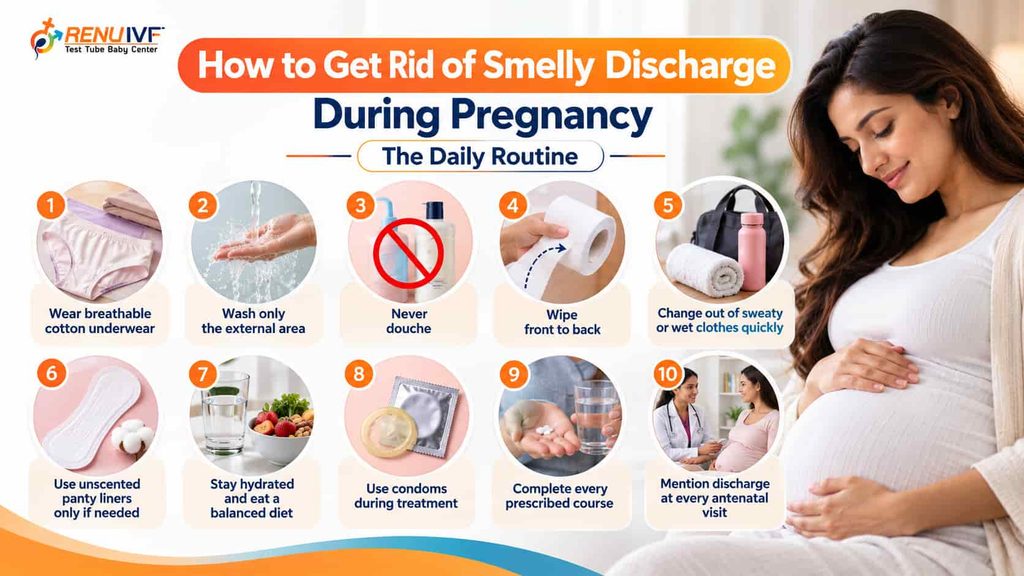
6. Use unscented panty liners only if needed, and change them every few hours. The NHS notes that liners can help with heavy discharge or worries about smell, but fragranced products can irritate.
7. Stay hydrated and eat a balanced diet. If you have gestational diabetes or repeated yeast infections, follow your sugar-control plan.
8. Use condoms during treatment and with any new partner, and make sure a partner is treated if your doctor says so.
9. Complete every prescribed course, even when symptoms disappear.
10. Mention discharge at every antenatal visit. Many infections cause no symptoms at all.
For more everyday intimate-health guidance, browse our Gynecological Health articles. If you are also thinking about recovery after delivery, our guide on vaginal care after childbirth covers what is safe and what is not.
What not to do: common mistakes and home “remedies”
| Do not | Why |
| Douche or use vaginal washes and deodorants | ACOG-referenced guidance advises against douching to prevent or treat vaginitis. It disrupts protective bacteria and can raise risks for you and your baby. |
| Insert garlic, curd or yogurt, apple cider vinegar, tea tree oil, baking soda, turmeric or neem paste | No proven benefit and not tested in pregnancy. They can irritate tissue, upset vaginal pH and delay treatment of a real infection. Mayo Clinic Health System advises against treating BV at home with such methods. |
| Use antiseptic liquids, alum (fitkari) or herbal washes for “cleaning” | Antiseptics and strong cleansers can inflame tissue and make odour and infection worse. |
| Take leftover antibiotics or buy oral antifungal tablets | The wrong drug can fail, mask the diagnosis or be unsafe. The CDC no longer recommends oral fluconazole in pregnancy. |
| Use boric acid capsules | Expert consensus says boric acid should be avoided during pregnancy. |
| Use scented pads, wipes, bubble baths or hot tubs | Fragrances and baths can irritate and alter vaginal balance. |
| Wear liners all day, every day | Trapped moisture favours odour and irritation. |
| Self-diagnose from symptoms or internet photos | Self-diagnosis of vaginitis is unreliable, even for women who have had yeast infections before. |
Trimester-by-Trimester Guide to Vaginal Smell
| Trimester | What changes | Common smell-related causes | Watch for |
| First (weeks 1 to 13) | Discharge often rises early as estrogen climbs. Light spotting can occur. | Normal leukorrhea; BV or yeast; vaginal progesterone if you are on IVF support | Any smell with bleeding, one-sided pain or fever needs same-day care |
| Second (weeks 14 to 27) | Discharge usually continues and may increase. Yeast infections become more common in the second and third trimesters. | Yeast; BV; urine leakage begins for some | Watery leaks, pelvic pressure or cramping; history of preterm birth should be discussed with your doctor |
| Third (weeks 28 to 40) | Heaviest discharge. Mucus plug and “show” may appear. Many women leak a little urine. | Yeast; BV; urine leakage; mucus plug | Gushing or trickling fluid, contractions, reduced movements. Routine swabs such as GBS at around 36 to 37 weeks are separate and not linked to smell. |
For more week-by-week guidance, see our Pregnancy Care & Complications library.
Discharge, Urine, Mucus Plug or Waters Breaking? How to Tell
Many women worry that wetness is their waters breaking. This table helps you decide when to call, but if you are unsure, always call your maternity unit instead of waiting.
| Usual look and feel | Typical clues | Action | |
| Normal discharge | Thin, clear or milky white; mild or no smell | Small amounts that gradually increase; usually thinner and less in one go than a mucus plug (Tommy’s) | No action; routine care |
| Urine leak | Smells of urine | Leaks when you cough, sneeze or laugh; pelvic floor squeeze reduces it | Mention at your next visit; urine test |
| Mucus plug or “show” | Thick, sticky, jelly-like; clear, pink or blood-tinged | Late pregnancy; the NHS describes it as a sign the body is preparing for birth | Call if heavy bleeding, pain or contractions |
| Amniotic fluid | Watery, continues to leak or gushes | Keeps coming and soaks a pad | Go to the maternity unit now |
Premature rupture of membranes can lead to infection and early labour, so assessment should not be delayed. ACOG’s guidance on prelabor rupture of membranes explains how it is evaluated. If you suspect leaking, put on a clean pad, note the colour, smell and time, and call.
If Your Pregnancy Began With IVF, ICSI or IUI
Pregnancy after fertility treatment is monitored a little more closely, and vaginal health has some specific angles worth knowing.
• Vaginal progesterone increases discharge. Progesterone gels, pessaries or capsules are widely used after embryo transfer and commonly cause more, sometimes waxy-looking, white or off-white discharge. It is not expected to cause a foul or fishy smell, so do not assume an odour is “just the medicine”. Tell your clinic.
• Check and treat infections early. Fertility specialists commonly look for and treat vaginal infections before procedures such as IUI or embryo transfer, because infection can complicate treatment. If you are preparing for IVF or ICSI, report any persistent odour before your cycle starts.
• Ask for extra review if you have a high-risk history. A previous preterm birth, late miscarriage or cervical procedure is a reason to discuss vaginal infection checks with your doctor.
• Keep follow-up consistent. Continued monitoring is part of the support described in our IVF journey and patient education articles.
Diet and Lifestyle for a Healthy Vaginal Environment
No food cures an infection, but good general health supports a balanced vaginal ecosystem. A nutritious, balanced diet helps maintain overall health, including the vaginal environment during pregnancy. Practical points:
• Drink enough water, which also keeps urine less concentrated and less strongly scented.
• Eat plenty of vegetables, fruit, pulses, whole grains and protein as advised by your doctor. Curd and fermented foods are fine as part of a healthy diet, but they are not a treatment.
• If you have gestational diabetes, keeping sugar well controlled helps reduce recurrent yeast infections.

• Avoid smoking, which is listed as a risk factor for vaginitis.
• Get adequate rest and manage stress, since illness and exhaustion make everything harder to tolerate.
For stage-by-stage food guidance, see our articles on nutrition and lifestyle for fertility and pregnancy, including this guide to diet through the festive season.
How to Prepare for Your Doctor Visit
A little preparation makes the appointment faster and more accurate.
• Do not douche, and avoid inserting any creams or medicines before the visit unless prescribed. Normal bathing is fine.
• Bring a list of every medicine, supplement and vaginal product you have used.
• Write down when the smell began, whether it changes after sex or periods of sweating, and any pain, bleeding or fever.
• Note any history of preterm birth, late miscarriage, cervical stitch, sexually transmitted infection or diabetes.
• Bring your partner’s details if testing or treatment of the partner may be needed.
A simple symptom diary
| Date | Smell (fishy, onion, foul, none) | Colour and texture | Itch, burn or pain? | Products or medicines used |
Questions worth asking your doctor
• Which infection do I have, and how was it confirmed?
• Which treatment is safest at my stage of pregnancy, and how long will it take?
• Does my partner need testing or treatment?
• Do I need a follow-up test, and when?
• What should I do if the smell returns?
Myths and Facts
| Myth | Fact |
| “A bad smell means I am dirty.” | BV and similar infections are not caused by poor hygiene. Over-washing and douching can make them more likely. |
| “All discharge in pregnancy is an infection.” | Increased discharge is normal. Infection is suggested by smell, colour change, itching or pain. |
| “BV is a sexually transmitted infection.” | The NHS says BV is not classed as an STI, although sex can trigger it. Trichomoniasis, however, is an STI. |
| “Curd or yogurt will cure it.” | There is no proof, and Mayo Clinic does not recommend probiotics as BV treatment. |
| “If I have BV, my baby will definitely be harmed.” | Most pregnancies with BV go normally. Treatment lowers worry and is advised when symptoms occur. |
| “Antibiotics are never safe in pregnancy.” | Some antibiotics are specifically recommended in pregnancy, and untreated infections carry their own risks. |
| “If the smell goes away, I can stop the tablets.” | Finishing the course reduces the chance of recurrence. |
Prevention Checklist
• Cotton underwear, changed daily and when damp.
• Plain water for the outside; no douching; no scented products.
• Front-to-back wiping; dry thoroughly after bathing.
• Condoms with new partners; treat partners when advised.
• Keep every antenatal appointment and mention any change in discharge.
• Treat infections early and complete all courses.
• Keep blood sugar controlled if you have diabetes in pregnancy.
Frequently Asked Questions
Is vaginal smell during pregnancy normal?
A mild, slightly musky or tangy smell with thin, clear or milky-white discharge is normal, because discharge increases in pregnancy. A strong fishy, foul or onion-like smell, or any smell that comes with itching, burning, soreness, green or yellow discharge, or pain, is not typical and should be checked by a doctor.
Can vaginal odour during pregnancy harm my baby?
The odour itself cannot, but some infections behind it can. Bacterial vaginosis and trichomoniasis have been linked to preterm birth, premature rupture of membranes and low birth weight. The NHS notes that bacterial vaginosis causes no problems in most pregnancies, but it advises treatment in pregnancy because of the small chance of complications. That is why symptomatic infections are treated.
Why does my discharge smell like onions when I am pregnant?
There is no single “onion-smell” condition. Women use this description for bacterial vaginosis, trapped sweat in the vulval area, a forgotten tampon or other retained object, trichomoniasis, or urine and hygiene-related odour. If the smell returns within hours of washing and changing underwear, or comes with discharge, itching or pain, get examined rather than guessing.
Is a fishy vaginal smell always bacterial vaginosis?
No, but BV is the most common cause. Mayo Clinic lists bacterial vaginosis as the most common vaginal infection that causes odour, and trichomoniasis can also cause a fishy or foul smell. Only a swab, pH test and microscopy can tell them apart, and the treatments are different.
White discharge with a fishy odor: do I need antibiotics?
If tests confirm bacterial vaginosis or trichomoniasis, yes. CDC guidance recommends treating all symptomatic pregnant women with BV, using a pregnancy-appropriate oral or vaginal regimen chosen by the doctor. Do not take leftover antibiotics or buy tablets yourself.
Is metronidazole safe in pregnancy?
CDC guidelines recommend metronidazole as a standard treatment for symptomatic bacterial vaginosis and for trichomoniasis in pregnant women, while tinidazole is avoided. Some older guidance urged extra caution in the first trimester, so your doctor will choose the drug, route and timing for your stage of pregnancy. Never self-start it.
Can I use an over-the-counter yeast cream?
Only after a doctor has confirmed yeast. The CDC recommends only topical azole creams applied for 7 days in pregnancy and says oral fluconazole is no longer recommended. Self-diagnosis is unreliable, and yeast infections usually do not cause a strong smell, so a smelly discharge is more likely BV or another infection.
How long does smelly discharge treatment take to work?
Most CDC-listed BV regimens run 5 to 7 days, and symptoms usually improve within a few days. Finish the full course even if the smell disappears, then tell your doctor if it returns, because BV often recurs.
Will the smell come back after treatment?
It can. The NHS says BV commonly returns within a few months. If it does, do not simply repeat the last course: ask your doctor to re-test and review triggers such as douching, scented products and new sexual partners.
Is it safe to have sex while I have vaginal odour?
In an uncomplicated pregnancy, sex is generally safe unless your doctor has advised otherwise. While being treated for BV, the CDC advises avoiding sex or using condoms consistently, and for trichomoniasis both partners should be treated and avoid sex until treatment is complete. Clindamycin cream can weaken latex condoms, so ask your doctor about this.
Do curd, yogurt or probiotics cure vaginal smell in pregnancy?
Curd can be part of a healthy diet, but there is no proof that eating it or inserting it treats an infection. Mayo Clinic does not recommend probiotics as a treatment for bacterial vaginosis. Inserting curd, garlic or vinegar into the vagina can irritate tissue and delay proper treatment.
Can bad-smelling discharge mean a miscarriage?
Smell alone does not mean miscarriage. However, foul-smelling discharge with bleeding, fever, cramps or pain needs same-day assessment because infection and pregnancy complications can look alike. Studies have also linked BV in early pregnancy with late miscarriage and preterm delivery, which is one more reason to treat it.
How can I get rid of vaginal smell fast and safely during pregnancy?
Get the cause diagnosed, take the prescribed treatment, wear breathable cotton underwear, wash only the outside with plain water, change damp clothes quickly, and avoid douching, scented products and home “remedies” inserted into the vagina. Safe self-care supports treatment but cannot replace it.
Does vaginal progesterone after IVF cause a bad smell?
Vaginal progesterone commonly increases discharge, which can look white or waxy, but it is not expected to cause a foul or fishy smell. Do not assume an odour is “just the medicine”: tell your fertility clinic, especially if there is itching, irritation, pain or a change in colour.
When should I see a doctor for smelly discharge in pregnancy?
Call your doctor or midwife if discharge smells unpleasant, turns green or yellow, or comes with itching, soreness or pain when passing urine. Go to a maternity unit immediately for watery fluid that keeps leaking, fever, severe pain, contractions, heavy bleeding or reduced baby movements.
When to Talk to a Specialist: Care at Renu IVF, Kanpur
A change in smell during pregnancy is common, and it is usually treatable once the cause is known. The most helpful step is also the simplest: get examined instead of guessing, avoid douching and home remedies, and complete the treatment you are given.
At Renu IVF in Kalyanpur, Kanpur, Dr. Renu Singh Gahlaut and the care team support women through fertility treatment, early pregnancy and high-risk pregnancy care, including evaluation of abnormal discharge. We also welcome patients from Unnao, Kanpur Dehat, Fatehpur, Kannauj, Etawah and Hardoi.
| Book a consultation : Book an appointment online or contact us.Phone: +91 63935 77649 or +91 95170 88055 | Email: info@renuivf.comAddress: C-13, New Azad Nagar, Kalyanpur, Kanpur, Uttar Pradesh 208017Hours: Monday to Saturday 9 AM to 7 PM, Sunday 9 AM to 2 PM. Free consultation available. |
| Medical disclaimerThis article is for general education and does not replace a medical examination or personalised advice. Do not start, stop or change any medicine without consulting your doctor. If you have heavy bleeding, fever, severe pain, contractions, reduced baby movements or watery fluid that keeps leaking, seek emergency care immediately. |