

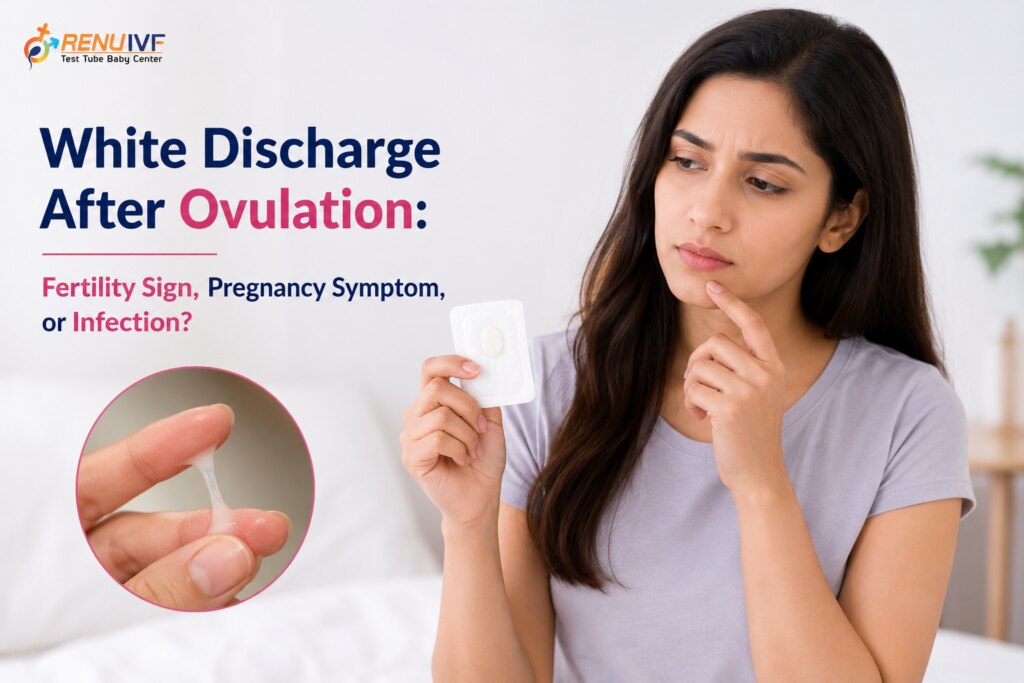
White discharge after ovulation is one of the most commonly searched topics in women’s reproductive health and also one of the most misunderstood. Thousands of women every day search phrases like “creamy white discharge after ovulation,” “is white discharge a sign of pregnancy,” or “how to tell if discharge is normal or infection.” This confusion is completely understandable. The female body goes through remarkable hormonal shifts every single month, and discharge is one of the most visible and sensitive indicators of those internal changes.
Whether you are actively trying to conceive, tracking your fertility cycle, or simply trying to understand your body better, white discharge after ovulation deserves a detailed, science-backed explanation not panic, not guesswork.
At Renu IVF Centre, this is one of the most frequently asked concerns brought by women during consultations. Women often arrive feeling confused, sometimes anxious, unsure whether what they are experiencing is a hopeful pregnancy sign, a normal part of their cycle, or something that needs medical attention. This guide is written to answer all of those questions with clarity, honesty, and compassion.
Understanding Vaginal Discharge: The Basics
Before diving into what happens specifically after ovulation, it helps to understand what vaginal discharge actually is and why it exists. Vaginal discharge also referred to medically as cervical mucus is a natural fluid produced by the cervix and vaginal glands throughout the menstrual cycle. Far from being something unusual or problematic, healthy discharge is the body’s intelligent self-cleaning and self-protecting mechanism.
Discharge plays several important roles in the female reproductive system:
- It keeps the vaginal tissues lubricated and healthy
- It flushes out dead cells and potentially harmful bacteria
- It helps maintain the natural pH balance of the vagina
- During the fertile window, it actively assists sperm in traveling toward the egg
- It changes in texture and volume depending on where you are in your cycle
The key thing to understand is that discharge is not static. It changes constantly because the hormones that govern it primarily estrogen and progesterone fluctuate every single day. This means that noticing different textures, colors, or amounts of discharge at different points in your cycle is not only normal, it is actually a sign that your body is functioning as it should.
What Happens to Discharge After Ovulation?
Ovulation is the pivotal moment of every menstrual cycle. It is the point at which a mature egg is released from the ovary and becomes available for fertilization. In the days leading up to ovulation, estrogen levels rise sharply and the body produces a very distinct type of discharge clear, stretchy, slippery, resembling raw egg white. This fertile-quality cervical mucus is the body’s way of creating the ideal environment for sperm survival and movement.
After ovulation occurs, the hormonal picture shifts dramatically. Progesterone rises, estrogen drops, and the cervical mucus responds accordingly. The previously clear and slippery discharge transforms into something thicker, creamier, and whiter. This progesterone-driven change in cervical mucus is what most women are referring to when they talk about white discharge after ovulation.
This shift is not random it serves a biological purpose. The thicker post-ovulatory mucus creates a protective barrier that is less hospitable to sperm (since the fertile window has passed) and helps seal the cervical opening. It also forms the foundation of what becomes the mucus plug if pregnancy occurs.
Types of Discharge Across the Menstrual Cycle
| Cycle Phase | Type of Discharge | What It Indicates |
| Right after period ends | Dry or very minimal | Low estrogen, low fertility |
| Pre-ovulation (days 8–11) | Sticky or slightly creamy | Fertility beginning to rise |
| Approaching ovulation | Wet, clear, slippery | Estrogen peak, fertile window opening |
| Ovulation day | Stretchy, egg-white consistency | Peak fertility |
| Immediately post-ovulation | Thick, white, creamy | Progesterone rise, fertile window closing |
| One week before period | Thicker or reduced discharge | Luteal phase, PMS phase |
| Early pregnancy | Increased milky white discharge | Elevated estrogen and blood flow to cervix |
Understanding where you fall in this table can immediately reduce anxiety about what you are experiencing.
Is White Discharge After Ovulation Normal?
The short answer is: yes, in most cases, absolutely. Creamy or milky white discharge after ovulation is a recognized, well-documented hormonal response to the rise of progesterone in the luteal phase. It is experienced by the vast majority of women and is not, on its own, a cause for concern.
Normal post-ovulation white discharge typically has the following characteristics:
- Color: White, off-white, or slightly cream-colored
- Texture: Thick, lotion-like, or creamy — similar to hand lotion
- Odor: Mild or completely odorless
- Amount: Moderate — noticeable but not soaking through clothing
- Sensation: No burning, no itching, no irritation
If your discharge fits this description, it is very likely a normal part of your luteal phase. Many women who track their fertility using the Fertility Awareness Method (FAM) learn to recognize this post-ovulatory mucus pattern as confirmation that ovulation has occurred and progesterone is doing its job.
Can White Discharge After Ovulation Be a Sign of Pregnancy?
This is the question that sits at the heart of what most women are really asking. The answer is nuanced— yes, it can be, but it is not definitive proof. Here is why.
In early pregnancy, the body begins producing significantly higher levels of estrogen and human chorionic gonadotropin (hCG). Blood flow to the pelvic region increases. The cervix softens and becomes more vascular. All of these changes cause an increase in vaginal secretions, often described as thin, milky, or creamy white discharge. This early pregnancy discharge even has a medical name leukorrhea and it typically begins within one to two weeks after conception, often before a woman even knows she is pregnant.
The frustrating reality, however, is that progesterone-driven post-ovulation discharge in a non-pregnant cycle can look almost identical to early pregnancy discharge. Both tend to be white or creamy, both can increase in amount, and both occur in the same two-week window after ovulation. This is why so many women find this symptom maddeningly ambiguous.
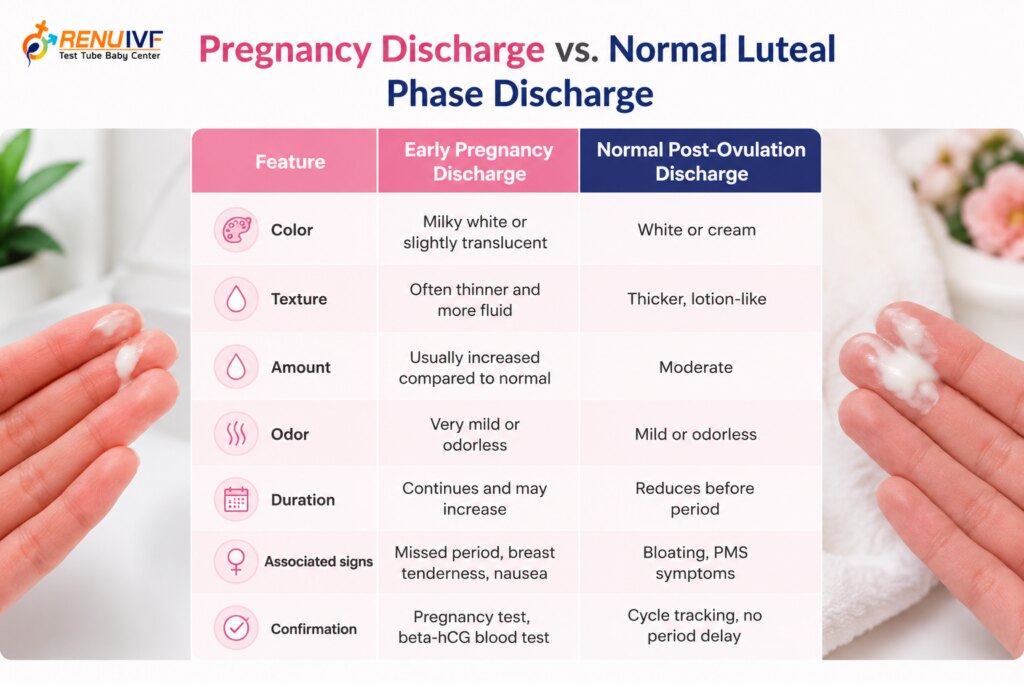
Pregnancy Discharge vs. Normal Luteal Phase Discharge
| Feature | Early Pregnancy Discharge | Normal Post-Ovulation Discharge |
| Color | Milky white or slightly translucent | White or cream |
| Texture | Often thinner and more fluid | Thicker, lotion-like |
| Amount | Usually increased compared to normal | Moderate |
| Odor | Very mild or odorless | Mild or odorless |
| Duration | Continues and may increase | Reduces before period |
| Associated signs | Missed period, breast tenderness, nausea | Bloating, PMS symptoms |
| Confirmation | Pregnancy test, beta-hCG blood test | Cycle tracking, no period delay |
Discharge alone, no matter how closely observed, cannot confirm pregnancy. Only a pregnancy test, blood beta-hCG test, or ultrasound can do
When White Discharge Signals Infection
This is the section that every woman needs to read carefully. While white discharge after ovulation is often completely harmless, there are specific warning signs that indicate the discharge may be caused by an infection rather than normal hormonal changes. Ignoring these signs especially when trying to conceive or during pregnancy can have serious consequences.
White discharge becomes medically concerning when it is accompanied by one or more of the following:
- Itching or burning inside or around the vaginal opening
- Strong or unpleasant odor — particularly a fishy, sour, or foul smell
- Unusual color — yellow, green, grey, or brown-tinged discharge
- Texture changes — cottage cheese-like clumps, frothy or foamy consistency
- Pain — during urination, during intercourse, or general pelvic discomfort
- Redness or swelling around the vulva or vaginal area
- Fever alongside discharge changes
These symptoms suggest that something beyond normal hormonal activity is occurring, and a gynecologist should be consulted promptly.
Common Infections That Cause Abnormal White Discharge
Yeast Infection (Candidiasis) Yeast infections are among the most common causes of abnormal white discharge in women of reproductive age. They are caused by an overgrowth of the fungus Candida, which naturally exists in the vagina in small amounts. When the vaginal pH balance is disrupted by antibiotics, hormonal changes, diabetes, or a weakened immune system Candida can multiply rapidly. The hallmark discharge of a yeast infection is thick, white, and cottage-cheese-like, accompanied by intense itching and burning. It is not sexually transmitted and is highly treatable with antifungal medication.
Bacterial Vaginosis (BV) Bacterial vaginosis occurs when the natural balance of vaginal bacteria is disturbed, with harmful bacteria outnumbering the protective Lactobacillus bacteria. Unlike a yeast infection, BV discharge tends to be thin and greyish-white rather than clumpy, and it carries a distinctive fishy odor that worsens after intercourse. BV requires antibiotic treatment and, if left untreated, can increase susceptibility to sexually transmitted infections and complicate fertility or pregnancy.
Sexually Transmitted Infections (STIs) Certain STIs, including chlamydia, gonorrhea, and trichomoniasis, can cause abnormal discharge as one of their symptoms. Trichomoniasis, in particular, produces a frothy, yellow-green discharge with a foul smell. Many STIs are asymptomatic in early stages, which is why regular sexual health screening is recommended, especially for women trying to conceive.
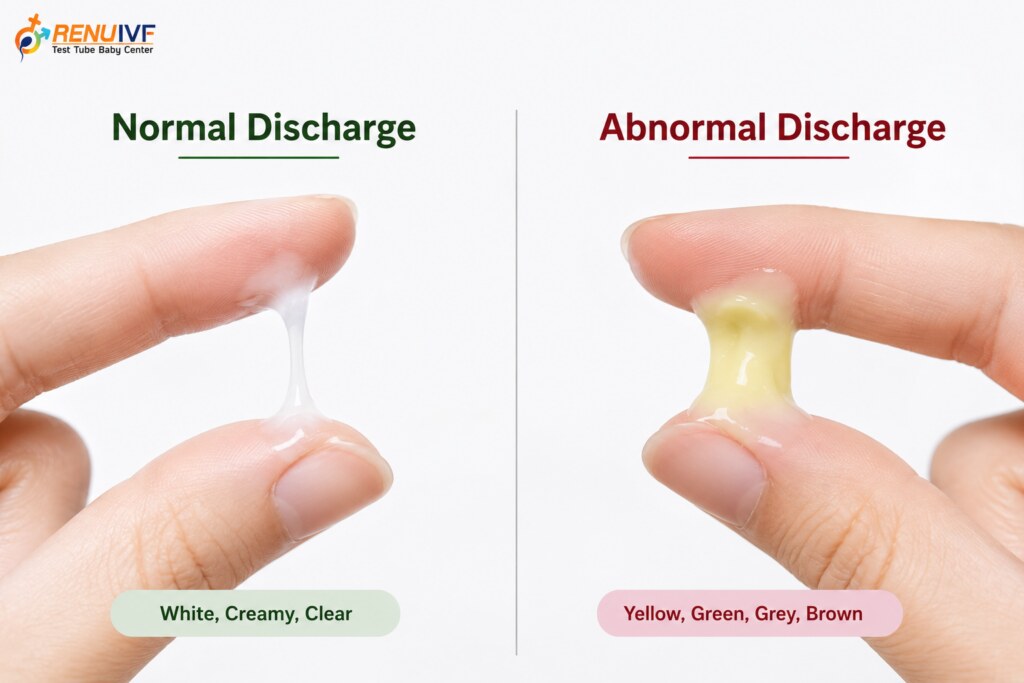
Normal vs. Abnormal Discharge: A Quick Reference
| Feature | Normal Discharge | Abnormal Discharge |
| Color | White, cream, clear | Yellow, green, grey, brown |
| Odor | Mild or none | Strong, fishy, or foul |
| Texture | Smooth, creamy, or watery | Clumpy, cottage cheese, frothy |
| Itching | None | Present mild to severe |
| Burning | None | Present during urination or daily |
| Pain | None | Pelvic, vulvar, or during sex |
| Amount | Moderate, predictable | Sudden dramatic increase |
Expert Perspective from Renu IVF Centre
At Renu IVF Centre in Kanpur, a large proportion of women who visit for fertility consultations raise concerns about discharge changes during their cycle. Many arrive having spent days or weeks interpreting every bodily change through the lens of pregnancy hope or infection fear. Dr. Renu Singh Gahlaut, the lead fertility specialist at Renu IVF Centre and a highly experienced IVF consultant, consistently emphasizes one important principle: understanding your body’s hormonal patterns is empowering, but self-diagnosis through internet searches alone is rarely accurate and often anxiety-inducing.
Dr. explains that creamy white discharge after ovulation is one of the most common “non-problems” she sees women worried about. In the majority of cases, it is a perfectly healthy progesterone response. However, when discharge is paired with itching, odor, pain, or fertility difficulties, it deserves proper clinical evaluation not a Google diagnosis. At Renu IVF Centre, women receive individualized hormonal assessments, fertility tracking support, and clear explanations of what their body’s signals actually mean, all in a compassionate and judgment-free environment.
White Discharge After Ovulation During Fertility Treatment or IVF
Women undergoing fertility treatments such as IUI, IVF, or ovulation induction frequently notice discharge changes that can feel alarming. These are, in most cases, direct side effects of the hormonal medications used in treatment protocols.
Here is what commonly happens during fertility treatment:
- Progesterone supplements (whether oral, injectable, or vaginal) significantly increase the thickness and volume of cervical mucus, leading to noticeable creamy discharge
- Vaginal progesterone pessaries leave a white residue that can be mistaken for infection-related discharge
- Estrogen medications used during frozen embryo transfer cycles alter cervical mucus characteristics
- Post-trigger injection hormonal surges can temporarily increase vaginal secretions
Women at Renu IVF Centre are counseled extensively about these expected medication side effects so that they can distinguish between a normal treatment response and a genuine concern that requires attention.
White Discharge and PCOS: What You Should Know
Polycystic Ovary Syndrome (PCOS) adds another layer of complexity to interpreting white discharge after ovulation. Because PCOS disrupts the normal hormonal architecture of the menstrual cycle with elevated androgens, insulin resistance, and irregular or absent ovulation discharge patterns become unpredictable and unreliable as fertility indicators.
In women with PCOS:
- Ovulation may be delayed, sporadic, or absent entirely, meaning the expected post-ovulatory discharge shift may not happen on a predictable schedule
- Hormonal imbalances can cause unusual discharge patterns that do not correlate neatly with cycle phases
- Higher estrogen relative to progesterone in anovulatory cycles may produce discharge that resembles fertile mucus even when no egg has been released
- PCOS also increases susceptibility to yeast infections and bacterial vaginosis due to altered vaginal pH
For women with PCOS trying to conceive, discharge tracking alone is insufficient. Ovulation monitoring through ultrasound and blood tests, as offered at Renu IVF Centre, provides a far more reliable picture of reproductive health.
The Emotional Weight of the Two-Week Wait
For women actively trying to conceive, the two weeks between ovulation and an expected period are often described as emotionally exhausting. Every subtle bodily change including discharge gets scrutinized, interpreted, hoped upon, and worried about. This is not weakness; it is the entirely understandable result of deeply wanting something and having very little control over the outcome.
White discharge after ovulation becomes particularly loaded during this waiting period. Women find themselves comparing their discharge to descriptions online, measuring it, photographing it, asking in forums all in the hope of finding a clue about whether pregnancy has occurred. While some degree of body awareness is genuinely useful, obsessive symptom tracking during the two-week wait often amplifies anxiety without providing reliable answers.
The only thing that can truly tell you whether you are pregnant during this window is a pregnancy test taken after the expected period date, or a blood hCG test. Everything else including discharge, cramping, breast tenderness, and mood changes exists in an ambiguous space that cannot be read with certainty.
Lifestyle and Hygiene Factors That Affect Vaginal Discharge
The quality and quantity of vaginal discharge is influenced by far more than just hormones. Several everyday lifestyle factors can alter discharge in ways that are benign but noticeable:
- Diet and hydration: Adequate water intake supports healthy cervical mucus production. Diets high in sugar may increase yeast infection risk.
- Stress levels: Chronic psychological stress affects the hypothalamic-pituitary-ovarian axis the hormonal communication chain that governs ovulation and discharge patterns.
- Sexual activity: Arousal naturally increases vaginal lubrication. Semen can also temporarily alter vaginal discharge appearance after unprotected intercourse.
- Antibiotic use: Antibiotics disrupt the natural balance of vaginal bacteria, frequently triggering yeast infections and associated discharge changes.
- Tight or synthetic clothing: Poor ventilation around the vaginal area creates a warm, moist environment that encourages bacterial and fungal overgrowth.
- Hygiene products: Scented soaps, intimate washes, and douching disrupt the natural vaginal pH and microbiome, often worsening discharge problems rather than solving them.
Healthy vaginal hygiene tips to follow:
- Wear breathable, cotton underwear
- Clean the external vulva gently with plain warm water only
- Avoid all scented intimate products and douching
- Change underwear daily and more often during heavy discharge days
- Practice safe sex to protect against STIs
- Manage blood sugar if diabetic, as elevated glucose increases yeast infection risk
Myths About White Discharge After Ovulation — Debunked
Myth: White discharge after ovulation always means pregnancy. This is false. The vast majority of women experience white creamy discharge after ovulation as a normal hormonal event every single cycle, regardless of whether conception has occurred.
Myth: All white discharge indicates infection. Completely false. Healthy vaginal discharge is one of the body’s most important protective functions. The absence of discharge is not healthier than normal discharge.
Myth: If you have no discharge, it means you are infertile. Fertility is determined by a complex combination of factors including egg quality, ovarian reserve, uterine health, sperm quality, and hormonal balance not by discharge volume alone.
Myth: Thick white discharge means implantation has happened. There is no specific discharge pattern that reliably confirms implantation. Implantation bleeding light spotting is sometimes reported, but thick white discharge is not a recognized implantation sign.
Myth: You can tell the difference between pregnancy discharge and normal discharge just by looking. As the comparison table earlier in this article shows, early pregnancy discharge and normal luteal phase discharge are often indistinguishable to the naked eye.
When to See a Doctor at Renu IVF Centre
Seek prompt medical consultation if you experience white discharge along with any of the following:
- A strong, unpleasant, or unusual odor
- Itching, burning, or soreness in or around the vagina
- Yellow, green, grey, or blood-tinged discharge
- Pain during urination or sexual intercourse
- Pelvic pain or lower abdominal discomfort
- Fever or general unwellness alongside discharge changes
- Discharge that is dramatically heavier than usual for no obvious reason
Additionally, if you have been trying to conceive for six months or more without success (or three months if you are over 35), or if your menstrual cycles are irregular, it is time to seek a fertility evaluation. Early assessment can identify treatable causes of delayed conception and prevent unnecessary months of waiting and worry.
Renu IVF Centre offers comprehensive consultations covering hormonal evaluation, fertility workup, cycle monitoring, ovulation assessment, and infection screening all under the expert guidance of Dr. Renu Singh Gahlaut.
Frequently Asked Questions (FAQs)
1. Is white discharge after ovulation a sign of pregnancy? It can be an early pregnancy indicator, but it is not reliable on its own. Progesterone-driven white discharge occurs in normal non-pregnant cycles too. A pregnancy test remains the only accurate confirmation.
2. How many days after ovulation does pregnancy discharge typically begin? If implantation occurs, hormonal changes may cause increased discharge within 6 to 12 days after ovulation. However, the timing varies between individuals and cannot be predicted precisely.
3. Ovulation ke baad creamy white discharge normal hota hai kya? Haan, bilkul normal ho sakta hai. Ovulation ke baad progesterone hormone badhta hai jis se cervical mucus thick aur creamy ho jaata hai. Yeh ek healthy hormonal response hai.
4. White discharge aur yeast infection mein difference kaise pehchanein? Normal white discharge mein koi itching, burning, ya bad smell nahi hoti. Yeast infection mein discharge thick aur cottage cheese jaisi hoti hai, saath mein intense itching aur burning bhi hoti hai.
5. Can white discharge after ovulation confirm that ovulation was successful? Discharge changes can suggest that ovulation occurred and progesterone has risen, but they cannot confirm egg quality, fertilization, or successful implantation. Ultrasound and hormonal testing provide far more reliable confirmation.
6. White discharge ke saath smell aaye toh kya karna chahiye? Agar discharge ke saath strong smell, itching, ya irritation ho, toh turat gynecologist se milein. Yeh bacterial vaginosis ya yeast infection ka sign ho sakta hai.
7. Can stress cause increased vaginal discharge? Yes. Stress affects the hormonal axis that governs ovulation and cervical mucus production. Chronic stress can also weaken immunity, increasing susceptibility to vaginal infections.
8. Is discharge tracking alone enough to monitor fertility? Discharge tracking can be a useful supporting tool within broader fertility awareness methods, but it is insufficient on its own particularly for women with PCOS, irregular cycles, or fertility concerns. Ovulation kits, basal body temperature tracking, and clinical monitoring provide more complete information.
Final Thoughts
White discharge after ovulation is, in the overwhelming majority of cases, a completely normal and healthy part of the female reproductive cycle. It reflects the body’s intelligent hormonal choreography progesterone rising after ovulation, cervical mucus thickening, the reproductive system preparing for either the arrival of a pregnancy or the next menstrual cycle.
Sometimes, this discharge may indeed be an early signal of pregnancy one of the first whispers the body offers during those hopeful days before a positive test. Other times, it is simply the body doing exactly what it does every month, beautifully and without drama.
What matters most is learning to distinguish what is normal for your individual body, recognizing when something genuinely feels different or concerning, and knowing when to seek expert guidance rather than relying solely on internet searches.
At Renu IVF Centre, the philosophy is simple: informed women make better decisions about their health. Understanding discharge, fertility signals, and the difference between normal and abnormal does not require medical training it requires accurate, compassionate information delivered by people who genuinely care. That is what Dr. Renu Singh Gahlaut and the entire team at Renu IVF Centre are committed to providing, every single day.