

Pregnancy is often described as a simple biological event sperm meets egg, fertilization happens, and conception follows. In reality, this process involves a long sequence of precise biological steps, and one of the most important yet least understood among them is sperm capacitation. Many couples trying to conceive focus almost entirely on sperm count and motility, assuming that a normal semen report guarantees fertility. However, fertilization depends on far more than just the number of sperm or how fast they swim. It also depends on whether sperm can undergo a series of functional changes that prepare them to actually fertilize an egg. This process, known as sperm capacitation, plays a central role in both natural conception and assisted reproductive treatments such as IVF. Understanding what happens during this stage can help couples better interpret their fertility journey, whether they are trying to conceive on their own or exploring treatment options with a fertility specialist.
What Is Capacitation of Sperm?
So, what is capacitation of sperm exactly? In the simplest terms, sperm capacitation is the process through which sperm undergo biochemical and functional changes that allow them to become capable of fertilizing an egg. When sperm is released during ejaculation, it may appear healthy, active, and normal under a microscope, but it is not yet ready to fertilize an egg. It must first pass through a series of internal transformations, and this maturation process is what we call capacitation.
It’s important to understand that capacitation does not involve sperm growing larger or increasing in number. The sperm has already been fully formed in the testes long before ejaculation. Capacitation is purely a functional change it modifies how the sperm behaves, how its membrane responds to its surroundings, and how it eventually interacts with the egg. Without this step, sperm may look completely normal on paper but still be functionally unprepared to complete fertilization.
This is one of the reasons fertility specialists often emphasize that a semen analysis alone cannot capture the complete picture of male fertility. A report might show adequate sperm count, movement, and shape, while the sperm still lacks the functional readiness that only capacitation can provide.
Where Does Capacitation of Sperm Occur In?
A frequent question among couples researching fertility is: capacitation of sperm occur in which part of the body? In the case of natural conception, this process mainly takes place inside the female reproductive tract, particularly as sperm makes its way through the cervix, uterus, and fallopian tubes.
The environment inside the female reproductive tract is very different from the environment of semen. Semen actually contains certain substances that temporarily suppress sperm’s fertilizing ability, likely to prevent premature activation before the sperm even leaves the body. Once inside the female reproductive tract, these suppressive influences are gradually removed, and the sperm membrane begins to change in composition and behavior.
This transformation does not happen instantly or in one single location. Instead, capacitation occurs progressively as sperm travels toward the site of fertilization, which is typically within the fallopian tube. This is also why natural conception is such a complex, multi-step journey sperm must first survive the acidic environment of the vagina, move through the cervix, travel through the uterus, and finally undergo capacitation as it approaches the fallopian tube, all before it can attempt to fertilize an egg.
Why Sperm Capacitation Matters for Fertilization
Fertilization is not as simple as sperm physically reaching the egg. For fertilization to be successful, the sperm needs to complete several biological tasks in the correct order. Capacitation prepares sperm for exactly these tasks.
During capacitation, a number of important changes take place:
- The sperm membrane undergoes biochemical restructuring, changing its composition and flexibility
- Cholesterol is gradually removed from the sperm membrane, which increases its fluidity
- The sperm becomes more responsive to chemical signals released by the egg and surrounding cells
- Sperm movement transforms into a stronger, more vigorous pattern known as hyperactivation
- The sperm becomes capable of undergoing the acrosome reaction, a critical step that allows it to penetrate the egg’s outer protective layers
Each of these changes builds upon the last, and together they allow sperm to move more effectively, respond appropriately when it nears the egg, and ultimately deliver genetic material during fertilization. This explains why even sperm that appear structurally normal and move well can still fail to fertilize an egg if they have not properly undergone capacitation. Male fertility, in other words, is not just about numbers it is about the sperm’s functional capability at every stage of the journey.
Capacitation in Natural Conception vs IVF
| Factor | Natural Conception | IVF |
| Where sperm meets egg | Inside the fallopian tube | In a controlled laboratory setting |
| Sperm capacitation | Occurs naturally as sperm travels through the reproductive tract | Achieved through laboratory sperm preparation techniques |
| Egg retrieval | Not required | Eggs are surgically retrieved from the ovaries |
| Fertilization location | Takes place inside the body | Takes place outside the body, in the lab |
| Sperm selection | Natural biological filtering occurs along the reproductive tract | Sperm are selected and processed using laboratory methods |
| Timing control | Determined by the body’s natural cycle | Can be more precisely timed by the medical team |
| Embryo transfer | Not applicable | A selected embryo may later be transferred to the uterus |
This comparison highlights an important point while the biological purpose of capacitation remains the same in both scenarios, the environment and method through which it is achieved are entirely different. Natural conception relies on the body’s own internal processes, while IVF relies on carefully controlled laboratory conditions designed to replicate what would normally happen inside the body.
How Does Sperm Capacitation Happen?
Sperm capacitation is not a single, isolated event. It unfolds as a series of interconnected biological changes that occur progressively. Once sperm enters the female reproductive tract, its surrounding environment shifts dramatically compared to semen, and this shift triggers internal changes within the sperm itself.
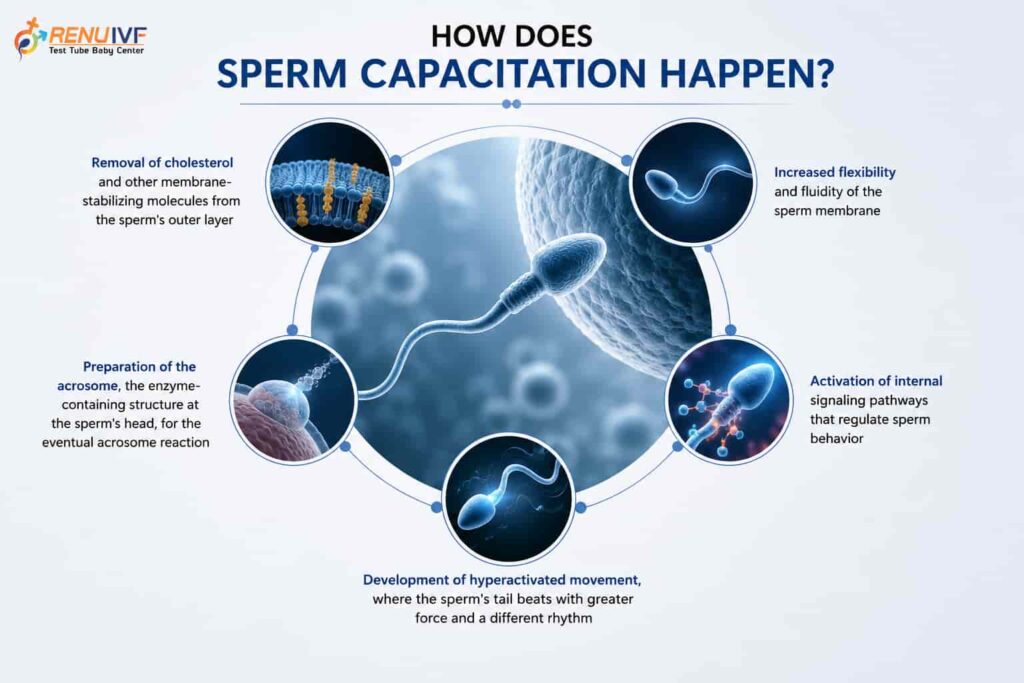
Some of the key changes involved include:
- Removal of cholesterol and other membrane-stabilizing molecules from the sperm’s outer layer
- Increased flexibility and fluidity of the sperm membrane
- Activation of internal signaling pathways that regulate sperm behavior
- Development of hyperactivated movement, where the sperm’s tail beats with greater force and a different rhythm
- Preparation of the acrosome, the enzyme-containing structure at the sperm’s head, for the eventual acrosome reaction
These changes do not happen randomly. They occur in a coordinated sequence that ultimately determines whether a sperm cell will be capable of completing fertilization. If any part of this sequence is disrupted, whether due to underlying health conditions, oxidative stress, or other biological factors, sperm may struggle to fertilize an egg even if basic semen parameters appear within normal range.
How Long Does Sperm Capacitation Take?
Sperm capacitation is a gradual process rather than an instant transformation. It occurs progressively as sperm travels through the female reproductive tract, and the exact timing can vary from person to person depending on individual biological conditions and the surrounding reproductive environment.
It would be inaccurate to assume that capacitation always follows a fixed, predictable timeline. Some sperm may complete the process more quickly, while others take longer, depending on numerous physiological factors. What remains constant, however, is that this functional maturation must occur before sperm can effectively participate in fertilization, regardless of how long it takes for any individual sperm cell.
What Happens After Sperm Capacitation?
Once a sperm cell has completed capacitation, it becomes far better equipped to locate and interact with an egg. The overall sequence of events can be understood as follows:
Ejaculation → Sperm enters the female reproductive tract → Capacitation begins → Hyperactivation develops → Acrosome reaction occurs → Sperm interacts with the egg → Fertilization takes place
After capacitation, sperm becomes responsive to chemical signals released by the egg and its surrounding cells. It must then successfully penetrate the egg’s protective outer layers using the acrosome reaction before it can fuse with the egg itself. Interestingly, although millions of sperm may be present in a single ejaculation, only one sperm typically succeeds in fertilizing the egg. Once fertilization occurs, biological mechanisms within the egg activate to prevent any additional sperm from entering, ensuring that only one sperm contributes genetic material to the resulting embryo.
Role of Sperm Capacitation in Natural Conception
In natural conception, millions of sperm are released during ejaculation, yet only a small fraction ever reach the vicinity of the egg, and an even smaller number are capable of completing every step required for successful fertilization. The female reproductive tract functions almost like a selective filter, allowing only the most functionally capable sperm to progress toward the egg.
For natural conception to succeed, several factors need to align simultaneously:
- Adequate sperm production and concentration
- Normal sperm movement and motility
- Proper sperm shape and structure
- The sperm’s ability to survive the female reproductive environment
- Successful completion of capacitation
- The ability to undergo the acrosome reaction at the right time
- Good egg quality and maturity
- Accurate ovulation timing
- Overall reproductive health of both partners
Sperm capacitation is just one piece of this much larger puzzle, but it is a critical piece. Even if every other factor is favorable, incomplete or delayed capacitation can prevent fertilization from occurring, which is why fertility specialists increasingly emphasize sperm function alongside basic semen parameters.
Role of Sperm Capacitation in IVF
In IVF, fertilization occurs outside the body, inside a controlled laboratory environment, which changes how sperm capacitation is achieved. Since sperm cannot naturally pass through the female reproductive tract in this scenario, laboratory techniques are used to replicate the conditions that would normally trigger capacitation inside the body.
Before fertilization takes place, semen samples undergo a preparation process in the laboratory. This typically includes:
- Washing the semen sample to remove seminal fluid
- Separating motile, healthy sperm from immotile or abnormal sperm
- Concentrating the most viable sperm for use during fertilization
- Creating conditions that mimic the natural reproductive environment, encouraging functional maturation
In conventional IVF, prepared sperm are placed together with retrieved eggs in a laboratory dish, allowing fertilization to occur in a manner similar to what happens naturally inside the body. In cases involving significant male-factor infertility, doctors may recommend ICSI, where a single selected sperm is injected directly into an egg. This technique bypasses several of the physical barriers sperm would normally need to overcome, including some aspects of natural capacitation and the acrosome reaction. However, this does not mean sperm quality becomes irrelevant with ICSI the sperm still contributes half of the embryo’s genetic material, so its overall health and genetic integrity remain highly relevant to treatment outcomes.
Capacitation of Sperm in IVF vs ICSI
| Feature | Conventional IVF | ICSI |
| Fertilization method | Sperm and egg are placed together in a dish | A single sperm is injected directly into the egg |
| Sperm must reach the egg naturally | Yes | No |
| Sperm penetration of egg | Occurs naturally within the laboratory setting | Mechanically assisted by the embryologist |
| Sperm selection process | Laboratory-prepared sperm sample is used | An individual sperm is manually selected |
| Typically used for | Cases with reasonably normal sperm parameters | Cases involving significant male-factor infertility |
| Does sperm quality still matter? | Yes | Yes |
Can Poor Sperm Capacitation Affect Fertility?
Yes, it certainly can. Fertility is not determined by sperm count alone. A man may have a sperm count and motility that fall within normal ranges, yet still experience difficulty conceiving due to functional issues affecting capacitation or other biological processes required for fertilization.
Problems affecting sperm function can quietly contribute to unexplained infertility, even though capacitation itself is not routinely assessed during a standard fertility evaluation. When a couple struggles to conceive despite trying for an extended period, doctors typically look at a combination of factors rather than isolating a single cause. A standard semen analysis usually evaluates parameters such as:
- Sperm concentration
- Total sperm count
- Sperm motility
- Sperm morphology
- Semen volume
- Additional laboratory parameters, when clinically indicated
If these results appear largely normal but conception still isn’t happening, further investigation into sperm function, including aspects related to capacitation, may become relevant, particularly when combined with a thorough evaluation of the female partner as well.
Can Sperm Capacitation Be Improved?
There is no single medication or supplement that can guarantee improved sperm capacitation, since this is a complex biological process influenced by multiple factors within the body. However, general sperm health, which indirectly supports proper capacitation, can often be improved through certain lifestyle changes.
Some helpful measures include:
- Avoiding smoking and tobacco use entirely
- Limiting excessive alcohol consumption
- Maintaining a healthy body weight through diet and exercise
- Engaging in regular physical activity
- Eating a balanced, nutrient-dense diet
- Managing underlying health conditions that may affect male fertility
- Avoiding unnecessary heat exposure around the testes, such as from prolonged laptop use or hot baths
- Seeking timely medical evaluation if fertility issues persist beyond a year of trying
- Following prescribed treatment for conditions such as varicocele or hormonal imbalances, when diagnosed
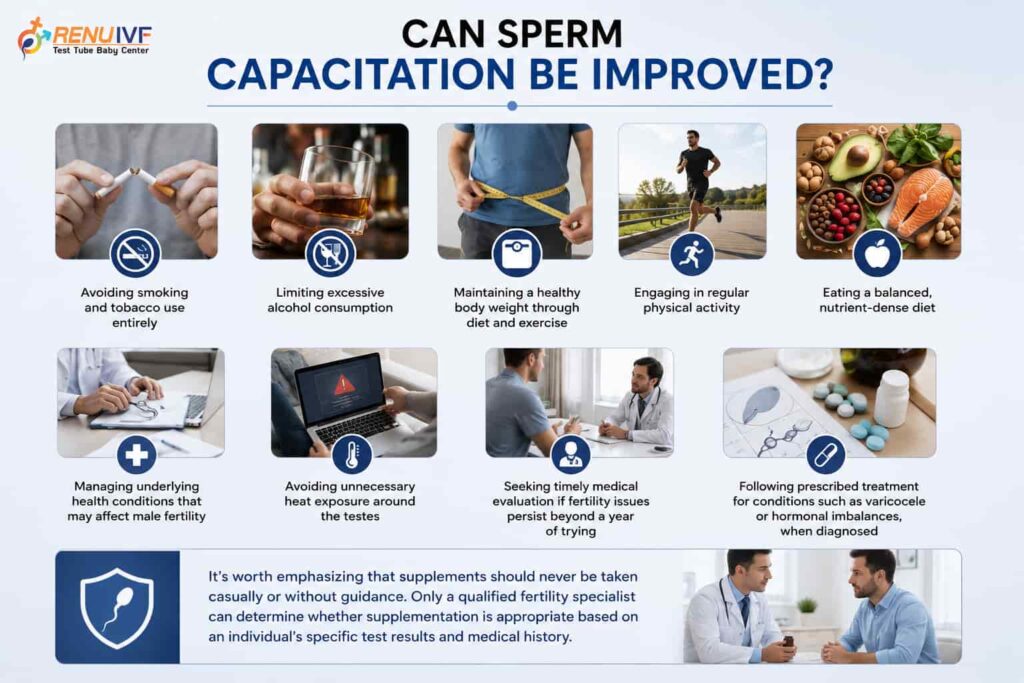
It’s worth emphasizing that supplements should never be taken casually or without guidance. Only a qualified fertility specialist can determine whether supplementation is appropriate based on an individual’s specific test results and medical history.
Does a Normal Semen Analysis Mean Sperm Capacitation Is Normal?
Not necessarily. A routine semen analysis provides valuable insight into sperm quantity and certain basic physical characteristics, but it does not directly measure functional processes like capacitation. This means a semen report can appear entirely normal in terms of count, motility, and morphology, while other functional aspects of sperm biology remain unassessed.
This is precisely why a comprehensive fertility evaluation looks at both partners together and considers the complete clinical picture, rather than relying solely on one test result to determine fertility potential.
If you’ve been trying to conceive for a while without success, it’s worth getting a proper evaluation rather than guessing at the cause. According to Dr. Renu Singh Gahlaut, fertility assessment should always look at both partners together, since sperm function, egg quality, ovulation timing, and reproductive health all interac no single factor tells the full story. Many couples begin their search by looking for an IVF Hospital Near Me, but proximity alone shouldn’t be the deciding factor. It’s far more important to look closely at the fertility team’s experience, laboratory facilities, and transparency around success rates before choosing where to begin treatment. For couples exploring options in Uttar Pradesh, consulting an experienced ivf specialist in kanpur early in the process can help identify the underlying cause of delay and guide the right next steps, whether that involves further testing, lifestyle adjustments, or assisted reproductive treatment.
Key Factors That Influence Fertilization
| Factor | Why It Matters |
| Sperm count | Determines how many sperm are available to attempt fertilization |
| Sperm motility | Helps sperm travel effectively toward the egg |
| Sperm morphology | Abnormal shape can interfere with sperm function |
| Capacitation | Prepares sperm functionally so it becomes capable of fertilizing an egg |
| Acrosome reaction | Allows sperm to penetrate and interact with the egg’s outer layers |
| Egg quality | Essential for successful fertilization and healthy embryo development |
| Ovulation timing | Determines the window during which the egg is available for fertilization |
| Fallopian tube health | Important for natural fertilization to occur |
| Uterine health | Plays a key role in successful implantation and ongoing pregnancy |
Frequently Asked Questions
1.How long does capacitation of sperm take?
There’s no fixed time period for capacitation, as it varies from person to person depending on individual biological factors. It happens gradually while sperm travels through the female reproductive tract, and the exact duration cannot be predicted the same way for everyone.
2. Capacitation of sperm occur in which part of the body?
In natural conception, capacitation occurs progressively within the female reproductive tract, primarily as sperm travels through the uterus and fallopian tubes toward the site of fertilization.
3. Is sperm capacitation necessary for natural pregnancy?
Yes. Capacitation is a necessary part of the natural sequence of events that allows sperm to become functionally capable of fertilizing an egg during conception.
4. Does sperm capacitation happen during IVF?
Sperm used in IVF undergoes laboratory preparation before being introduced to the egg. This preparation process is designed to replicate the natural conditions required for functional maturation.
5.Is 70% sperm motility normal?
Yes, 70% sperm motility is considered good and is above the typical reference range used in semen analysis. WHO reference values generally consider total motility above 40% as within the normal range, so 70% reflects healthy sperm movement, though motility alone does not confirm overall fertility potential.
6. What are the 7 steps of fertilization?
Fertilization generally involves the following sequence: sperm capacitation, sperm transport through the female reproductive tract, sperm binding to the outer layer of the egg, the acrosome reaction, sperm penetration through the egg’s outer layer, fusion of the sperm and egg membranes, and finally, activation of the egg along with the combining of genetic material to form an embryo.
7. Does sperm capacitation determine IVF success?
No. IVF outcomes depend on multiple interconnected factors, including egg quality, sperm quality, embryo development, age, and uterine health. Capacitation is simply one part of a much larger fertilization process.
Conclusion
Sperm capacitation may not be a term most couples are familiar with, but it plays a quiet, essential role in the journey from sperm production to successful fertilization. In natural conception, this process unfolds inside the body as sperm travels through the female reproductive tract, gradually becoming functionally ready to interact with the egg. In IVF, laboratory preparation techniques step in to recreate similar conditions, helping sperm reach that same state of readiness in a controlled clinical setting.
If you’re facing difficulty conceiving, it’s important to remember that no single factor, whether sperm count, capacitation, or egg quality, tells the complete story on its own. A thorough fertility evaluation should always consider both partners together, along with reproductive anatomy, hormonal health, age, and previous treatment history. Renu IVF offers personalized fertility evaluation and evidence-based treatment planning tailored to each couple’s specific needs, helping you understand exactly what’s happening in your fertility journey and what steps make sense next.