
When couples start exploring fertility treatment, one question comes up again and again: “Which treatment has the highest success rate for my age?”
There’s no single answer. Age matters a lot but IUI, IVF and ICSI aren’t interchangeable options ranked by success rate. They’re different procedures suited to different problems, and age interacts with each one differently. Ovarian reserve, sperm quality, fallopian tube condition, endometriosis, prior treatment history, and embryo quality all factor in alongside age.
Does Age Really Affect Fertility Treatment Success?
Yes. As women get older, ovarian reserve generally declines and a higher proportion of remaining eggs have chromosomal abnormalities. This lowers the chance of forming a healthy embryo and raises miscarriage risk. The effect becomes more noticeable after the mid-30s and more significant after 40.
This doesn’t mean pregnancy is impossible after 35 or 40 it means the odds shift, and treatment planning matters more.
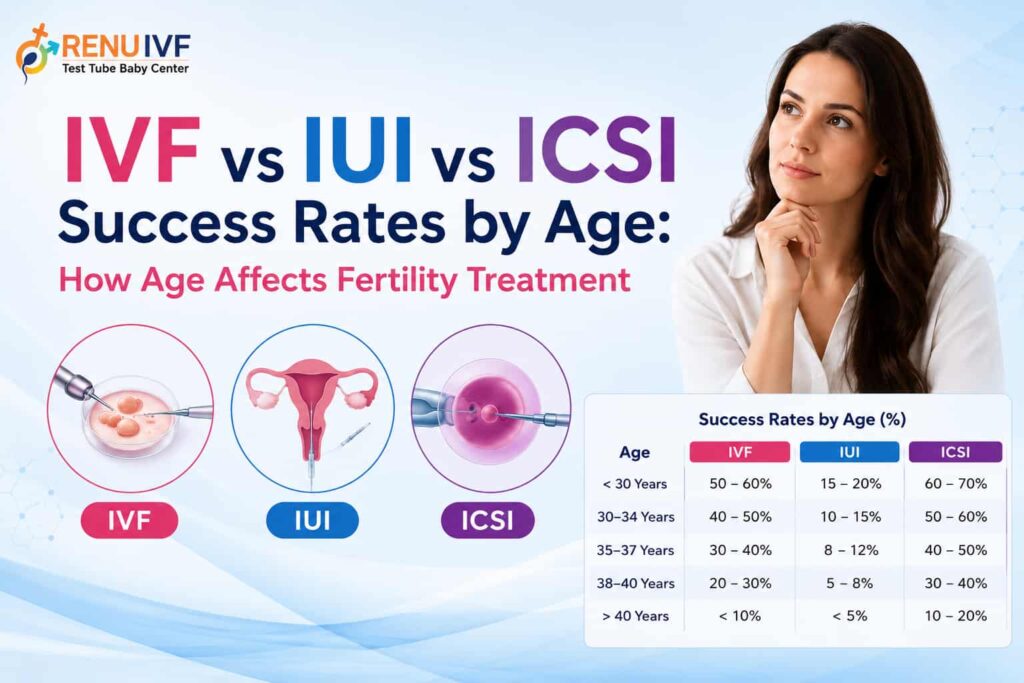
A note on the statistics below: different registries measure “success” differently. UK data (HFEA) typically reports birth rate per embryo transfer. US data (CDC) typically reports live-birth rate per treatment cycle started. These numbers are not directly comparable to each other a per-transfer rate will usually look higher than a per-cycle rate, because not every cycle reaches transfer. Treat each figure as belonging to its own data set.
- HFEA (UK, 2022): birth rate per fresh embryo transfer, own eggs roughly 35% for ages 18–34, 10% for ages 40–42, 5% for ages 43–44.
- CDC (US, 2022): live-birth rate per ART cycle, own eggs roughly 42.8% under 35, 39.9% for 35–37, 34.9% for 38–40, 27.7% over 40.
Both confirm the same direction success declines with age but don’t average them together or treat either as a personal prediction. They’re population-level figures, not individual forecasts, and won’t match outcomes at any specific clinic, including one in India.
What’s the Difference Between IUI, IVF and ICSI?
| Treatment | What Happens | Main Use |
| IUI | Prepared sperm is placed directly into the uterus around ovulation | Selected cases of unexplained infertility, ovulation issues, or mild sperm problems |
| IVF | Eggs are retrieved and fertilised with sperm in a lab | Tubal problems, several other infertility causes, some unexplained cases |
| ICSI | A single sperm is injected directly into a mature egg during IVF | Male-factor infertility, or after previous fertilisation failure |
ICSI is not “IVF with better odds.” It’s a fertilisation technique used inside an IVF cycle. The American Society for Reproductive Medicine’s guidance states that routine ICSI does not improve live-birth rates in patients without male-factor infertility or prior fertilisation failure and specifically, ICSI does not improve outcomes for advanced maternal age or diminished ovarian reserve on its own. Injecting a sperm directly into an egg doesn’t make an older egg biologically younger.
IUI Success by Age
IUI is less invasive and cheaper than IVF, but it relies on natural fertilisation and embryo development, so age still matters.
| Age Group | General Pattern |
| Under 30 | Generally more favourable, if no major fertility issues |
| 30–34 | Generally favourable for selected patients |
| 35–37 | Decline may begin; other fertility factors matter more |
| 38–40 | Noticeably lower than younger groups; doctors often reassess repeated attempts |
| 40+ | Generally lower; IVF or other options often considered sooner |
Important honesty note: there’s no single reliable published IUI-success-by-age percentage table the way there is for IVF, because IUI outcomes depend heavily on individual factors (ovulation, sperm quality, follicle count, tubal patency). Be suspicious of any source that gives you a precise IUI percentage by age band without citing a specific study.
IVF Success by Age (Own Eggs)
| Age | General Trend |
| Under 35 | Highest success generally seen here |
| 35–37 | Still reasonable, beginning to decline |
| 38–40 | Decline more noticeable |
| 41–42 | Significantly lower |
| 43–44 | Considerably lower |
| 45+ | Generally very low with own eggs, though individual cases vary |
(See the HFEA/CDC figures above same pattern, different measurement methods.)
What these numbers don’t show: cumulative success. Single-cycle statistics understate real-world chances because most patients who don’t succeed on cycle one try again. Cumulative live-birth rate across 2–3 cycles is typically meaningfully higher than any single-cycle number. If you’re deciding whether treatment is worth pursuing at all, ask your clinic for cumulative rates, not just per-cycle rates the per-cycle number alone can look more discouraging than the realistic picture.
Why Does IVF Success Decrease With Age?
Both egg quality and egg quantity decline with age and it’s the combination of the two, not just one, that lowers IVF success. A woman can ovulate regularly at 40 without her eggs having the same reproductive potential they had at 25–30. With age:
- Egg quantity (ovarian reserve) declines, so fewer eggs are available in the ovaries to begin with
- Fewer eggs are retrieved per cycle, a direct result of lower egg quantity
- Egg quality drops, meaning a higher proportion of remaining eggs are chromosomally abnormal
- Because of this decline in egg quality, fewer embryos develop normally after fertilisation
- Miscarriage risk increases, largely due to poor egg quality producing chromosomally abnormal embryos
IVF can address many causes of infertility, but it can’t reverse either the declining egg quantity or the declining egg quality that comes with age it can only work with the eggs a woman still has.s.
The Option Most Articles Skip: Donor Eggs
This matters enough to have its own section, not a footnote. Every statistic above assumes the patient’s own eggs. That caveat quietly hides the single most important fact for older patients:
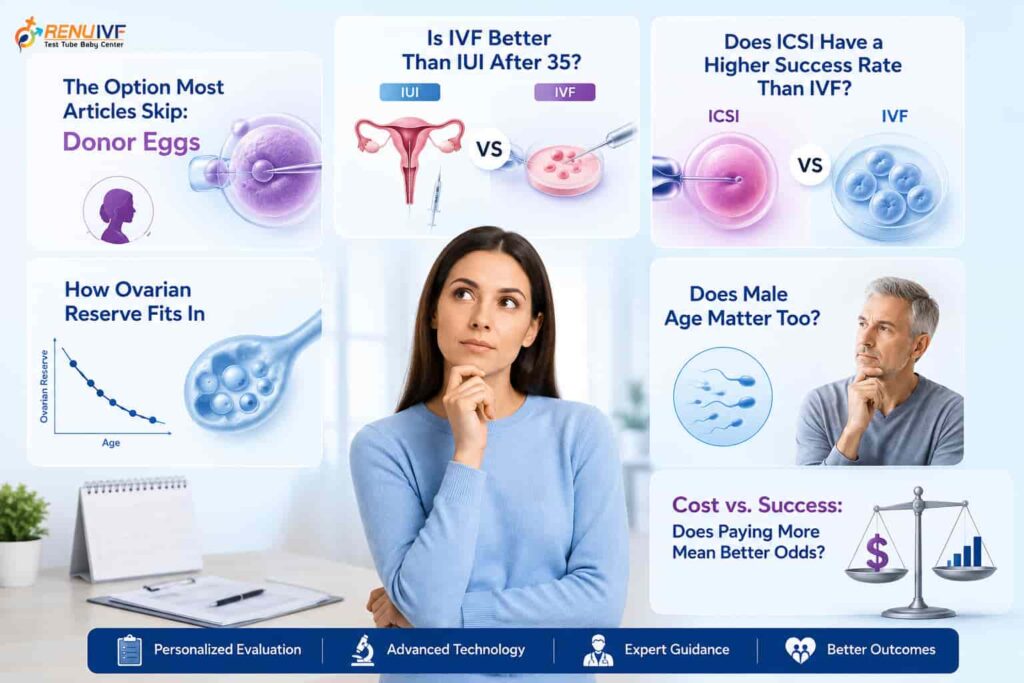
IVF success rates using donor eggs do not decline with the recipient’s age the same way. Because a younger donor’s eggs are being used, success rates for donor egg IVF stay comparatively high regardless of the recipient’s own age often in a similar range to IVF success rates for women under 35, though exact figures vary by clinic and should be requested directly.
If you’re over 40 and being quoted only “own-egg” success rates, ask explicitly about donor-egg statistics too. It’s a different decision with different implications (genetic relationship, cost, personal preference), but it deserves to be on the table, not omitted.
Is IVF Better Than IUI After 35?
Not automatically. The real question is whether IUI still has a reasonable chance for your specific situation regular ovulation, open tubes, decent sperm parameters. If ovarian reserve is low, tubes are blocked, endometriosis is significant, or male-factor infertility is present, repeated IUI cycles may not be the best use of time, especially as age narrows the window.
Does ICSI Have a Higher Success Rate Than IVF?
Not by default. ICSI improves fertilisation odds in specific situations (severe male-factor infertility, previous fertilisation failure) but higher fertilisation rate doesn’t automatically mean higher live-birth rate. Using ICSI without a clear medical indication isn’t a scientifically supported reason to expect better outcomes.
How Ovarian Reserve Fits In
AMH and antral follicle count estimate egg quantity and how the ovaries might respond to stimulation they don’t reliably measure egg quality. A woman can have normal AMH and still experience age-related decline in egg quality, or low AMH and still succeed. Doctors weigh age, ovarian reserve, fertility history and other clinical factors together no single number tells the whole story.
Does Male Age Matter Too?
Yes, though female age is generally the stronger factor because of egg aging. Male age can affect sperm motility and DNA integrity, which matters for fertilisation and embryo development in both IUI and IVF/ICSI. A semen analysis is a standard and important part of evaluation.
Cost vs. Success: Does Paying More Mean Better Odds?
No. IUI is generally cheapest, IVF costs more due to lab and procedural steps, and ICSI adds further lab cost. Cost reflects procedural complexity, not likelihood of success for your specific case the most expensive option isn’t automatically the most effective one for you, and the cheapest isn’t automatically inadequate. The decision should follow medical indication, not price.
Other Factors That Affect Success
- Ovarian reserve and egg quality
- Sperm count, motility, morphology
- Tubal condition
- Endometriosis
- Uterine health
- Embryo quality
- Prior pregnancies or treatment attempts
- Underlying medical conditions
- Lab and clinic-specific factors
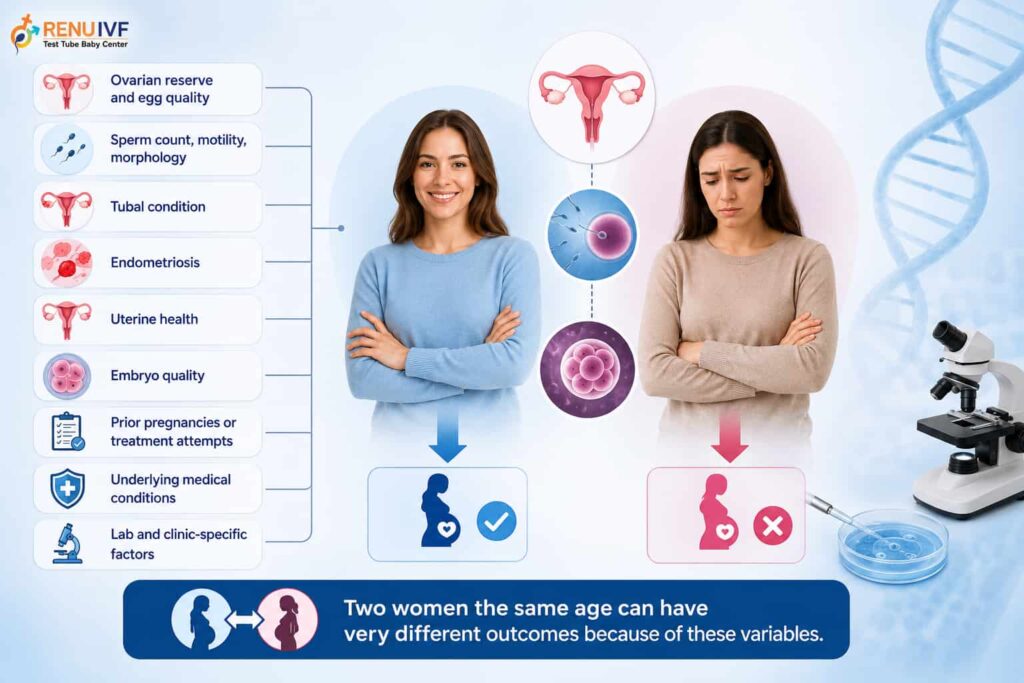
Two women the same age can have very different outcomes because of these variables.
When Should You See a Fertility Specialist?
Consider an evaluation sooner rather than later if:
- You’re 35+ and haven’t conceived after several months of trying
- You’re over 40
- Periods are irregular or absent
- Endometriosis is known or suspected
- Tubes may be blocked
- You’ve had recurrent miscarriage
- Male-factor infertility is known
- Previous fertility treatment failed
- Ovarian reserve may be reduced
Choosing Between IUI, IVF and ICSI Based on Age
Age should shape treatment planning early, but it shouldn’t be the only deciding factor. Example: a 32-year-old with blocked tubes may be advised IVF over IUI despite her age being favourable, while a 38-year-old with open tubes, regular ovulation and good sperm parameters may still be a reasonable candidate for IUI. ICSI may suit a younger couple with severe male-factor infertility, while offering no added benefit for an older woman without that indication.
Identify the cause of infertility first. Choose the treatment based on that not based on which one has the highest advertised success rate in general population statistics.
FAQs
Is IVF successful after 35?
Yes, pregnancy is still possible, but success rates using a woman’s own eggs generally decline with age.
What is the best age for IVF?
There’s no single “best” age. Success is generally higher at younger reproductive ages, but ovarian reserve and diagnosis matter alongside age.
Is IUI successful after 40?
Possible, but generally less likely than at younger ages. A doctor may recommend discussing IVF or donor-egg options depending on ovarian reserve and cause of infertility.
Is ICSI better than IVF for older women?
Not automatically. ICSI helps with male-factor infertility or prior fertilisation failure it doesn’t reverse age-related decline in egg quality.
Does low AMH mean IVF will fail?
No. Low AMH suggests reduced egg quantity and may affect how many eggs are retrieved, but it doesn’t predict failure on its own.
Does age affect egg quality?
Yes this is one of the main reasons treatment success declines with age.
Conclusion
Age is one of the most important factors in fertility treatment but not the only one, and not the whole story. IUI can suit selected younger patients with favourable conditions. IVF applies more broadly. ICSI helps specifically with sperm-related or fertilisation-failure cases. Donor eggs are a legitimate and effective option for older patients whose own egg quality has declined significantly, and shouldn’t be left out of the conversation.
Don’t choose a treatment because it has the highest advertised success rate in general statistics. Your specific age, ovarian reserve, sperm parameters, history and diagnosis need to be assessed together ideally by a fertility specialist who can walk through all the realistic options with you, including donor eggs where relevant.