

Treatment Guide
When couples try to get pregnant and nothing seems to work, one common reason is blocked fallopian tubes. Many women don’t even realize something is wrong at first. The tubes are inside the body, so there are no big warnings or loud symptoms. Things just stay quiet. And that can be confusing and stressful.
This blog explains things in a simple way so anyone can understand what happens, what the signs might be, and how doctors usually treat this condition. No complicated medical talk.
What Is Fallopian Tube?
Let’s quickly clear what is fallopian tube even means.
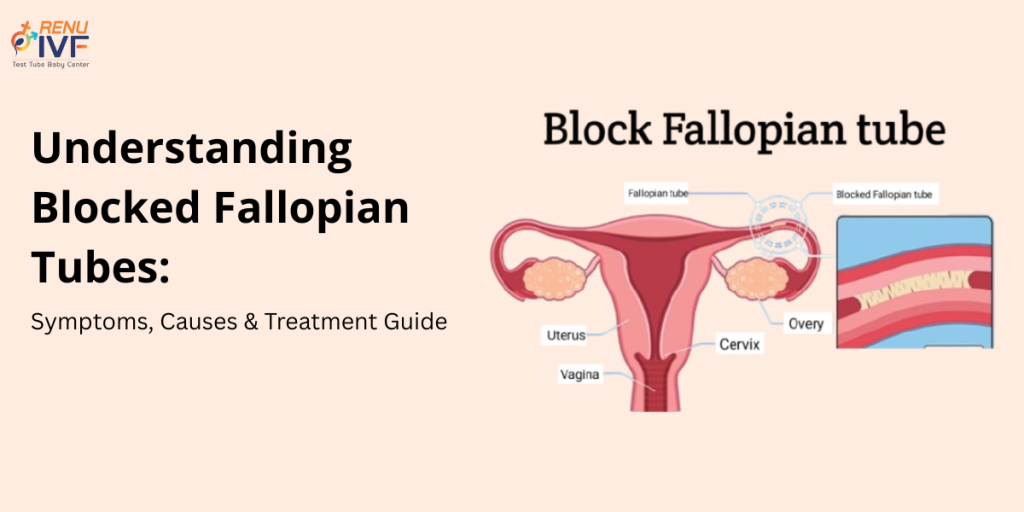
Every woman has two small tubes. One on the left, one on the right. These connect the ovaries to the uterus.
- The egg comes out from the ovary
- The fallopian tube picks it up
- Sperm meets egg inside the tube
- The fertilized egg then moves to the uterus
If the tube is blocked, the egg and sperm simply cannot meet. So, pregnancy gets difficult.
That’s basically it. No tubes working → harder to get pregnant.
What Are Blocked Fallopian Tubes?
Blocked fallopian tubes means there is something inside or around the tube that stops it from being open. It might be scarring tissue, infection, old swelling, fluid, or sometimes the tube collapses or sticks to nearby organs.
One or both tubes can be blocked. Some women only find out after trying for pregnancy for a long time.
Blocked Fallopian Tubes Symptoms
Many women have no clear blocked fallopian tubes symptoms, which is why this issue stays hidden for years. But there are a few signs that show up in some cases.
1. Trouble Getting Pregnant
This is the big one. If someone tries for months and nothing is happening, doctors check the tubes.
2. Mild Pain in Lower Belly
Not sharp pain. More like dull or annoying discomfort sometimes.
3. Unusual Discharge
If the blockage is because of old infection, the discharge may be thick or smelly at times.
4. Pain During Periods
Some women feel stronger period pain if the tubes are inflamed.
5. Pain During Intercourse
This is not always there, but it can happen.
Most women don’t get all these symptoms. Some don’t get any.
Signs of Blocked Fallopian Tubes
“Symptoms” are what women feel.
“Signs” are what doctors see during tests.
Common signs of blocked fallopian tubes include:
- No dye coming out of the tubes during HSG test
- Tubes look swollen with fluid (hydrosalpinx)
- Tubes stuck to ovaries
- Scar tissue inside pelvis
- Endometriosis marks near the tubes
These signs help confirm the diagnosis.
Causes of Blocked Tubes (Why This Happens)
There are a few common causes doctors see again and again.
Pelvic Inflammatory Disease (PID)
Past infections that were not treated fully can damage the tubes.
Endometriosis
This condition causes tissue to grow where it shouldn’t, including around the tubes.
Past Surgeries
C-section, appendix surgery, fibroid removal… all these can cause scar tissue.
Hydrosalpinx
Fluid collects inside the tube and makes it swollen and not useful.
Sexually Transmitted Infections (old ones too)
Even if treated, they may leave behind scars.
Tuberculosis (in some countries)
TB can also affect the tubes silently.
Some women never know how the blockage started. It just develops slowly.
How Blocked Tubes Affect Fertility
If only one tube is blocked, pregnancy can still happen through the other side.
But if both tubes are blocked, egg and sperm never meet naturally.
Hydrosalpinx (fluid-filled tube) also lowers IVF success because the fluid can leak into the uterus and disturb implantation.
So, treatment is needed.
How Doctors Test for Blocked Tubes
Here are the common tests used:
HSG (Dye X-Ray Test)
A dye is put inside the uterus. If the tubes are open, the dye spills out smoothly. If not, it stops.
SSG (Saline Test)
Saline is pushed into the uterus, and ultrasound shows how it moves.
Laparoscopy
A small camera goes into the body to see the tubes directly.
This shows the most accurate picture.
Ultrasound
Good for detecting hydrosalpinx.
Different women need different tests depending on symptoms.
Fallopian Tube Blockage Treatment Options
Now the main part: fallopian tube blockage treatment options. Treatment depends on how bad the block is and where exactly it is.
Here are the usual choices:
1. Medicines (Only for Infection)
If the blockage is because of infection and it’s early, antibiotics help prevent more damage.
But medicines can’t fix scarring already there.
2. Tubal Cannulation
If the blockage is near the uterus side of the tube, a small tool can gently push through and open it.
3. Laparoscopic Surgery
Used when scar tissue, endometriosis, or adhesions are causing the blockage.
Surgeons clear the area and free the tube.
4. Salpingostomy
If the tube’s end is sealed, a new opening is made.
5. Salpingectomy
If the tube is severely damaged (especially in hydrosalpinx), it is removed to improve chances in IVF.
6. IVF (In Vitro Fertilization)
This is the most successful method when both tubes are blocked.
IVF skips the tubes entirely.
Egg and sperm meet outside the body, and the embryo is placed in the uterus.
A lot of women with blocked tubes become mothers through IVF today.
Can Pregnancy Happen Naturally?
Yes — if only one tube is blocked and the other works fine. Many women get pregnant with one healthy tube.
If both tubes are blocked, natural pregnancy becomes unlikely without treatment.
Simple Tips to Keep Tubes Healthy
Not all blockages can be avoided, but these help:
- Treat infections quickly
- Practice safe sex
- Manage endometriosis early
- Avoid repeated abdominal surgeries unless needed
- Get regular check-ups
These steps protect reproductive health in the long run.
FAQs
1. What are the signs of blocked fallopian tubes?
Difficulty conceiving, mild pelvic pain, and unusual discharge are common signs.
2. Can blocked tubes open on their own?
No. Once scar tissue forms, medical treatment is needed.
3. Is IVF the only option?
Not always. Some blockages can be fixed with surgery.
4. Can I get pregnant if only one tube is blocked?
Yes, natural pregnancy is possible.
5. What causes fallopian tubes to get blocked?
Infections, endometriosis, hydrosalpinx, or past surgeries.
Conclusion
Blocked fallopian tubes are a common reason for infertility, but the condition is treatable. Understanding blocked fallopian tubes symptoms, recognizing early signs of blocked fallopian tubes, and choosing the right fallopian tube blockage treatment makes a major difference. With early diagnosis and proper treatment, many women conceive successfully and safely