
When couples think about fertility, the conversation often focuses on women. But male fertility plays an equally important role in conception, and at the center of it is a process called spermatogenesis. If sperm are not produced properly, natural pregnancy becomes difficult, no matter how healthy the female partner is. Understanding how sperm are made, what controls the process, and what can go wrong is the first step toward addressing fertility concerns early instead of waiting years to find answers.
This guide explains what is spermatogenesis, its meaning, the stages of spermatogenesis, the hormones involved, and how it compares to egg formation in women. We’ll also look at what can disrupt sperm production and when it’s time to consider male fertility treatment.
What Is Spermatogenesis?
So, what is spermatogenesis? In simple words, it is the biological process by which the male body produces sperm cells. This happens inside the testes, in thin coiled tubes called seminiferous tubules, where millions of sperm are created every single day.
The meaning of spermatogenesis becomes clearer when you break the word down. “Spermato” refers to sperm, and “genesis” means formation or creation. So the meaning of spermatogenesis is simply the formation and development of sperm cells from immature germ cells into fully mature sperm capable of fertilizing an egg.
Unlike women, who are born with a fixed number of eggs that gradually gets used up, men start producing sperm at puberty and continue doing so for most of their adult life. That said, sperm quality and quantity can decline with age, illness, or poor lifestyle habits, which is why spermatogenesis isn’t something to take for granted even though it happens automatically.
A few structures inside the male reproductive system work together to make this process possible:
| Part | Function |
| Testes | Produce sperm and testosterone |
| Seminiferous Tubules | Main site where spermatogenesis takes place |
| Sertoli Cells | Nourish and protect developing sperm cells |
| Leydig Cells | Produce testosterone |
| Epididymis | Stores sperm and helps them mature fully |
Each part has a specific job, and if any one of them isn’t functioning properly, sperm production can suffer as a result.
Describe the Process of Spermatogenesis
If someone asks you to describe the process of spermatogenesis, the easiest way to picture it is as a journey. It starts with a basic, immature cell and ends with a fully formed sperm that can swim and fertilize an egg. In between, that cell divides repeatedly, grows, splits its genetic material in half, and physically reshapes itself into something built for movement.
The entire journey, from the first cell division to a sperm ready for ejaculation, takes around 75 to 90 days. That includes the roughly 64 to 74 days spent inside the testes, plus another 10 to 14 days maturing inside the epididymis. This is also why doctors usually ask men to wait about three months after a lifestyle change, medication, or surgery before repeating a semen analysis the body needs that much time to produce a completely new batch of sperm.
Stages of Spermatogenesis
The stages of spermatogenesis can be grouped into four main phases. Each one plays a distinct role, and skipping or disrupting any stage affects the final sperm quality.
| Stage | What Happens |
| Multiplication Stage | Germ cells divide repeatedly to keep producing new cells |
| Growth Stage | Cells enlarge and prepare their DNA for division |
| Maturation Stage | Cells divide through meiosis, cutting chromosomes in half |
| Spermiogenesis | Round cells reshape into sperm with a head and tail |
Multiplication stage. This stage begins with cells called spermatogonia, sitting inside the seminiferous tubules. These cells divide through mitosis, meaning one cell splits into two identical ones. Some of these stay behind as a reserve for future sperm production, while others move ahead in the process. This is what allows sperm production to continue day after day without ever running out of starting material.
Growth stage. The cells that move forward, now called primary spermatocytes, start growing larger. They absorb nutrients and copy their DNA in preparation for the next stage. No sperm are formed yet at this point this stage is essentially preparation work.
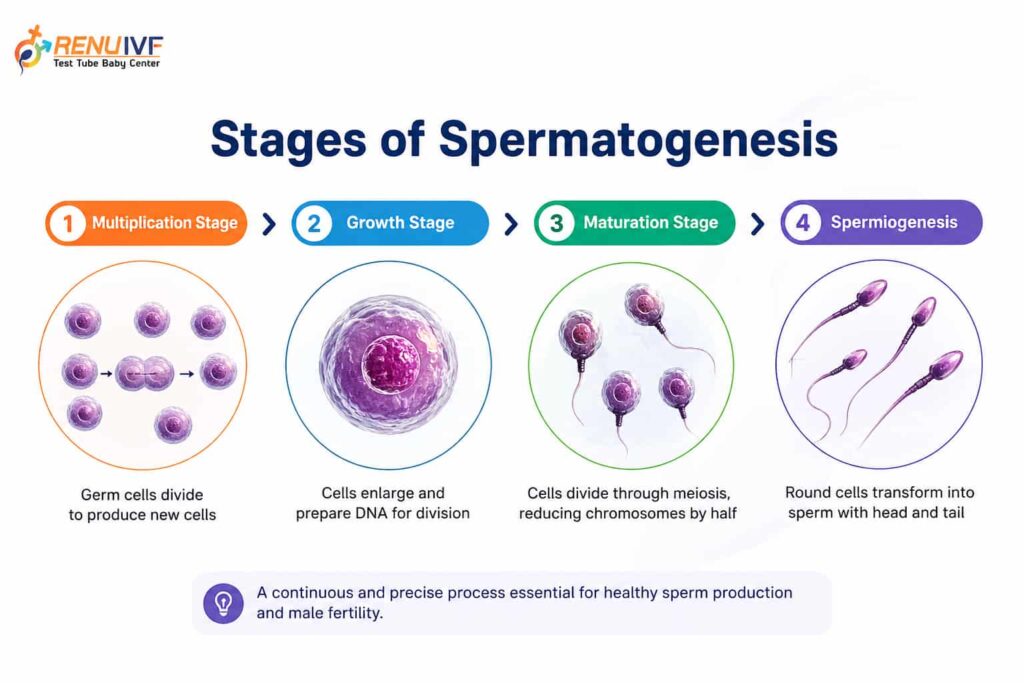
Maturation stage. This is arguably the most important part of the entire process. The primary spermatocytes go through two rounds of division known as meiosis I and meiosis II. The purpose of this is to cut the chromosome count in half, from 46 down to 23. This matters because when sperm eventually fuses with an egg (which also carries 23 chromosomes), the resulting embryo gets the full, normal set of 46. By the end of this stage, small round cells called spermatids have formed.
Spermiogenesis. Spermatids can’t swim or fertilize anything yet they still need to transform physically. During spermiogenesis, no cell division happens; instead, the cell reshapes itself. A head forms to hold genetic material, a tail develops for movement, energy-producing structures form in the midsection, and extra cellular material is shed so the sperm becomes streamlined. What comes out the other end looks like the sperm most people picture.
Even after spermiogenesis, sperm aren’t fully functional. They move to the epididymis, where they spend one to two more weeks learning to swim properly and gaining the ability to fertilize an egg. Without this final stretch, sperm would be present but essentially useless for conception.
Hormones That Control Spermatogenesis
Sperm production doesn’t happen in isolation — it’s controlled by a hormonal feedback loop between the brain and the testes.
| Hormone | Produced By | Role |
| GnRH | Hypothalamus | Triggers release of FSH and LH |
| FSH | Pituitary gland | Stimulates sperm production directly |
| LH | Pituitary gland | Signals testes to produce testosterone |
| Testosterone | Testes | Supports sperm development and male reproductive function |
Testosterone gets most of the public attention, but it’s really just one part of a chain reaction. The hypothalamus releases GnRH, which tells the pituitary gland to release FSH and LH, which then act on the testes to stimulate both testosterone production and sperm development directly. If any hormone in this chain is off too high, too low, or blocked sperm production can slow down or stop altogether.
It’s worth noting that testosterone supplements, when taken without medical supervision, can actually suppress natural sperm production instead of helping it. The body senses the extra testosterone and reduces its own signaling through GnRH, LH, and FSH, which paradoxically lowers sperm count. Anyone considering hormone therapy for fertility reasons should talk to a specialist first rather than self-medicating.
What Can Affect Spermatogenesis
Several everyday habits and medical conditions can interfere with healthy sperm production. Some are easy to fix, while others need proper medical evaluation.
Lifestyle-related factors include:
- Smoking and excessive alcohol use
- Poor diet and obesity
- Lack of physical activity
- Chronic stress and poor sleep
- Frequent exposure to heat around the testes (saunas, hot tubs, laptops on the lap)
Medical conditions that can interfere include:
- Varicocele (enlarged veins in the scrotum that raise testicular temperature)
- Hormonal imbalances involving FSH, LH, or testosterone
- Infections such as mumps orchitis or sexually transmitted infections
- Diabetes and other chronic illnesses
- Genetic conditions like Klinefelter syndrome
- Past chemotherapy or radiation treatment
Most men with poor spermatogenesis don’t notice obvious symptoms. The most common way it’s discovered is simply through difficulty conceiving after a year of trying, which is usually when a semen analysis and hormone tests come into the picture.
Difference Between Spermatogenesis and Oogenesis
People often confuse how sperm and egg production compare, so it helps to look at the difference between spermatogenesis and oogenesis side by side.
| Feature | Spermatogenesis | Oogenesis |
| Occurs in | Testes | Ovaries |
| Produces | Sperm | Eggs |
| Begins | At puberty | Before birth |
| Continues until | Most of adult life | Menopause |
| Quantity | Millions produced daily | Usually one egg per month |
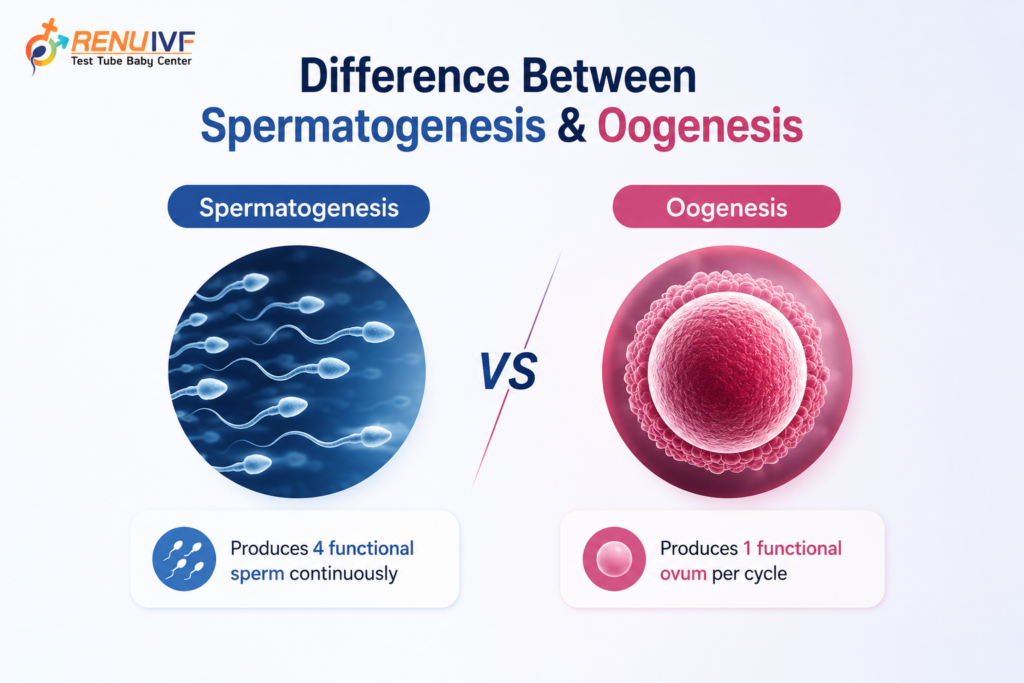
| Final product | Four sperm from one starting cell | One egg from one starting cell |
The biggest difference between spermatogenesis and oogenesis is timing and continuity. Spermatogenesis is a constant, ongoing process a man’s body is always producing new sperm. Oogenesis, on the other hand, is essentially fixed before birth; a woman doesn’t create new eggs later in life, she simply releases one from her existing supply each month until menopause.
This distinction matters practically. Because sperm are made fresh continuously, lifestyle improvements in a man’s habits today can show up in better sperm quality within about three months. Egg quality, by contrast, is far less responsive to short-term lifestyle changes since the eggs were already formed decades earlier.
How to Support Healthy Spermatogenesis Naturally
Not every fertility issue can be fixed through lifestyle alone, but healthy daily habits genuinely do support better sperm production over time. A few changes worth making:
- Eat a balanced diet with fruits, vegetables, lean protein, nuts, and whole grains
- Maintain a healthy body weight through regular exercise
- Sleep 7 to 9 hours a night consistently
- Manage stress through activities like walking, yoga, or hobbies
- Cut back on smoking and alcohol
- Avoid prolonged heat exposure to the testes
None of these guarantee results on their own, especially if there’s an underlying medical cause, but they create the best possible conditions for the body’s natural process to work well.
When to Seek Male Fertility Treatment
If a couple hasn’t conceived after a year of regular, unprotected intercourse, it’s reasonable to get the male partner evaluated alongside the female partner. Male fertility treatment isn’t just for men with an obvious problem sometimes sperm count and hormone levels look fine on the surface but subtle issues with motility or shape are affecting fertilization.
Evaluation usually starts with a semen analysis, checking sperm count, movement, and shape, followed by hormone testing if numbers look abnormal. Depending on the cause, treatment could involve lifestyle changes, medication to correct hormonal imbalance, surgery for conditions like varicocele, or assisted reproductive techniques such as IUI, IVF, or ICSI when natural conception isn’t working despite other treatment.
Choosing the right clinic matters as much as the treatment itself. A top IVF centre in Kanpur will typically offer detailed semen analysis, hormone panels, and access to advanced techniques like ICSI under one roof, so couples aren’t shuttled between multiple labs and specialists during an already stressful process.
It’s worth seeing a specialist sooner rather than later if there’s a history of testicular injury or surgery, hormonal disorders, recurrent miscarriage, or previous chemotherapy or radiation these situations benefit from earlier evaluation rather than waiting the full year.
Frequently Asked Questions
1. What are the 5 stages of spermatogenesis in order?
Spermatogenesis is generally described in 4 stages: the multiplication stage (germ cells divide), growth stage (cells enlarge and prepare DNA), maturation stage (meiosis halves the chromosome number to 23), and spermiogenesis (cells reshape into mature sperm with a head and tail). Some sources split maturation into two sub-steps to count it as 5, but there’s no universally recognized fifth stage beyond these four core steps.
2. What are the three main types of sperm?
Sperm aren’t divided into fixed “types” —this usually refers to the three parameters checked in a semen analysis: sperm count (concentration), motility (movement), and morphology (shape). A sperm sample is evaluated as normal or abnormal based on these three factors rather than being sorted into separate categories.
3. What happens after 74 days of spermatogenesis?
After around 64–74 days inside the testes, sperm move to the epididymis, where they spend another 10–14 days maturing, gaining the ability to swim properly, and becoming capable of fertilizing an egg before being stored until ejaculation.
4. Which hormone is important for spermatogenesis?
Testosterone and FSH (Follicle Stimulating Hormone) are the two most important hormones FSH stimulates sperm production directly inside the testes, while testosterone, triggered by LH, supports and sustains the entire process.
Final Thoughts
Spermatogenesis is a continuous, tightly regulated process that plays a central role in male fertility. Understanding what is spermatogenesis, its stages, and the hormones that drive it helps explain why sperm health isn’t just about numbers on a report it’s about a multi-week biological process that can be affected by everyday habits as much as by underlying medical conditions.
If you and your partner are facing difficulty conceiving, don’t wait too long to get evaluated. Renu IVF, known as a top IVF centre in Kanpur, offers thorough fertility evaluation and personalized male fertility treatment for couples at every stage of their journey. With experienced specialists and a patient-first approach, Renu IVF works closely with couples to identify the root cause of infertility and guide them toward the most effective path to parenthood.