

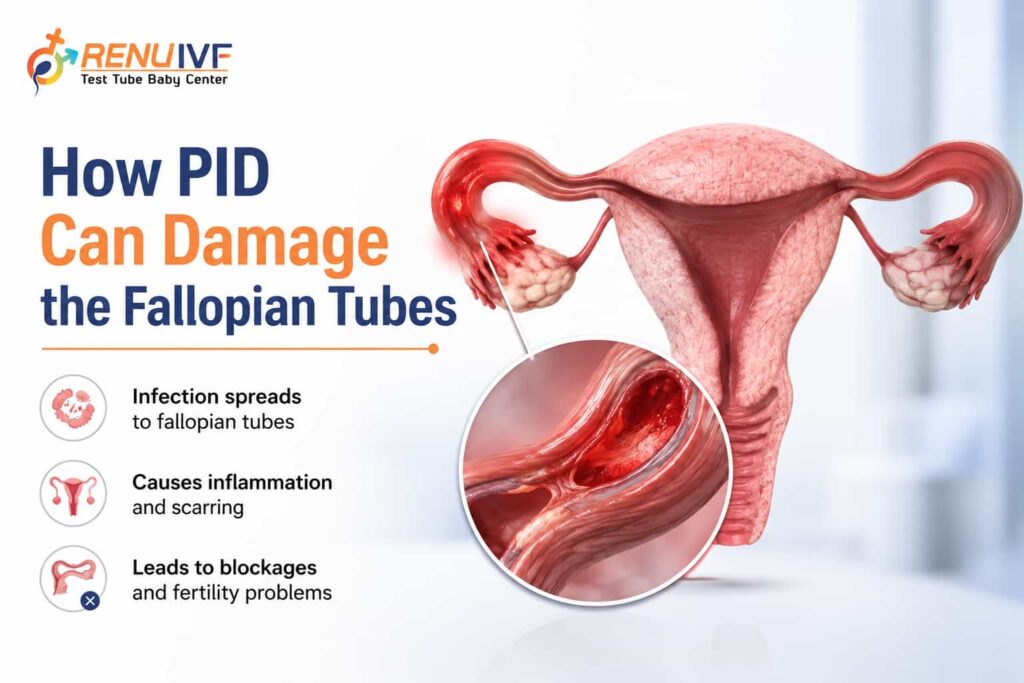
Pelvic Inflammatory Disease, or PID, is one of the leading and most underestimated causes of female infertility. Part of what makes pid disease dangerous is that it doesn’t always cause obvious symptoms. A woman can go through an active infection with nothing more than mild discomfort, while the infection itself does lasting damage to the reproductive organs, particularly the fallopian tubes.
The fallopian tubes carry the egg from the ovary to the uterus and are where fertilization normally happens. When they become inflamed, scarred, or blocked because of an untreated pelvic infection, natural conception becomes significantly harder sometimes impossible without medical intervention.
This blog explains how PID develops, how it damages the fallopian tubes specifically, what pid symptoms and pelvic infection symptoms actually look like, and what pid treatment options exist once damage has occurred.
What Is PID and How Does It Start?
PID disease begins as an infection in the lower reproductive tract usually the vagina or cervix and spreads upward if it isn’t treated. Most cases trace back to untreated sexually transmitted infections like chlamydia or gonorrhea, though PID can also follow childbirth, miscarriage, abortion, or certain gynecological procedures where bacteria enter the uterus.
| Organ | Function |
| Ovaries | Produce eggs and hormones |
| Fallopian tubes | Carry the egg to the uterus; site of fertilization |
| Uterus | Supports pregnancy |
| Cervix | Connects uterus to vagina |
Of these, the fallopian tubes are the most fragile. They’re lined with cilia tiny hair-like structures that physically move the egg along and even mild, prolonged inflammation can damage this mechanism permanently.
Common Causes and Risk Factors
| Risk Factor | Why It Matters |
| Untreated STIs | Most common trigger for pid disease |
| Multiple sexual partners | Increases exposure risk |
| Previous PID episode | Raises recurrence risk significantly |
| Delayed treatment of vaginal infections | Gives bacteria time to spread upward |
| Recent childbirth or miscarriage | Creates an entry point for bacteria |
| Poor genital hygiene | Minor contributing factor |
Not every pelvic infection becomes PID. But an untreated one has a real chance of progressing, which is exactly why catching it early matters more than most women realize.
From Pelvic Infection to Blocked Fallopian Tubes: How the Damage Happens
A pelvic infection is the early stage; PID is what it becomes once bacteria move past the cervix into the uterus, tubes, and sometimes the ovaries. The progression generally follows four stages:
- Infection begins — bacteria enter the tract, symptoms are often minimal or absent
- Inflammation increases — tubes swell, cilia begin sustaining damage
- Scar tissue forms — as the body heals, scarring narrows the inside of the tube
- Blocked fallopian tubes develop — in severe or repeated cases, one or both tubes close off completely
Once scarring reaches stage four, the egg has no reliable path to the uterus, and sperm may not reach the egg at all. This is the direct mechanical reason PID causes infertility it isn’t hormonal, it’s structural.
Recognizing PID Symptoms and Pelvic Infection Symptoms
Pelvic infection symptoms typically show up first and are often milder: persistent lower abdominal discomfort, mild changes in vaginal discharge, occasional pain during urination, and mild pelvic tenderness.
As the infection progresses into full PID, symptoms tend to intensify:
- Pain in the lower abdomen or pelvis
- Unusual or foul-smelling vaginal discharge
- Pain during intercourse
- Burning sensation while urinating
- Irregular or heavy menstrual bleeding
- Fever and chills
- Fatigue
- Nausea
- Difficulty conceiving after months of trying
Seek emergency care immediately if you experience severe abdominal pain, high fever with chills, or bleeding that won’t stop these can indicate a ruptured abscess or an ectopic pregnancy, both medical emergencies.

The core problem with pid symptoms is that they’re easy to dismiss as something minor. Many women only connect the dots after struggling to conceive.
Diagnosing PID and Tubal Damage
Diagnosis combines medical history, physical examination, and targeted testing.
| Test | Purpose |
| Pelvic examination | Checks for tenderness and infection |
| Blood tests | Detects inflammation markers |
| Vaginal swab | Identifies the causative bacteria |
| STI testing | Rules in/out chlamydia, gonorrhea |
| Ultrasound | Detects swollen tubes or abscess |
| Laparoscopy | Direct visualization when needed |
If fertility concerns arise afterward, doctors specifically test tubal patency:
| Test | What It Checks |
| HSG (Hysterosalpingography) | Whether dye flows freely through the tubes |
| Sonosalpingography | Tubal patency via ultrasound and fluid |
| Diagnostic laparoscopy | Direct examination of tubes and pelvic organs |
Chronic Pelvic Pain: A Complication That Outlasts the Infection
One of the most common long-term effects of pid disease is chronic pelvic pain, which develops when scar tissue pulls on surrounding tissue and organs. Some women feel this constantly; others notice it mainly during intercourse, menstruation, or physical activity.
Chronic pelvic pain matters clinically for a specific reason: it can persist long after antibiotics have cleared the actual infection, because scar tissue doesn’t resolve the way an active infection does. Persistent pain after treatment should always be re-evaluated, not assumed to be normal.
Ectopic Pregnancy Risk After PID
Scarring that partially not fully narrows a fallopian tube creates a specific and serious danger: ectopic pregnancy risk. If a fertilized embryo can’t travel freely through a narrowed tube, it may implant inside the tube itself instead of reaching the uterus.
This is a medical emergency. A tubal ectopic pregnancy can rupture the tube and cause severe internal bleeding, requiring immediate surgical intervention.
| Cause | Effect on Ectopic Pregnancy Risk |
| Damaged cilia | Slows embryo movement through the tube |
| Scar tissue | Physically narrows the tube |
| Partial blockage | Traps the embryo before it reaches the uterus |
| Repeated infection | Compounds damage, raising risk further |
This is why even a mild or “resolved” PID episode still warrants monitoring in a future pregnancy the anatomical risk doesn’t disappear just because symptoms did.
PID Treatment: What It Can and Can’t Reverse
Pid treatment for active infection is antibiotics oral for milder cases, IV for more severe or complicated infections, sometimes requiring hospital admission if an abscess has formed. Completing the full antibiotic course matters even if symptoms resolve quickly, since an incompletely treated infection can smolder and cause further damage.
What antibiotics cannot do is undo existing scar tissue. This is the honest limitation of pid treatment: it stops ongoing damage, it doesn’t reverse damage that’s already occurred.

Surgery becomes relevant when:
- A pelvic abscess doesn’t respond to antibiotics
- Scar tissue causes ongoing pain or fertility problems
- Blocked fallopian tubes are confirmed and affecting fertility
- An ectopic pregnancy has developed
In these cases, a laparoscopic surgeon may recommend minimally invasive surgery to remove adhesions, evaluate tubal condition directly, or address a fluid-filled tube (hydrosalpinx) before proceeding to fertility treatment.
Can You Get Pregnant After PID?
Yes but the honest answer depends on timing and severity. Women treated early, before significant scarring develops, often retain normal fertility. Women with repeated infections or delayed treatment face meaningfully higher risk: roughly 10-15% infertility risk after a single PID episode, rising substantially with each additional episode.
| Situation | Typical Path Forward |
| One tube open, mild scarring | Natural conception or IUI |
| Localized adhesions only | Laparoscopic surgery, then reassess |
| Both tubes blocked | IVF |
When blocked fallopian tubes affect both sides, IVF becomes the direct path because it bypasses the tubes entirely eggs are retrieved, fertilized in a lab, and the embryo is transferred straight into the uterus.
Preventing PID and Protecting Future Fertility
- Treat any pelvic infection immediately rather than waiting to see if it resolves
- Complete the full antibiotic course, even after symptoms improve
- Practice safe sex and get tested for STIs regularly
- Disclose any past PID episode to your doctor before trying to conceive
- Attend follow-up appointments after treatment, not just the initial visit
Frequently Asked Questions
What’s the difference between a pelvic infection and PID?
A pelvic infection is the earlier, more contained stage. PID is what develops once that infection spreads to the uterus, fallopian tubes, or ovaries.
Is chronic pelvic pain permanent?
Not always, but it can persist after the infection itself is gone if scar tissue has formed. It should be evaluated separately from the original infection.
Can I still get pregnant naturally with one blocked tube?
Often yes, provided the other tube is open and ovulation is otherwise normal.
How is ectopic pregnancy risk managed for women with a PID history?
Through earlier and more frequent monitoring in early pregnancy, since anatomical risk from past scarring doesn’t disappear even after successful treatment.
Conclusion
PID doesn’t have to end in infertility, but treating early symptoms as minor is what most often leads to permanent damage. Recognizing pid symptoms and pelvic infection symptoms without delay, completing pid treatment fully, and following up on chronic pelvic pain or fertility concerns afterward are what actually determine long-term outcomes not luck.
For women facing fertility challenges after PID, Renu IVF evaluates the actual extent of tubal damage before recommending a path forward, whether that means laparoscopic surgery, IUI, or IVF. As a leading IVF centre in Kanpur, the approach starts with what’s salvageable, not a default jump to IVF. If you need assessment from an IVF expert in Kanpur, or evaluation by a laparoscopic surgeon in Kanpur for suspected tubal damage or blocked fallopian tubes, earlier evaluation means more options not just a higher success rate later.