
Most doctors will tell you “wait till 12 weeks.” That answer is incomplete and for IVF patients, it can be dangerous to follow blindly.
IVF pregnancy comes with stage-specific risks, and its monitoring differs significantly from a natural pregnancy. The key milestones also follow a different pattern. This guide breaks everything down week by week helping you understand when risks start to decline, what warning signs to watch for, and what level of care to expect from your ivf centre at each stage.
Why IVF Pregnancy Is Not the Same as Natural Pregnancy
Before getting to the week-by-week breakdown, this needs to be said clearly: IVF pregnancies are medically different from natural pregnancies in the early weeks, not because something is wrong, but because of how they begin.
- The embryo is transferred directly into the uterus implantation monitoring is more critical
- Progesterone and estrogen are given externally hormonal crashes can happen if support is stopped too early
- OHSS (Ovarian Hyperstimulation Syndrome) risk is still active in early weeks
- Multiple pregnancy risk is higher twins and triplets carry more complications
- The emotional and psychological load is heavier anxiety can affect physical symptoms
Because of all this, the question “after how many weeks is IVF pregnancy safe” does not have one single answer. It has several milestones, each one reducing a specific risk.

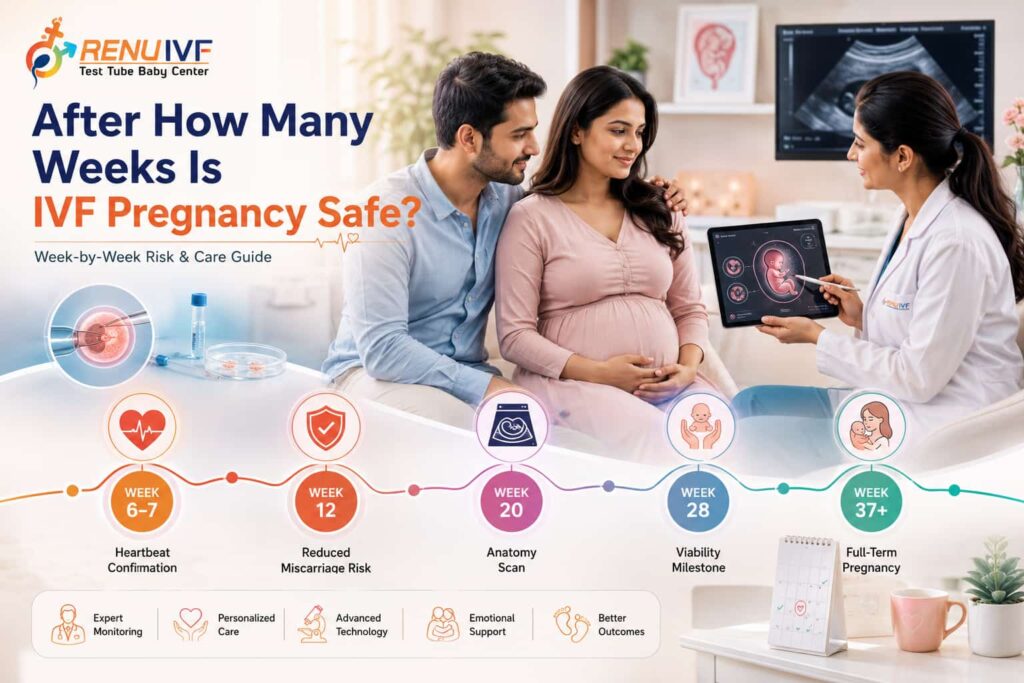
The Most Important Milestones – Quick Overview
| Milestone | What It Means |
| Week 6–7 | Heartbeat confirmed – miscarriage risk drops significantly |
| Week 8 | Progesterone support decision point |
| Week 10 | OHSS risk mostly resolved |
| Week 12 | First trimester screening done – chromosomal risk assessed |
| Week 16 | Second trimester – most stable phase begins |
| Week 20 | Anatomy scan – major structural check |
| Week 28 | Viability milestone – baby can survive with NICU support |
| Week 34–36 | Safe delivery zone for most IVF pregnancies |
Week-by-Week Risk and Care Guide
Weeks 1–2: Embryo Transfer to Implantation
This is the two-week wait – the most anxious phase for any IVF patient.
What is happening:
- Embryo is settling into the uterine lining
- Beta hCG (pregnancy hormone) begins to rise if implantation is successful
- No visible signs of pregnancy yet
What the risks are:
- Failed implantation – the embryo does not attach
- Chemical pregnancy – hCG rises briefly then falls
- Very early miscarriage before clinical pregnancy is confirmed
What you should do:
- Follow all progesterone and estrogen support prescriptions exactly – missing a dose in this window is high risk
- Avoid heavy lifting, intense exercise, and heat exposure
- No home pregnancy test before day 14 – it gives false readings either way
- Rest, but complete bed rest is not required and not proven to help
What Renu IVF does at this stage:
- Beta hCG blood test on day 14 post transfer
- Second beta hCG 48 hours later to confirm it is doubling correctly – this is more important than the first number
Weeks 3-5: Positive Test to First Ultrasound
Your pregnancy is confirmed. But clinically, this is still fragile territory.
What is happening:
- The gestational sac is forming inside the uterus
- hCG should be doubling every 48 hours
- No heartbeat visible yet – this is normal
What the risks are:
- Ectopic pregnancy – in IVF this is rare but possible; embryo may implant outside the uterus even after transfer
- Blighted ovum – sac forms but no embryo develops inside
- Subchorionic hematoma – small bleeding under the placenta, more common in IVF
Warning signs to report immediately:
- Any bright red bleeding
- Severe one-sided pelvic pain
- Bloating with difficulty breathing – possible OHSS
What you should do:
- Continue all hormone medications – do not stop progesterone even if you feel fine
- Avoid NSAIDs (ibuprofen, aspirin) unless prescribed – harmful in early pregnancy
- Light walking is fine; no running, swimming, or gym
Weeks 6–7: The Heartbeat Scan – First Major Milestone
This is the single most important early scan in any IVF pregnancy.
What is happening:
- Fetal heartbeat should be visible on ultrasound
- Normal fetal heart rate: 90–110 bpm at 6 weeks, rising to 150-170 bpm by 7 weeks
- Yolk sac and fetal pole become visible
Why this milestone matters: Once a strong heartbeat is confirmed at 7 weeks, the miscarriage risk drops from approximately 25-30% to under 5% in IVF pregnancies. This is the first real safety checkpoint.
What the risks are:
- No heartbeat detected – requires repeat scan in 1 week before any decision is made
- Slow heartbeat (under 90 bpm at 6 weeks) – higher miscarriage risk, needs close monitoring
- Subchorionic bleed – spotting is common; not always dangerous but needs assessment
What you should do:
- Attend this scan – do not skip it even if you feel well
- If bleeding occurs before this scan, call your clinic the same day
- Hydration is important – low fluid intake increases cramping risk
Weeks 8-10: Hormone Support Review and OHSS Resolution
Week 8 is where most clinics begin tapering progesterone support. This needs to be done carefully.
What is happening:
- The placenta begins taking over hormone production
- External progesterone and estrogen can start to be reduced – but only under supervision
- OHSS, if it occurred after egg retrieval, should be resolving by week 10
Why week 8 matters for IVF specifically: Many miscarriages in IVF patients between weeks 8–10 happen because progesterone was stopped too early or tapered too fast. The placenta does not always take over instantly. This is a known IVF-specific risk that gets very little attention.
What you should do:
- Never stop progesterone on your own – always follow your doctor’s tapering schedule
- If you were on vaginal progesterone suppositories, some spotting when reducing the dose is normal
- OHSS warning signs that should still be watched: severe abdominal bloating, nausea, reduced urination, weight gain of more than 1 kg in 24 hours
Weeks 10–12: First Trimester Screening – The Genetic Checkpoint
This is where the bigger picture of the pregnancy’s health becomes clearer.
What is happening:
- NT scan (Nuchal Translucency) measures risk of chromosomal conditions like Down syndrome
- NIPT (Non-Invasive Prenatal Testing) can be done from week 10 – a blood test that checks fetal DNA
- First trimester combined screening includes NT scan + blood markers (beta hCG + PAPP-A)
Why this matters for IVF patients: IVF pregnancies – especially in women over 35 or those with recurrent miscarriage – have a slightly higher rate of chromosomal abnormalities. NIPT is not mandatory, but it gives you important information early.
What you should do:
- Book NT scan between weeks 11 and 13 weeks 6 days – the window is strict
- Discuss NIPT with your doctor if you are over 35, have had previous miscarriages, or had a Day 5 embryo (blastocyst) transfer
- If you did PGT-A testing on embryos before transfer, chromosomal risks are already significantly lower
Week 12: The “Safe Zone” Everyone Talks About – What It Actually Means
By week 12, miscarriage risk has dropped to under 2% for most pregnancies including IVF. This is why it is commonly called “safe.”
But safe from what, exactly:
- Safe from most miscarriages – yes
- Safe from all complications – no
- Safe from preterm birth risk – no
- Safe from placenta problems – no
- Safe from gestational diabetes – no
The 12-week milestone is real, but it is the beginning of safety, not the end of monitoring. For IVF pregnancies especially, the care does not reduce at 12 weeks – it shifts focus.
Weeks 13-19: Second Trimester Begins – Relative Stability
This is typically the most comfortable phase physically.
What is happening:
- Risk of miscarriage is now very low
- Energy often improves, nausea reduces
- Uterus grows out of the pelvis and becomes abdominal
- Baby’s organs are formed and developing
What IVF-specific risks remain:
- Cervical incompetence – more common in women with uterine anomalies or previous uterine surgeries; can cause late second trimester loss
- Placenta previa – where placenta partially covers the cervix; needs monitoring
- Multiple pregnancy complications if carrying twins – growth restriction, preterm labour risk
What you should do:
- Attend all scheduled antenatal appointments – do not assume everything is fine because you feel well
- If carrying twins, your monitoring schedule will be more frequent than singleton
- Watch for any watery or bloody discharge – can indicate cervical issues
Week 20: The Anatomy Scan – Second Major Milestone
This is the most detailed scan in the entire pregnancy.
What is checked:
- Brain, spine, heart, kidneys, limbs, face
- Placenta position
- Amniotic fluid levels
- Cervical length (important for preterm risk)
Why this matters for IVF: IVF pregnancies have a modestly higher rate of placenta previa and low-lying placenta. If found at 20 weeks, most cases resolve by 32–34 weeks, but it needs follow-up.
What you should do:
- Do not skip this scan even if your 12-week results were normal – it checks different things
- Ask specifically about cervical length – a cervix under 25mm at 20 weeks is a preterm risk factor
- If anomalies are found, do not panic – many are minor and some resolve; get a second opinion if needed
Weeks 20–27: The Growth Phase
What to monitor:
- Fetal growth scan every 4 weeks is standard; every 2–3 weeks if carrying twins
- Gestational diabetes screening between weeks 24–28
- Blood pressure monitoring – preeclampsia risk is higher in IVF pregnancies
IVF-specific risk in this window: Preeclampsia (high blood pressure in pregnancy) is statistically more common in IVF pregnancies, particularly in donor egg cycles. Symptoms include:
- Headache that does not go away
- Swelling of face and hands (not just feet)
- Visual disturbances
- Upper abdominal pain
Report any of these the same day – do not wait for your next appointment.
Week 28: Viability – The Third Major Milestone
At 28 weeks, a baby born prematurely has a greater than 90% chance of survival with NICU support. This is the viability milestone.
This does not mean 28 weeks is the goal. It means if premature labour happens after this point, the medical team has strong tools to help.
What happens at this stage:
- Growth scan and Doppler to check blood flow through the umbilical cord
- Anti-D injection for Rh-negative mothers
- Discussion of birth plan begins
- Iron and calcium supplementation review
Weeks 28-36: Monitoring Intensifies
This is where most high-risk IVF pregnancies require closer surveillance.
- Fetal growth scans every 2-4 weeks
- Non-stress test (NST) may be done to check baby’s heart rate patterns
- Preterm labour symptoms to watch: regular tightening before week 37, low back pain that comes and goes, watery discharge or bleeding
If carrying twins conceived via IVF:
- Delivery is often planned at 36–37 weeks even without complications
- Risk of twin-to-twin transfusion syndrome (TTTS) in identical twins needs regular monitoring from week 16 onward
Weeks 37–40: Full Term
At 37 weeks, the pregnancy is considered full term. For IVF singleton pregnancies without complications, delivery between 38–40 weeks is the standard goal.
For IVF pregnancies specifically:
- Many fertility specialists recommend not going past 40 weeks – placental function can decline and the risk of stillbirth, while small, increases after 40 weeks in IVF pregnancies
- Induction of labour at 39–40 weeks is often discussed proactively
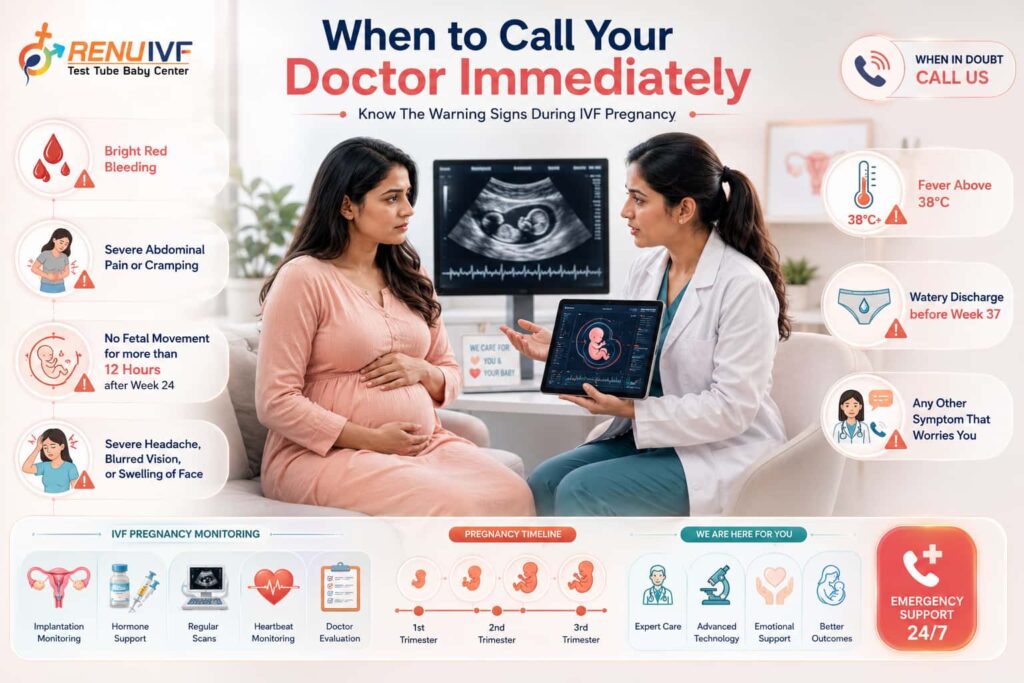
When to Call Your Doctor Immediately – At Any Week
Do not wait for your next appointment if you experience:
- Bright red bleeding at any stage
- Severe abdominal pain or cramping
- No fetal movement for more than 12 hours after week 24
- Severe headache, blurred vision, or swelling of face
- Fever above 38°C
- Watery discharge before week 37
Frequently Asked Questions
After how many weeks is IVF pregnancy safe from miscarriage? The risk drops significantly after a heartbeat is confirmed at 6-7 weeks, and falls below 2% after week 12. However, IVF pregnancies need close monitoring beyond 12 weeks for other risks like preterm birth and preeclampsia.
Is an IVF pregnancy more risky than a natural pregnancy? In the first trimester, yes – slightly higher miscarriage risk and OHSS risk. After 12 weeks, the pregnancy itself is similar to a natural pregnancy, but monitoring is more intensive because of the background of fertility treatment.
When can I stop progesterone injections or suppositories in IVF? Usually between weeks 8 and 12, depending on your protocol. Never stop without your doctor’s guidance – early stopping is a known cause of early IVF pregnancy loss.
Is bed rest needed in IVF pregnancy? No. Complete bed rest is not evidence-based and is not recommended. Light activity is safe and often beneficial. Avoid strenuous exercise in the first trimester.
Can I travel during IVF pregnancy? After heartbeat confirmation and before week 32 is generally the safest travel window. Avoid long-haul flights in the first trimester and after week 32 unless cleared by your doctor.
The Renu IVF Approach to Pregnancy Monitoring
At Renu IVF, Kanpur, we do not discharge you after embryo transfer and tell you to see a regular OB. We follow IVF pregnancies through the critical early weeks with structured monitoring:
- Beta hCG on day 14 and day 16 post transfer
- First scan at 6 weeks for heartbeat confirmation
- Hormone tapering done under direct supervision, not by protocol alone
- High-risk pregnancy coordination with maternal-fetal medicine if needed
- Patient available on call for any warning signs – no waiting
If you are currently in an IVF cycle, pregnant after IVF, or planning your first transfer and want to understand what monitoring looks like – book a consultation with Dr. Renu Singh Gahlaut.
Book Your Consultation 📍 Renu IVF, Kanpur