
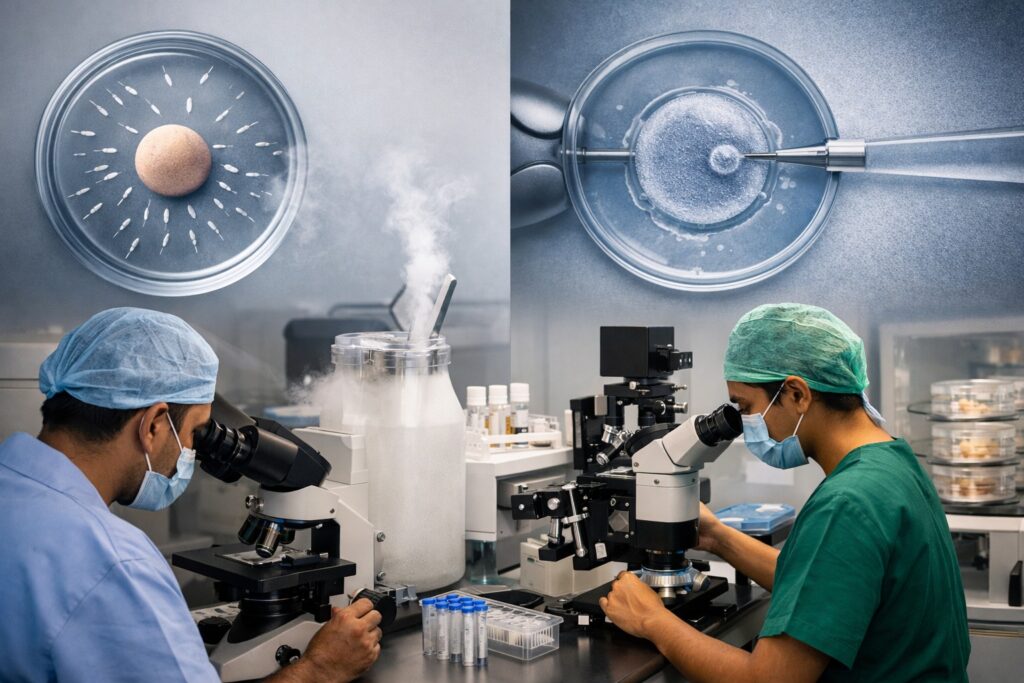
WHAT ICSI REALLY MEANS
ICSI is usually described in one simple sentence “A single sperm is injected into an egg.” True — but that explanation barely scratches the surface. At Renu IVF, we believe couples exploring icsi treatment in kanpur deserve clarity about what truly changes inside the lab and inside the biological process.
ICSI stands for Intracytoplasmic Sperm Injection — meaning the sperm is placed directly inside the egg’s cytoplasm. When you choose this approach at an experienced ivf center in kanpur, you’re not just selecting a lab technique. You’re changing the natural fertilization pathway and how sperm selection happens.
WHAT CHANGES WITH ICSI
Understanding ICSI requires knowing what shifts when you move from conventional IVF to this specialized technique:
- Natural sperm selection is removed
- Control shifts from biology to the embryology laboratory
- Fertilization is mechanically assisted rather than naturally occurring
This shift has both benefits and consequences. Forcing fertilization to occur is not the same as improving embryo quality—and that distinction matters significantly in your treatment journey at Renu IVF.
HOW ICSI CHANGES THE FERTILIZATION PROCESS
The following comparison illustrates the fundamental differences between conventional IVF and ICSI at Renu IVF:
SPERM COMPETITION
Conventional IVF: Thousands of sperm compete to penetrate the egg
ICSI at Renu IVF: Competition is removed; one sperm is selected
EGG BARRIERS
Conventional IVF: Egg’s outer layers filter sperm quality
ICSI at Renu IVF: Barriers are bypassed completely
SELECTION PROCESS
Conventional IVF: Natural biological selection
ICSI at Renu IVF: Laboratory embryologist selection
PENETRATION
Conventional IVF: Only capable sperm successfully penetrate
ICSI at Renu IVF: Mechanical injection bypasses penetration
KEY UNDERSTANDING: ICSI solves a very specific problem—sperm that cannot reach or penetrate the egg. It does NOT improve egg quality, correct chromosomal issues, repair sperm DNA, or enhance implantation rates.
WHO ACTUALLY BENEFITS FROM ICSI AT RENU IVF
At Renu IVF, we recommend ICSI when specific clinical indicators suggest it will improve your fertilization outcomes. Our specialists consider ICSI treatment for the following situations:
PRIMARY ICSI INDICATIONS:
- Severe male factor infertility
- Very low sperm count (severe oligospermia)
- Poor sperm motility (asthenospermia)
- Abnormal sperm morphology (teratospermia)
- Surgically retrieved sperm (TESA, PESA, micro-TESE)
- Previous fertilization failure with conventional IVF
- Use of frozen or fragile sperm samples
- Pre-implantation genetic testing (PGT) planned to reduce contamination risk
CRITICAL INSIGHT: ICSI is a solution for fertilization failure risk—not a universal upgrade. In couples with normal sperm parameters at Renu IVF, it may not increase live birth rates. It primarily reduces the chance that fertilization fails completely.
THE ICSI PROCEDURE AT RENU IVF
BEFORE ICSI: THE IVF FOUNDATION
Before any ICSI procedure can take place, you’ll undergo the standard IVF pathway at Renu IVF. It’s important to understand that ICSI does not change ovarian stimulation. The pre-ICSI steps include:
- Ovarian stimulation with hormonal medications
- Regular monitoring through ultrasound scans and blood tests
- Trigger injection to finalize egg maturation
- Egg retrieval procedure (oocyte pickup)
- Sperm collection or surgical sperm retrieval
ESSENTIAL UNDERSTANDING: If egg quality is compromised, ICSI cannot fix that. If ovarian response is weak, ICSI cannot compensate for low egg numbers. The real battle for treatment outcome is often decided during stimulation planning—not during the injection step.
DURING ICSI: THE LABORATORY PROCESS
Once your eggs are retrieved, our Renu IVF embryology team performs the ICSI procedure with precision:
Step 1: Mature eggs (MII stage) are identified and selected
Step 2: Surrounding cumulus cells are carefully removed to expose the egg
Step 3: A single sperm is selected under high-magnification microscopy based on morphology and motility
Step 4: The selected sperm is immobilized and loaded into a microneedle
Step 5: The microneedle penetrates the egg shell and membrane, injecting the sperm directly into the cytoplasm
Step 6: The following day (approximately 16-18 hours later), fertilization is assessed
WHAT ICSI DOES AND DOESN’T DO
Understanding the scope and limitations of ICSI is essential for making informed decisions at Renu IVF.
WHAT ICSI DOES:
- Bypass sperm penetration barriers
- Achieve fertilization with very few sperm
- Enable fertilization with surgically retrieved sperm
- Reduce risk of total fertilization failure
- Work with frozen or fragile sperm
- Reduce genetic contamination for PGT testing
WHAT ICSI DOES NOT DO:
- Improve egg quality
- Correct chromosomal abnormalities
- Repair sperm DNA fragmentation
- Improve embryo implantation rates
- Guarantee embryo development
- Increase live birth rates in normal sperm cases
THE BOTTOM LINE: ICSI addresses one mechanical barrier and nothing beyond that. Its role is finished after fertilization occurs.
CRITICAL CONSIDERATIONS
At Renu IVF, we believe in transparent, complete information. Here are the aspects of ICSI that are often overlooked but deserve your attention:
1. THE SPERM SELECTION CHALLENGE
In natural conception, millions of sperm compete. In ICSI, one sperm is chosen based on limited visual criteria:
- Movement patterns
- Morphological shape
- Visual appearance under microscopy
However, under a microscope, our embryologists cannot see:
- DNA fragmentation levels
- Chromosomal abnormalities
- Epigenetic defects
If sperm DNA quality is poor, ICSI may force fertilization that natural selection might have prevented. This becomes relevant in cases of repeated embryo arrest, recurrent miscarriage, or poor blastocyst formation. At Renu IVF, when these patterns emerge, a basic semen analysis is not enough—deeper male fertility evaluation becomes necessary.
2. EGG DAMAGE RISK
ICSI is an invasive procedure. The injection needle must penetrate:
- The outer egg shell (zona pellucida)
- The egg’s delicate membrane (oolemma)
Some eggs may collapse or degenerate after injection. This risk increases when:
- Eggs are fragile due to advanced maternal age
- Ovarian response is poor
- Eggs are overmature or immature
In borderline egg quality cases, mechanical manipulation can reduce the number of usable embryos. This isn’t common—but it isn’t zero. Our team at Renu IVF carefully assesses each case to balance risks and benefits.
3. GENETIC TRANSMISSION QUESTIONS
Most ICSI babies are completely healthy. However, certain scenarios require discussion:
- If male infertility is genetic (such as Y chromosome microdeletions), that infertility pattern may pass to male offspring
- There is a slightly increased risk of rare imprinting disorders
- Structural chromosomal issues in sperm can potentially carry forward
These risks are small but not imaginary. In selected cases at Renu IVF, genetic counseling and pre-implantation genetic testing become important considerations that we’ll discuss with you.
4. ROUTINE USE VS. TARGETED USE
Many fertility clinics use ICSI in nearly all IVF cycles. Why? Because total fertilization failure is emotionally and financially devastating, and ICSI reduces that risk.
However: In couples with normal sperm parameters, routine ICSI may not improve live birth rates. It mainly changes fertilization dynamics and reduces the risk of zero fertilization.
At Renu IVF, the real question we help you answer is:
Is the risk of fertilization failure high enough to justify ICSI in your specific case?
This decision depends on multiple factors:
- Number of eggs retrieved
- Sperm quality parameters
- Previous IVF cycle history
- Cost sensitivity and insurance coverage
- Emotional tolerance for uncertainty
5. WHEN ICSI FAILS: NEXT STEPS
If fertilization remains low despite ICSI, deeper issues may be present:
- Sperm DNA damage beyond visual assessment
- Egg cytoplasmic immaturity
- Suboptimal ovarian stimulation response
- Incorrect trigger timing
- Laboratory environment factors
IMPORTANT: Repeating ICSI without reassessment rarely solves persistent failure. When fertilization repeatedly fails at Renu IVF, we widen the strategy to include:
- Ovarian stimulation protocol adjustment
- Sperm DNA fragmentation testing
- Modified trigger medication timing
- Pre-implantation genetic testing
- In some cases, consideration of donor gametes
ICSI is not the final escalation step—it’s one tool in a layered system of reproductive medicine.
COMMON QUESTIONS ABOUT ICSI
DOES ICSI INCREASE TWIN RISK?
No. Twin or multiple pregnancy depends on the number of embryos transferred, not the fertilization method. ICSI affects how fertilization occurs. Embryo transfer policy affects the likelihood of multiples. At Renu IVF, we follow evidence-based embryo transfer guidelines to optimize singleton pregnancy rates.
WHAT IS RECOVERY LIKE AFTER ICSI?
Physical recovery: Identical to standard IVF recovery. The injection happens in the laboratory after egg retrieval, so it doesn’t change your physical experience.
Emotional aspect: This can be different. Many couples believe ICSI guarantees fertilization. When fertilization numbers are lower than expected, the emotional impact can be significant. At Renu IVF, expectation management through counseling is a critical part of our ICSI protocol.
THE RENU IVF DECISION FRAMEWORK FOR ICSI
Instead of asking yourself “Should we do ICSI?”, we guide our patients to ask more precise questions:
1. What specific problem are we solving?
Is this a sperm penetration issue, or are there deeper DNA quality concerns?
2. How many mature eggs do we expect to retrieve?
With limited eggs, the risk-benefit calculation changes.
3. What is the acceptable risk of total fertilization failure?
This is often an emotional rather than statistical question.
4. What does previous cycle history tell us?
Past fertilization performance is highly predictive.
5. What is our long-term reproductive plan?
Are we building a family or completing it? This affects how we approach each cycle.
At Renu IVF: ICSI is powerful when precisely indicated. Used correctly, it prevents cycle collapse. Used routinely without clear indication, it may add cost without added benefit.