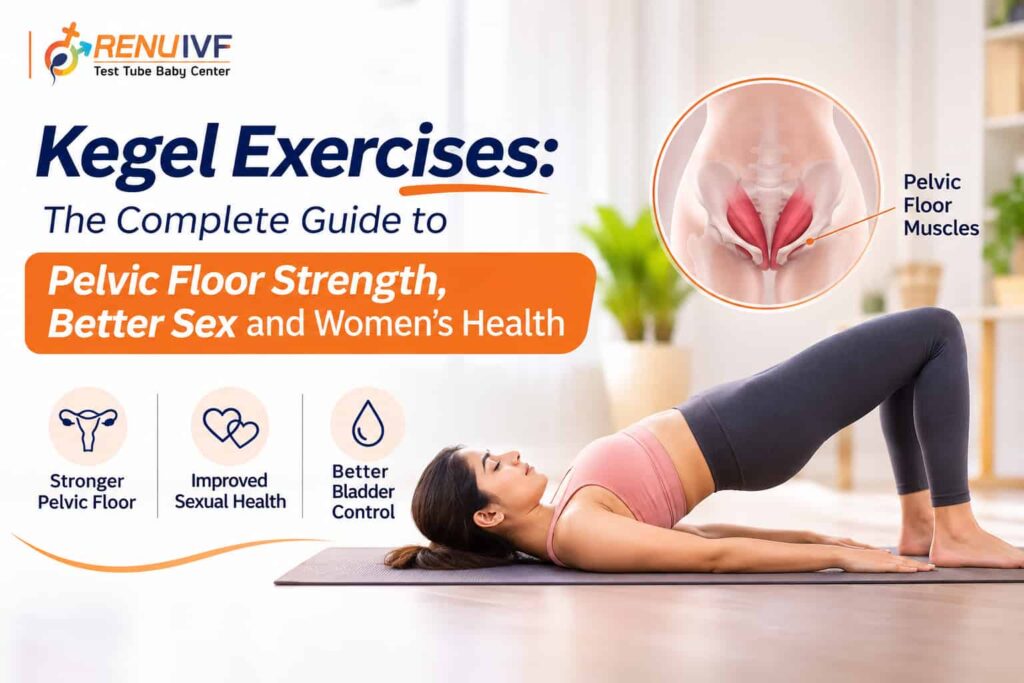

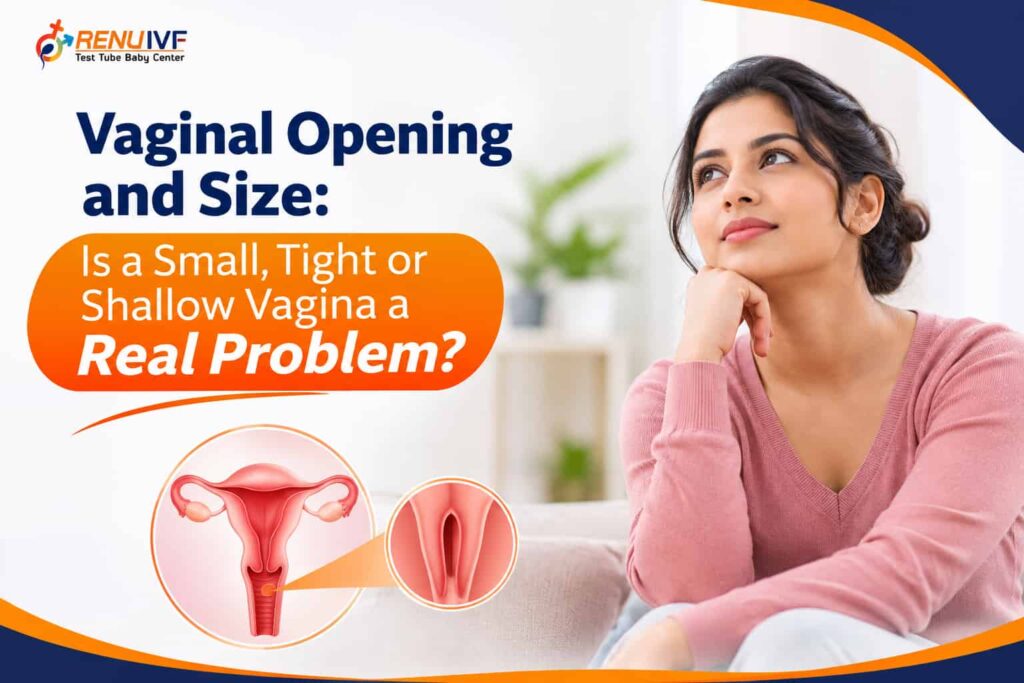
Many women quietly type questions like “how to increase vagina size”, “small vagina hole” or “how to open vagina” into a search bar. Behind these words there is usually worry, shame or pain. Some women feel that sex hurts. Some cannot use a tampon. Some have been told by a partner, or by a relative, that something is “too small”. Others are about to get married and are scared.
First, take a deep breath. In most cases there is nothing wrong with the size of your vagina. What women feel as a “small” or “hard” vagina is very often tight muscles, lack of arousal, anxiety, dryness or a treatable medical condition. This guide explains the real anatomy, the common causes, the myths that can hurt you, and the safe options that actually work. It is written in simple English, with care and without judgement.
| Quick Summary: Key Takeaways1. The vagina is a stretchy, muscular canal. It naturally becomes longer and wider when a woman is aroused and relaxed.2. A truly “too small” vagina is rare. Most cases are caused by muscle tightness (vaginismus), dryness, fear, pain conditions, or hormonal changes.3. Real structural causes (like a vaginal septum, a very tight hymen or a congenital difference) exist, but they are diagnosable and treatable by a doctor.4. No cream, tablet, herbal gel, home trick or “enlargement” product can safely make the vagina bigger. Many cause burns, infections and scarring.5. The safe path is: understand your body, relax the muscles, treat any cause, and use medical dilator therapy under guidance when needed.6. If sex or examination is painful, or you have never been able to have penetration, see a gynecologist. It is common and very treatable. |
Vaginal Opening and Size: The Real Anatomy
Many problems begin with a simple confusion. People say “vagina” when they mean the whole genital area. In medical terms there are different parts:
| Part | What it is |
| Vulva | The outer visible area: the outer lips, inner lips, clitoris, urethral opening and the vaginal opening. |
| Vaginal opening (introitus) | The entrance to the vaginal canal. It is surrounded by muscle and by the remains of the hymen, a thin, stretchy fold of tissue that varies a lot from woman to woman. |
| Vaginal canal | The soft, muscular, folded tube that leads from the opening up to the cervix (mouth of the womb). Its walls rest against each other, like a closed sleeve, until something enters. |
| Pelvic floor muscles | A hammock of muscles around the opening and the canal. When these tighten, the opening feels narrow or “blocked”. |
| Cervix and uterus | At the top of the canal. Their position can tilt forward or backward, which changes how deep or shallow the vagina feels in some positions. |
The key point: the vagina is not a fixed hole. It is a collapsed, elastic canal with folds (rugae) that allow it to stretch widely, for example during childbirth. Its feel and size change with arousal, hormones, muscle tension, stress and age.
What Is a “Normal” Vagina Size?
At rest, the vaginal canal is commonly around 7 to 10 cm (about 3 to 4 inches) long, though healthy women can be a little shorter or longer. When a woman is aroused, the upper part of the canal widens and lengthens, and the uterus lifts slightly. This is sometimes called “tenting”. So the length at rest is not the length during sex.
Just like noses, hands or feet, vaginas come in natural variety. There is no single correct size, and no medical benefit in changing a healthy size. Search terms such as tiny vagina, small vegina or shallow vagina often describe a feeling, not a measurement. The feeling can come from a normal anatomy plus tension, fear or inadequate arousal.
| Think about thisThe vagina is designed to allow a baby to pass through. That tells you how much it is able to stretch when the body is relaxed and the muscles are soft. The goal is not to make the vagina “bigger”. The goal is to help it relax, lubricate and respond naturally. |
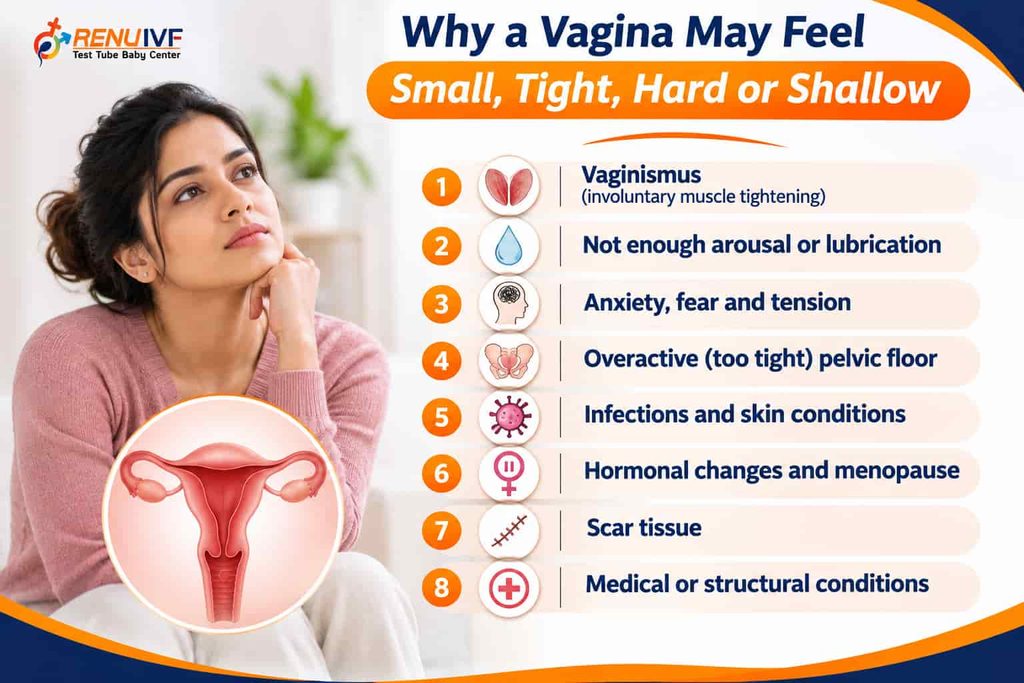
Why a Vagina May Feel Small, Tight, Hard or Shallow
Here are the most common reasons, from the most common to the least common.
1. Vaginismus (involuntary muscle tightening)
Vaginismus is one of the most common reasons women think they have a “small vagina”. The muscles around the opening tighten on their own, like the eyelid closing when something comes near the eye. The woman does not control it. It can make intercourse painful or impossible, and it can make tampon use or a doctor’s examination very difficult.
It may begin after a painful first attempt, fear of pain or pregnancy, strict upbringing about sex, past trauma, or without any clear reason. The structure is usually normal. The muscle response is the issue, and it is treatable.
2. Not enough arousal or lubrication
If penetration is attempted before the body is ready, the canal has not yet widened and lubricated. It then feels tight, dry and painful. Rushing, stress, tiredness, certain medicines and hormonal changes can all reduce arousal.
3. Anxiety, fear and tension
Fear of pain tightens the pelvic floor, and tight muscles cause pain, which increases the fear. This cycle is very common, especially before or just after marriage, or after a bad experience.
4. Overactive (too tight) pelvic floor
Long-term stress, constipation, holding urine, intense exercise or too many squeezing exercises can keep the pelvic floor muscles in constant contraction. This can feel like a “hard vagina” with pain or pressure.
5. Infections and skin conditions
Yeast infections, bacterial vaginosis, urinary infections and skin conditions like lichen sclerosus can cause burning, cracks and pain at the entrance. If you have unusual discharge or smell, read our guides on Vaginal Smell During Pregnancy and White Discharge with Blood for warning signs.
6. Hormonal changes and menopause
Low estrogen, after childbirth with breastfeeding, during perimenopause or after menopause, makes vaginal tissue thinner, drier and less stretchy. This can feel like the vagina has become smaller. Learn more in our article on Perimenopause: Symptoms and Preparation.
7. Scar tissue
Tears or stitches (episiotomy) after delivery, surgery, radiation therapy or trauma can leave scar tissue that narrows the opening or causes tenderness.
8. Medical or structural conditions
A small number of women have a structural difference from birth. These are explained in the next section.
Medical Conditions That Can Make the Vaginal Opening Narrow
These conditions are uncommon, but they are important not to miss. Only a doctor can diagnose them, usually with a gentle examination and an ultrasound or MRI.
| Condition | What it means | Usual approach |
| Hymenal variations (rigid, septate or cribriform hymen) | The hymen tissue is thick, has bands or very small openings, causing pain or difficulty with penetration or tampons. | Simple minor procedure to release the tissue, followed by gentle care |
| Imperforate hymen | The hymen has no opening. It is often noticed in teenage years when periods do not come out, with monthly lower belly pain. | Minor surgery by a gynecologist |
| Vaginal septum (longitudinal or transverse) | A wall of tissue that divides or partly blocks the vaginal canal. | Surgical removal of the septum after proper imaging |
| Congenital absence or shortened vagina (such as MRKH syndrome) | The vagina is missing or short since birth, often found when periods do not start. | Dilator therapy or surgery. See Absent Vagina: Causes, Symptoms and Treatment |
| Vaginal stenosis | Narrowing due to scarring, radiation, surgery, or severe infection or inflammation. | Dilator therapy, treating the cause, sometimes surgery |
| Genitourinary syndrome of menopause | Thin, dry, less elastic tissue due to low estrogen. | Moisturisers, lubricants and vaginal estrogen if suitable |
| Vulvodynia and vestibulodynia | Chronic pain at the vaginal entrance without a visible cause. | Pelvic floor therapy, medicines and counselling |
| Endometriosis or pelvic inflammation | Deep pain during sex, often felt in the lower belly rather than at the opening. | Evaluation, sometimes laparoscopy |
If you have never been able to have penetration, are a teenager who has not had periods, or have monthly pain with no bleeding, please see a gynecologist soon rather than waiting.
Small Vagina and Sex: What Really Happens
Women searching for small vagina sex or shallow vagina are usually describing one of three experiences:
• Pain at the entrance: often linked to dryness, muscle tightness, vaginismus or skin conditions.
• Pain deep inside: often related to position, an unaroused vagina, tilted uterus, endometriosis or pelvic inflammation.
• A “blocked” or “hard” feeling: often due to the pelvic floor muscles tensing involuntarily.
Sex should never be forced or painful. Pain is a signal, not something to endure. Continuing with pain teaches the body to expect pain and makes the tightness worse.
Comfort tips that help right away
• Take your time. Longer foreplay and emotional closeness help the canal widen and lubricate naturally.
• Use a good lubricant. Choose a water-based or silicone-based lubricant (without perfumes). Apply generously, and reapply as needed.
• Control the pace. Being on top, or side-lying, lets the woman control depth and speed.
• Try positions that reduce depth if deep pain is the issue. A pillow under the hips can also change the angle.
• Communicate with your partner. Agree that you can stop or slow down at any time with no blame.
• Breathe and relax your belly and thighs. A relaxed jaw, belly and thighs help the pelvic floor release.
• Do not rush. It is fine if penetration does not happen at all in the early sessions. Closeness without penetration also builds trust.
If a partner is anxious about size or performance, a calm talk helps more than any product. Pressure from either side tightens the muscles further.
Myths and Dangerous “Vagina Enlargement” Tricks
Search results for how to make vagina hole big, how to enlarge vagina or how to make vagina bigger are full of unsafe suggestions. Please avoid all of the following.
| Myth or Trick | The Truth |
| Herbal gels, tablets, creams and “yoni” powders that claim to enlarge or expand the vagina | There is no scientific proof. Many contain irritants and can cause burns, allergy, infection and scarring. |
| Inserting vegetables, bottles, candles or home objects to “stretch” | Very dangerous. They can tear tissue, carry germs, break, or get stuck. This can need emergency removal. |
| Hot water, steaming or douching | Can burn delicate tissue and wash away protective bacteria, increasing infections. |
| Alum, astringents or other harsh substances | Harm the lining and cause dryness and pain. They worsen the problem. |
| Forcing penetration “to get used to it” | Causes pain, tiny tears and a stronger muscle-spasm reflex. It makes vaginismus worse. |
| Alcohol or pain-relief tablets before sex | Mask pain without treating the cause and can cause injury without you noticing. |
| Cosmetic “vaginal enlargement” injections or procedures | There is no medically proven or recommended procedure to enlarge a healthy vagina. Be careful of unqualified providers. |
| “A small vagina cannot have a baby” | False. The vagina is made to stretch, and size at rest does not decide delivery. |
| “Your vagina is small because you are a virgin or have not had sex” | False. There is no link between sexual history and size. Tightness is about muscles, fear and arousal, not purity. |
| A word of cautionAny product or video that promises to “enlarge” or “expand” your vagina quickly is selling a promise, not a medical treatment. Please protect your health and talk to a doctor first. |
Safe Ways to Relax and Comfortably “Open” the Vagina
Let us gently correct the question. Instead of “how to open vagina” or “how to stretch vagina”, the better question is “how can my vagina and pelvic floor become relaxed, comfortable and responsive?” Here are safe, doctor-friendly steps.
Step 1: Understand your body without fear
Learn the anatomy in a calm, private setting. Many women are shy about their own bodies. A hand mirror and a few minutes of curiosity, with no pressure, can reduce fear. You are only observing, not testing yourself.
Step 2: Learn diaphragmatic (belly) breathing
Lie down with knees bent. Place one hand on your belly. Breathe in slowly through the nose for 4 counts so that your belly rises. Breathe out slowly for 6 counts. As you breathe out, imagine your pelvic floor softening and dropping like a flower opening. Practice for 5 to 10 minutes a day.
Step 3: Practice the “reverse Kegel” (pelvic floor drop)
Most people hear only about squeezing exercises, but if you feel tight, squeezing more can worsen it. Instead, practice letting go. As you breathe out, gently release and widen the muscles around the vagina and anus, as if you were letting urine pass. It is a soft release, not a push or strain. Then rest.
Step 4: Gentle pelvic stretches
| Stretch | How to do it (30 to 60 seconds, breathing slowly) |
| Child’s pose | Kneel, sit back on your heels, knees wide, fold forward and rest your forehead on the floor. |
| Happy baby pose | Lie on your back, hold the outer feet or shins and bring knees towards your armpits. Rock gently. |
| Butterfly stretch | Sit with the soles of your feet together, knees open. Lean forward slightly. |
| Deep squat with support | Squat with feet wide, heels down (use a cushion if needed). Press elbows gently on your knees. |
| Supine figure four | Lie on your back, cross one ankle over the opposite knee and draw the thigh towards your chest. |
Step 5: Warmth and relaxation
A warm bath or warm compress on the lower belly before practice can ease muscle tension. Choose a quiet time, dim lights and avoid distraction.
Step 6: Use lubricant and moisturiser the right way
For dryness, use a plain, fragrance-free vaginal moisturiser regularly (not just during sex) and a good lubricant during intimacy. Avoid oil with latex condoms, because oil can weaken latex.
Step 7: Treat what needs treating
Treat any infection, skin condition, or hormonal dryness first. Pain will not settle while the cause is still active.
Step 8: Get support for fear and anxiety
A trained counsellor or sex therapist can help break the pain-fear-tightness cycle. Cognitive behavioural therapy (CBT), gradual exposure and partner counselling have good results for vaginismus.
Step 9: Pelvic floor physiotherapy
A physiotherapist trained in pelvic health can teach you how to relax the muscles, and may use gentle hands-on release techniques. Many women improve with this alone.
Vaginal Dilator Therapy: A Step-by-Step Guide
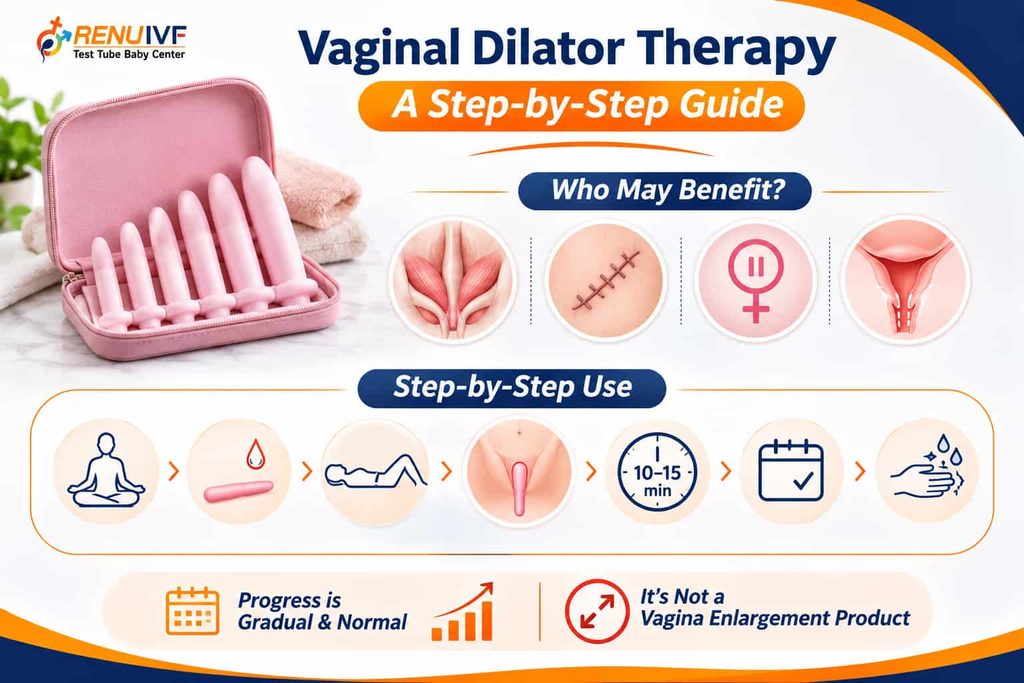
A vaginal dilator is a smooth, graduated set of tube-shaped devices made of medical-grade silicone or plastic. They are used for gradual, gentle, desensitising practice under medical guidance. This is the one method with real medical support for vaginismus, scarring and narrowing. It is not a “vagina enlargement” product, and it should be used only when a doctor or pelvic therapist has recommended it.
Who may benefit
• Women with vaginismus who find penetration or examination difficult.
• Women with narrowing from scarring, radiation, or surgery.
• Women with menopausal tissue changes (along with moisturisers or estrogen, if advised).
• Women with some congenital conditions, such as shortened or absent vagina, after a proper diagnosis.
General steps (always follow your own doctor’s plan)
• Choose a calm, private time. Empty your bladder. Do your breathing and a warm compress first.
• Start with the smallest size. Apply a generous amount of water-based lubricant to the dilator and the entrance.
• Find a comfortable position: lying on your back with knees bent and supported, or on your side.
• Insert slowly and only as far as is comfortable. Pause whenever you feel tightness. Breathe out and release the muscles.
• Stay for about 10 to 15 minutes. You may gently move or rotate only if your therapist advised. Never force it.
• Practice 3 to 5 times a week. Move to the next size only when the current one feels comfortable for several sessions.
• Clean after each use with mild soap and warm water, dry well and store in a clean container. Do not share.
Progress is slow and that is normal. Many women need several weeks to a few months. Celebrating small wins, such as reduced fear or one size up, helps a lot.
| Stop and call your doctor if you noticeHeavy bleeding, severe pain, fever, a foul-smelling discharge, or if the device feels stuck. Never use a dilator during an active infection or soon after surgery without your doctor’s permission. |
Treatment Options at a Clinic
After a careful history and a gentle, consent-based examination, your doctor may suggest one or more of the following:
| Treatment | When it is used |
| Counselling, CBT and sex therapy | Vaginismus, anxiety, past negative experiences, relationship stress. |
| Pelvic floor physiotherapy | Overactive or painful pelvic floor muscles. |
| Graduated dilator therapy | Vaginismus, scarring, stenosis, some congenital conditions. |
| Local numbing gel (as prescribed) | Short-term help with entry pain during therapy. |
| Vaginal moisturisers, lubricants, local estrogen | Dryness and menopausal or postpartum tissue changes. |
| Treatment of infections and skin conditions | Itching, burning, cracks, white patches or unusual discharge. |
| Botulinum toxin injection (in selected, resistant cases) | Severe vaginismus not improving with first-line treatment, under specialist care. |
| Minor surgery | Rigid or imperforate hymen, vaginal septum, tight scar bands. |
| Reconstructive procedures | Congenital absence or major narrowing, after full evaluation. |
At Renu IVF, our gynecology team provides a private, respectful consultation. You can learn more about our approach on the About Us page and read other helpful articles in our Gynecological Health section.
Hard Vagina After Delivery, Surgery or Menopause
After delivery
Some women feel the vagina is loose after delivery, and others feel it is tight, tender or hard to enter. Both can be true at different times. Tears, stitches, low estrogen with breastfeeding and tired pelvic muscles can all cause pain. Give your body time, use lubricant and do gentle exercises. If pain continues beyond a few months, see a doctor. Our guide, How to Tighten Vagina After Delivery, explains safe options if you feel the opposite problem, and the post on Uterine Prolapse lists signs such as heaviness or a bulge that need medical care.
After pelvic surgery or radiation
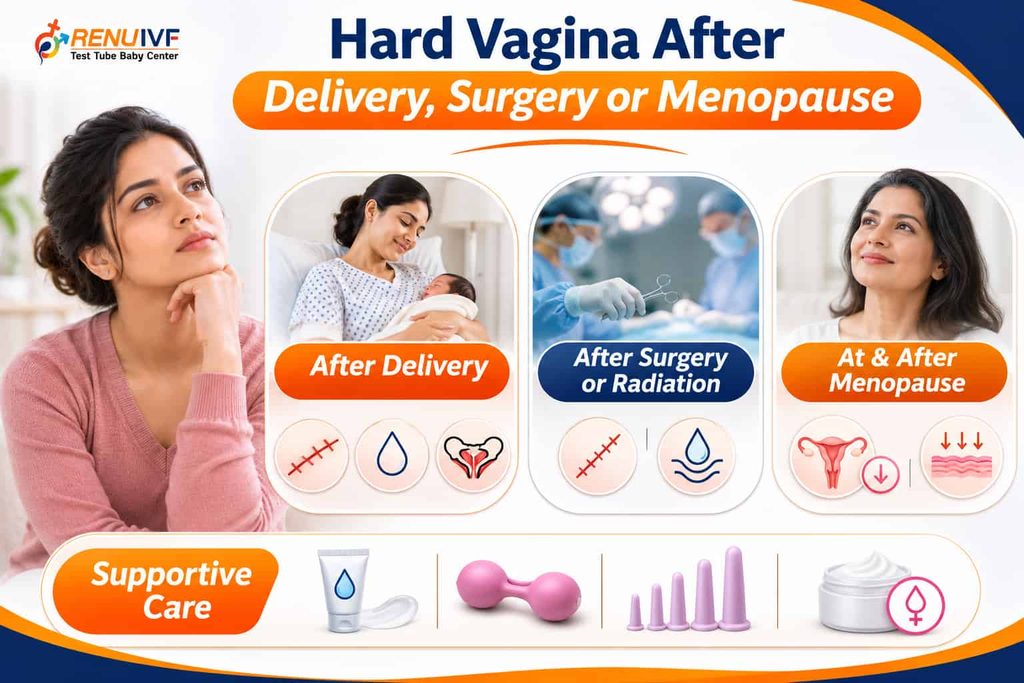
Scar tissue and dryness can narrow the canal. Early guidance from your treating team about dilators and moisturisers helps prevent stenosis.
At and after menopause
Falling estrogen thins the vaginal walls. Regular moisturiser, lubricant, local estrogen if suitable and gentle sexual activity or dilator practice keep tissues healthy.
First-Time Intimacy and Fear of Pain
Fear before the first intimate experience is very common. A few important points:
• First-time pain is not a rule. With enough arousal, lubrication, trust and no pressure, many couples have a comfortable experience.
• Some women do not bleed at the first time, and that is normal. The hymen can be stretchy or already worn by sports, cycling or tampon use. Bleeding is not a proof of anything.
• Never judge a woman’s past or purity by tightness or bleeding. Such beliefs are medically false and harmful.
• If penetration is not possible, do not keep trying again and again with force. Seek medical help. This is common and treatable.
• Premarital or pre-intimacy counselling with a gynecologist can reduce fear a lot.
For Partners: How to Support Her
• Listen without blame. Pain is real, even if there is no visible cause.
• Slow down. Make closeness, touch and kissing the goal, not penetration.
• Let her lead. Let her decide the pace, position and when to stop.
• Never force or pressure. Force damages trust and worsens vaginismus.
• Attend a consultation together if she wants it. Many couples improve faster when both understand the problem.
• Be patient. Healing may take weeks or months, and kindness is a part of the treatment.
Does Vaginal Size Affect Pregnancy and Delivery?
Vaginal size at rest does not decide whether you can conceive or deliver. Pregnancy needs ovulation, healthy sperm, open tubes and a receptive uterus. Delivery depends on the baby’s position, the pelvis, the uterus and the strength of contractions, and the vagina stretches during labour.
However, vaginismus or pain with intercourse can make it hard to conceive naturally, because intercourse may be avoided or difficult. In such cases, treatment of vaginismus often solves the problem. If you have been trying for a year (or six months if over 35) without success, consider a fertility assessment. Also see our guide on Pads vs Tampons vs Menstrual Cups if you find it difficult to insert a tampon or cup, as that is an early clue to muscle tension.
When to See a Doctor, and What to Expect
Please book a consultation if you have:
• Pain at the entrance or inside during sex, or when inserting a tampon.
• No ability to have penetration, or fear that stops you from trying.
• A teenager with no periods by age 15, or monthly lower belly pain without bleeding.
• Burning, itching, white patches, cracks, or unusual discharge.
• Pain, dryness or tightness after delivery, surgery, radiation or menopause.
• Bleeding after sex or in between periods.
• Emotional distress about your body or intimacy that affects your daily life.
What to expect at the visit
• A private, calm discussion about your symptoms and health history. You do not need to feel shy. The doctor has heard it all.
• A gentle examination only with your consent. You can ask the doctor to stop at any moment, and a female staff member can be present.
• If an internal examination is too painful, the doctor will not force it. They may start with external examination, ultrasound, or a relaxation plan first.
• A clear, step-by-step treatment plan that suits you and, if you wish, your partner.
Our team, led by Dr. Renu Singh Gahlaut, offers a respectful, private space where your concerns will be treated with care.
Frequently Asked Questions (FAQs)
Q. How to increase vagina size safely?
A healthy vagina does not need to be made bigger. If it feels small, the cause is usually muscle tightness, dryness, fear or a treatable medical condition. Safe steps are arousal, lubrication, relaxation, pelvic floor therapy and, when advised, medical dilator therapy. There is no safe product that enlarges the vagina.
Q. How to increase vagina hole or make a small vagina hole bigger?
If the opening feels narrow, a doctor should check the cause. Relaxation, dilator therapy, treatment of scarring or dryness, and minor surgery for a tight hymen or septum are the proper options. Do not use home objects or herbal products.
Q. How to open vagina for sex without pain?
Focus on relaxation rather than force. Use longer foreplay, plenty of lubricant, slow breathing, comfortable positions where she controls the pace, and communication. If pain continues, see a gynecologist.
Q. How to stretch vagina naturally?
The vagina stretches naturally with arousal and relaxation. Pelvic stretches, belly breathing, reverse Kegels and gradual dilator practice (under guidance) help the muscles soften. Avoid forceful stretching.
Q. Is a small or tiny vagina a medical problem?
Usually not. Vaginal size varies widely and the vagina lengthens and widens with arousal. A real structural problem is uncommon, but it can be diagnosed by a doctor.
Q. What is a shallow vagina?
It is a description of feeling pain or “hitting something” deep inside. This is often related to position, lack of arousal, a tilted uterus or conditions such as endometriosis. Try slower pace and different positions and get checked if pain continues.
Q. Why does my vagina feel hard or tight?
Common reasons are vaginismus, an overactive pelvic floor, dryness, infection, anxiety or hormonal changes. These can be treated.
Q. Can vaginismus be cured?
Yes. With the right combination of counselling, pelvic floor therapy and gradual dilator practice, most women improve a lot, and many have fully comfortable intimacy.
Q. Are vaginal dilators safe?
They are safe when used as advised, with lubricant, slowly and cleanly. They should not be used during infection or soon after surgery without your doctor’s approval, and never forced.
Q. Can exercise make the vagina bigger?
Exercises do not permanently change vaginal size. Relaxation exercises can reduce tightness, and strengthening exercises are meant for weakness, not for enlargement.
Q. Does having sex regularly make the vagina bigger?
Healthy sex does not permanently stretch the vagina. The canal returns to its resting shape. Comfort improves mostly because of relaxation and trust.
Q. Is a small vagina a problem for delivery?
No. The vagina stretches greatly during labour. Delivery depends on the baby, pelvis and uterine contractions.
Q. Is there surgery to enlarge the vagina?
There is no recommended cosmetic surgery to enlarge a healthy vagina. Surgery is done only for specific medical reasons such as a septum, imperforate hymen or severe scarring.
Q. Can a lack of virginity or sexual activity cause a small vagina?
No. This is a myth. Size and tightness have no link with sexual history.
Q. Which doctor should I see?
A gynecologist is the right first doctor. They may involve a pelvic floor physiotherapist, counsellor or sex therapist.
Conclusion
If you have been worried about a “small vagina”, please know that you are not alone and that your body is not broken. In most cases the vagina is perfectly normal, and the difficulty comes from tight muscles, fear, dryness or a condition that can be treated. Avoid risky “enlargement” tricks. Choose understanding, relaxation, medical advice and, when recommended, gentle dilator therapy.
You deserve comfort, respect and good care. A single private consultation can end months or years of worry.
| Book a Consultation at Renu IVF, KanpurLed by Dr. Renu Singh Gahlaut (MS Gold Medalist, FICOG, IVF Specialist & Laparoscopic Surgeon), our team offers confidential gynecology, pelvic health and fertility care.Call: +91 63935 77649 | +91 95170 88055Email: info@renuivf.comAddress: In front of C-13, New Azad Nagar, Kalyanpur, Kanpur, Uttar Pradesh 208017Timings: Mon to Sat 9 AM to 7 PM | Sunday 9 AM to 2 PMBook an Appointment | Contact Us | Visit renuivf.com |