

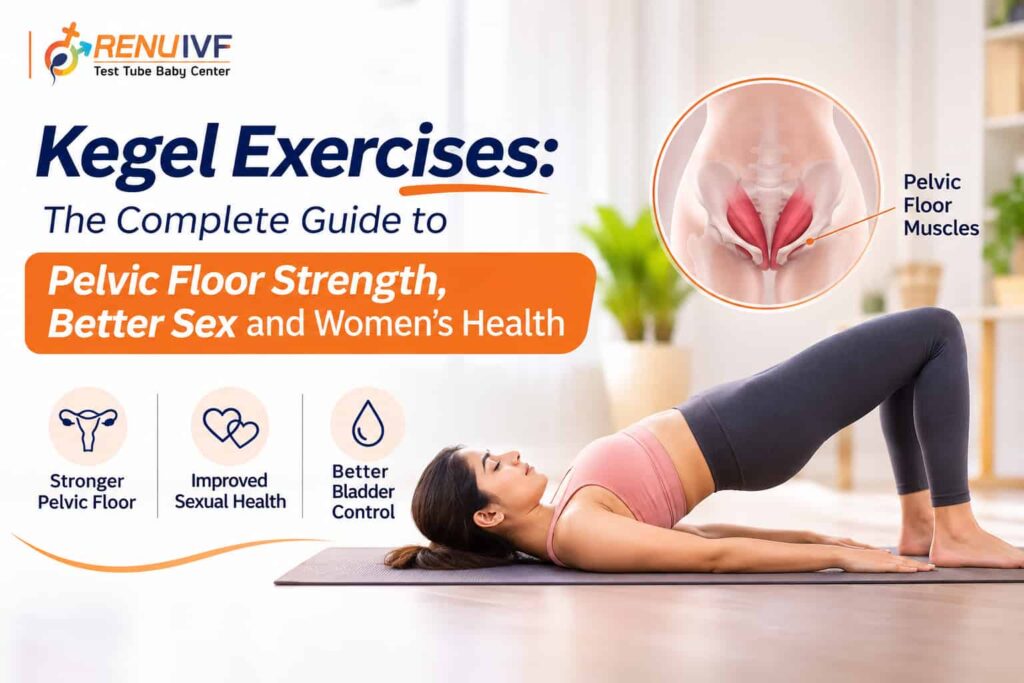
Many women have heard about Kegel exercises. Very few know how to do them correctly. Even fewer know when to use tools like Kegel balls, Kegel weights, a pelvic wand or a vaginal dilator, and when these tools can do more harm than good.
This guide explains everything in simple English. You will learn what your vaginal muscles do, the real benefits of Kegel exercises for women, how Kegel exercises can improve sex, a safe step-by-step routine, the truth about “yoni tightening” claims, how pelvic massage and oils can help, and when you should see a doctor. We have kept the language easy so that any reader can follow it.
| Quick Summary: Key Takeaways1. Kegel exercises strengthen the pelvic floor muscles that support your bladder, uterus and bowel.2. Good pelvic floor strength can help with bladder leaks, prolapse symptoms, recovery after delivery and sexual satisfaction.3. Kegels are not for everyone. If your muscles are already too tight, more squeezing can make pain worse. Relaxing and stretching may be what you need.4. Tools such as Kegel balls, weights, cones, dilators and pelvic wands are helpful for some women, but they are optional and must be used safely.5. Results take time. Most women notice a change in 4 to 12 weeks of regular practice.6. If you have pain, bleeding, heaviness, leaking urine or painful sex, see a gynecologist. Do not self-treat for months. |
In This Guide
• What are Kegel exercises?
• Your pelvic floor and vaginal muscles explained
• Benefits of Kegel exercises for women
• Kegel exercises for better sex
• How to find your muscles (the right way of squeezing)
• Step-by-step Kegel routine and 4-week plan
• Common mistakes to avoid
• Kegel balls for women, Kegel cones and Kegel weights
• Yoni tightening exercises: myths and facts
• Pelvic stretches for a relaxed pelvic floor
• Pelvic massage, pelvic floor massage and the pelvic wand
• Vaginal dilator: who needs it and how to use it
• Rectal and anal dilators: medical uses and safety
• Vagina oil massage and the best natural massage oil
• Kegels in pregnancy, after delivery and at menopause
• Kegel exercises for men
• Kegel exercises and fertility: the honest answer
• When to see a doctor
• Frequently asked questions
What Are Kegel Exercises?
Kegel exercises are simple squeeze-and-release movements for the pelvic floor muscles. They are named after Dr. Arnold Kegel, an American gynecologist who described them in the 1940s to help women who had urine leakage after childbirth. Today, doctors and pelvic floor physiotherapists across the world still recommend them.
Think of the pelvic floor as a hammock of muscles at the base of your pelvis. When you do a Kegel, you lift and tighten this hammock, hold for a few seconds, and then fully relax. You can do it sitting, standing or lying down, and nobody around you will know.
Your Pelvic Floor and Vaginal Muscles Explained
The pelvic floor is a group of muscles, ligaments and connective tissue stretching from your pubic bone at the front to your tailbone at the back. In women, three openings pass through it: the urethra (urine), the vagina and the anus.
When people say vaginal muscles, they usually mean the pelvic floor muscles that surround the vagina, mainly the pubococcygeus (PC muscle) and the levator ani group. These are voluntary muscles. That means you can train them, just like your arms or legs.
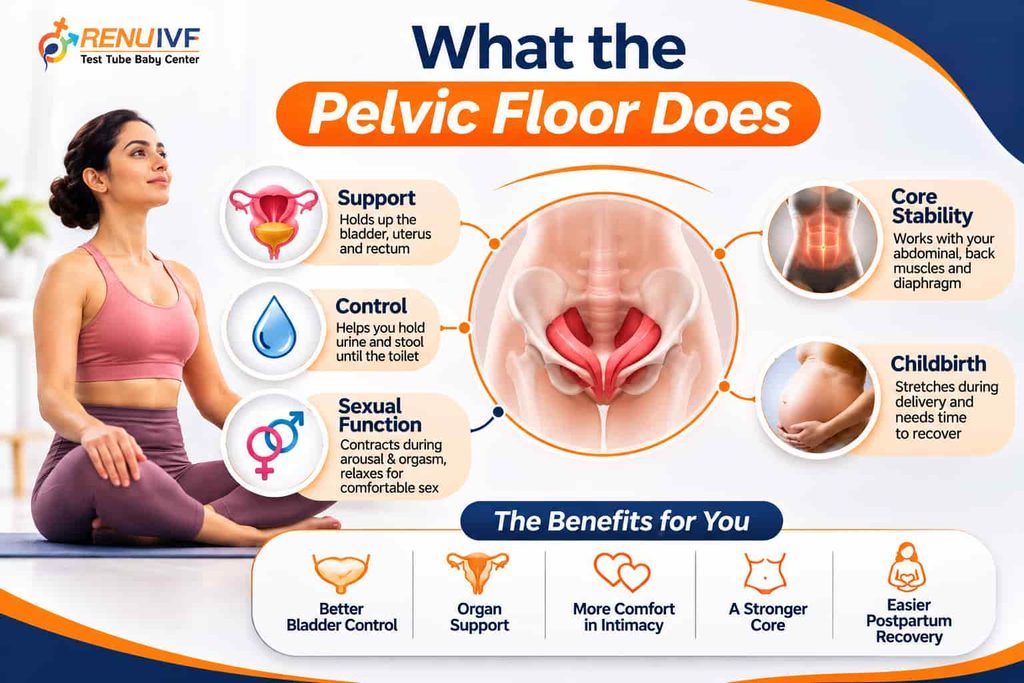
What the pelvic floor does
• Support: It holds up the bladder, uterus and rectum.
• Control: It helps you hold urine and stool until you reach the toilet.
• Sexual function: It contracts during arousal and orgasm, and it needs to relax for comfortable penetration.
• Core stability: It works along with your deep abdominal muscles, back muscles and diaphragm.
• Childbirth: It stretches during vaginal delivery and needs time to recover afterwards.
A pelvic floor can be weak (too loose, leading to leaks and prolapse) or overactive (too tight, leading to pain and difficulty with sex or tampons). Both problems are common, and they need different treatments. This is why knowing your own body matters before you start.
Benefits of Kegel Exercises for Women
Here are the proven and commonly reported benefits of Kegel exercises for women. We have also marked where the evidence is strong and where it is still limited.
| Benefit | How it helps | Evidence level |
| Less urine leakage | Stronger muscles close the urethra better during coughing, sneezing, laughing or lifting (stress incontinence). | Strong |
| Control of urgency | Quick squeezes can calm the sudden “I must go now” feeling (urge incontinence). | Good |
| Prolapse symptoms | A strong floor gives better support to the bladder, uterus and rectum and may reduce heaviness or dragging. | Good (mild to moderate prolapse) |
| Faster postpartum recovery | Helps muscles regain tone after pregnancy and delivery. | Good |
| Better sexual function | Improves blood flow, muscle tone, arousal and orgasm strength in many women. | Moderate |
| Bowel control | Helps with accidental gas or stool leakage. | Moderate |
| Support during menopause | Low estrogen weakens tissues. Exercises, along with medical care, help muscles stay active. | Moderate |
| Pregnancy preparation | A well-trained floor that can also relax may help during labour and recovery. | Moderate |
In short, the main benefits of Kegel exercises are bladder control, organ support, recovery after childbirth and better intimate health. It is a low-cost, no-equipment habit that you can start today.
Kegel Exercises for Better Sex
This is one of the most searched topics, so let us answer it clearly and honestly. Kegel exercises for sex can help many women, but they are not a magic pill.
How Kegels can improve your sex life
• More sensation and arousal: Regular pelvic floor work increases blood flow to the genital area. Better blood flow supports arousal and natural lubrication.
• Stronger orgasms for some women: The same muscles contract rhythmically during orgasm. Stronger, well-coordinated muscles often mean stronger contractions.
• Greater body awareness: Learning to contract and relax these muscles helps you understand your body and communicate better with your partner.
• More confidence: Many women feel less worried about leaks or “looseness” after childbirth, and that confidence improves intimacy.
• Less discomfort for some women: When you learn to fully relax the muscles after a squeeze, penetration may feel more comfortable.
Studies on pelvic floor muscle training show improvements in desire, arousal, lubrication, orgasm and satisfaction in many women. The research is encouraging, though study sizes are often small. So when you read kegel exercises benefits sexually, understand that it means “likely to help over time”, not “guaranteed”.
Kegels for better sex: what a partner may notice
Couples sometimes mention a firmer feeling and better muscle control. Remember that sexual satisfaction depends on many things: emotional closeness, stress, sleep, hormones, health conditions, medicines, and communication. Kegels are one helpful part of the picture.
| Important NoteIf sex is painful, Kegels may not be the answer. Pain during sex (dyspareunia) or involuntary tightening (vaginismus) usually needs relaxation, dilator therapy or medical treatment, not more squeezing. Please speak to a gynecologist. |
How to Find Your Muscles: The Right Way of Squeezing
Before you start, you must find the correct muscles. Many women squeeze their thighs, buttocks or stomach instead. Try one of these safe methods:
Method 1: The “stop the flow” check (only once)
While passing urine, try to stop the flow in the middle. The muscles you use are your pelvic floor muscles. Do this only once or twice to learn the feeling. Do not make it a habit, because repeated stopping can disturb normal bladder emptying and may lead to infection.
Method 2: The “hold back gas” feeling
Imagine you are trying not to pass gas in a quiet room. The squeeze and lift at the back is your anal sphincter and the back part of your pelvic floor.
Method 3: The lift feeling
Imagine you are slowly picking up a small berry with your vagina and lifting it upward, and then slowly letting it down. This inward-and-upward lift is the best cue for squeezing the vagina in the correct way.
Method 4: Use a mirror or finger check
Lie down with your knees bent. Wash your hands and gently place a clean finger just inside the vaginal opening. Squeeze. You should feel a gentle tightening and lift around your finger. If you feel nothing at all, or you feel pushing downward, speak to a pelvic floor physiotherapist.
| How to know you are doing it rightYour belly, thighs and buttocks stay soft. Your breathing stays normal. You feel a gentle lift inside, and when you let go you feel a clear relaxation. If your face turns red or you hold your breath, you are squeezing too hard. |
Step-by-Step Kegel Routine and 4-Week Plan
The basic Kegel
• Step 1: Empty your bladder and sit or lie down comfortably.
• Step 2: Breathe out gently and squeeze and lift the pelvic floor muscles.
• Step 3: Hold for 3 seconds at first. Keep breathing normally.
• Step 4: Release completely for 3 to 5 seconds. The relaxing part is just as important as the squeeze.
• Step 5: Repeat 8 to 10 times. This is one set.
• Step 6: Do 3 sets a day, morning, afternoon and night.
Two types of Kegels you should practice
• Slow (endurance) Kegels: Squeeze, hold up to 10 seconds, release. These build staying power.
• Quick (fast-twitch) Kegels: Squeeze and release quickly, 10 times in a row. These help with sudden pressure, like coughing or sneezing.
A simple 4-week plan
| Week | Slow Kegels | Quick Kegels | Frequency |
| Week 1 | Hold 3 sec, rest 3 sec, 8 reps | 5 quick squeezes | 2 times a day |
| Week 2 | Hold 5 sec, rest 5 sec, 10 reps | 8 quick squeezes | 3 times a day |
| Week 3 | Hold 7 sec, rest 7 sec, 10 reps | 10 quick squeezes | 3 times a day |
| Week 4 | Hold 10 sec, rest 10 sec, 10 reps | 10 quick squeezes + 1 “knack” before cough | 3 times a day |
The “knack” means squeezing your pelvic floor just before you cough, sneeze or lift something heavy. It trains the muscles to protect you in daily life.
Tip: Link your Kegels to a daily habit, such as brushing teeth, waiting for the kettle, or sitting in traffic. After week 4, continue 3 to 4 times per week to maintain your results.
Common Kegel Mistakes to Avoid
• Squeezing the wrong muscles: Tight buttocks, thighs or abs mean you are cheating.
• Holding your breath: Always breathe. Breathing out during the squeeze helps.
• Not relaxing fully: A muscle that never relaxes becomes tight and painful.
• Doing too many: More is not better. Over-training can create an overactive pelvic floor.
• Stopping urine regularly: This is a test, not an exercise.
• Expecting overnight results: Muscles need weeks to change.
• Ignoring pain: Kegels should never hurt. Pain means stop and get checked.
Kegel Balls for Women, Kegel Cones and Kegel Weights
Once you master basic Kegels, you may wonder about tools. Let us explain them without hype.
What are Kegel balls?
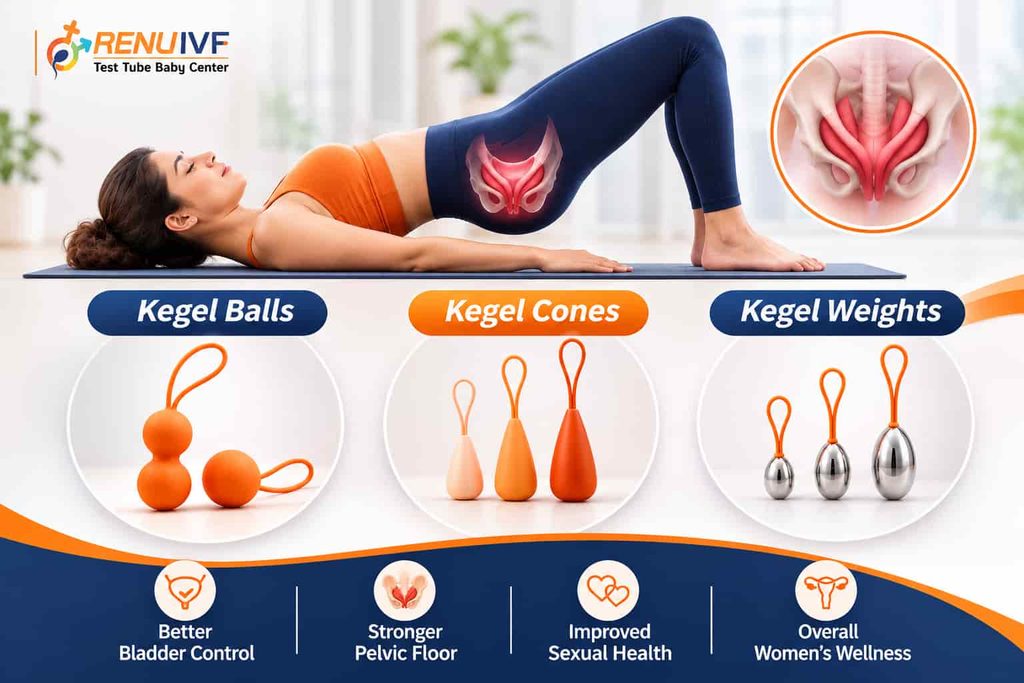
Kegel balls (also called Ben Wa balls, love balls or vaginal weights) are small, smooth balls made of medical-grade silicone or similar body-safe material. They are placed inside the vagina, and the muscles must work to hold them in place. Some come as a single ball, and some as two joined balls with a soft retrieval cord or loop. Kegel balls for women are sold in sets with different weights.
What are Kegel cones?
Kegel cones are weighted tapered devices shaped like a small tampon or cone. They are sold in graded sets, for example light, medium and heavy. Pelvic floor physiotherapists have used cones for years as a feedback tool, because you can feel when the muscles are holding or slipping.
What are Kegel weights?
Kegel weights and kegel exercise weights are simply the progressive-resistance version of these devices. You begin with the lightest and move to heavier ones as your muscles get stronger. Typical household sets range from around 20 grams to about 100 grams or more.
How to use them safely
• Start without a tool. Learn basic Kegels for 2 to 4 weeks first.
• Choose body-safe material: Medical-grade silicone, no strong smell, smooth surface, no seams or sharp edges.
• Begin with the lightest weight. If it falls out immediately or you feel pain, you are not ready for it, or you may be overusing your muscles.
• Use a water-based lubricant for easy insertion.
• Keep sessions short: 5 to 15 minutes, a few times a week. Never sleep with them in place, and do not wear them for hours.
• Clean before and after with warm water and mild unscented soap, or as the maker advises. Dry fully. Do not share them.
• Use a device with a retrieval cord or a flat base, never an object that can slip out of reach.
Who should NOT use Kegel balls?
• During pregnancy, unless your doctor has clearly approved.
• In the first weeks after delivery or surgery, before your doctor clears you.
• With an active vaginal infection, unexplained bleeding or pelvic infection.
• With pelvic pain, vaginismus or an already tight pelvic floor.
• With an IUD in place, without first checking with your doctor.
• With significant prolapse, without medical advice.
An honest note: Some studies suggest that weighted devices work no better than well-done plain Kegels. They can be useful for motivation and feedback, but they are not a must. If you are unsure, a pelvic floor physiotherapist can guide you.
| Tool | What it does | Best for | Caution |
| Kegel balls / cones / weights | Add resistance and feedback to Kegels | Mild weakness, postpartum (after clearance) | Not for pain, infection or tight pelvic floor |
| Pelvic wand | Releases tight spots in the pelvic floor | Pelvic pain, tightness, painful sex | Learn technique first; stop if sharp pain |
| Vaginal dilator set | Gradually stretches and desensitises tissue | Vaginismus, after radiation, narrowing, post-surgery | Go slowly; use lubricant; doctor guidance |
| Rectal / anal dilator | Gently widens the anal canal | Anal stenosis, after anal surgery, pelvic floor dyssynergia | Only on medical advice |
Yoni Tightening Exercises: Myths and Facts
Searches for yoni tightening exercises and yoni tight exercise are very common, especially after childbirth or in the late thirties and forties. Let us separate fact from marketing.
The facts
• The vagina is naturally elastic. It stretches during sex and delivery and returns close to its normal size.
• What may feel “loose” is often a weak pelvic floor, or changes in hormones and tissue after delivery or menopause.
• Kegel exercises, correct posture, healthy weight, good hydration and treating constipation can all improve muscle tone and support.
• In some women, medical options such as pelvic floor physiotherapy, vaginal estrogen (when advised), or surgical repair for significant prolapse may be needed.
The myths
• “Herbal tightening gels or tablets can permanently tighten the vagina.” There is no solid proof. Some products may irritate or burn delicate tissue.
• “Alum, astringent powders or home mixtures work.” They can damage the vaginal lining and disturb healthy bacteria.
• “A tight vagina means better health.” Not true. A healthy vagina is flexible, comfortable and well supported. Too tight can be a problem as well.
• “Vaginal steaming improves tightness.” It has no proven benefit and can cause burns.
For more practical advice after childbirth, read our detailed article: How to Tighten Vagina After Delivery: Safe, Doctor-Backed Ways That Actually Work.
Pelvic Stretches for a Relaxed Pelvic Floor
Strength is only half of pelvic health. If your pelvic floor is tight, pelvic stretches can reduce pain and make Kegels more effective. Hold each stretch for 30 to 60 seconds and breathe slowly into your belly and sides.
| Stretch | How to do it |
| Child’s pose | Kneel, sit back on your heels, widen your knees, fold forward and rest your forehead on the mat. Breathe into your lower back. |
| Happy baby pose | Lie on your back, bring knees toward your armpits, hold the outer feet or shins and gently rock side to side. |
| Deep squat (malasana) | Stand with feet wider than hips, sink into a squat with heels down (support with a cushion if needed). Press elbows gently into the knees. |
| Cat-cow | On hands and knees, slowly round and arch your spine with your breath. Let the pelvic floor soften on every exhale. |
| Butterfly stretch | Sit with soles of feet together and knees open. Lean forward gently from the hips. |
| Supine figure four | Lie on your back, cross one ankle over the opposite knee and draw the thigh toward your chest. |
| Glute bridge | Lie with knees bent. Lift hips slowly, then lower while fully releasing the pelvic floor. |
Reverse Kegel (the drop): After a normal squeeze, practice letting the pelvic floor drop and widen, as if letting go of urine. This is not pushing or bearing down. It is simply softening. Many women with pain or tightness need this more than the squeeze.
Pelvic Massage, Pelvic Floor Massage and the Pelvic Wand
Pelvic massage is a gentle way to release tight, sore or knotted spots in the pelvic floor and around the pelvis. It can be done externally (hips, lower belly, inner thighs, lower back) or internally by a trained therapist.
What is pelvic floor massage?
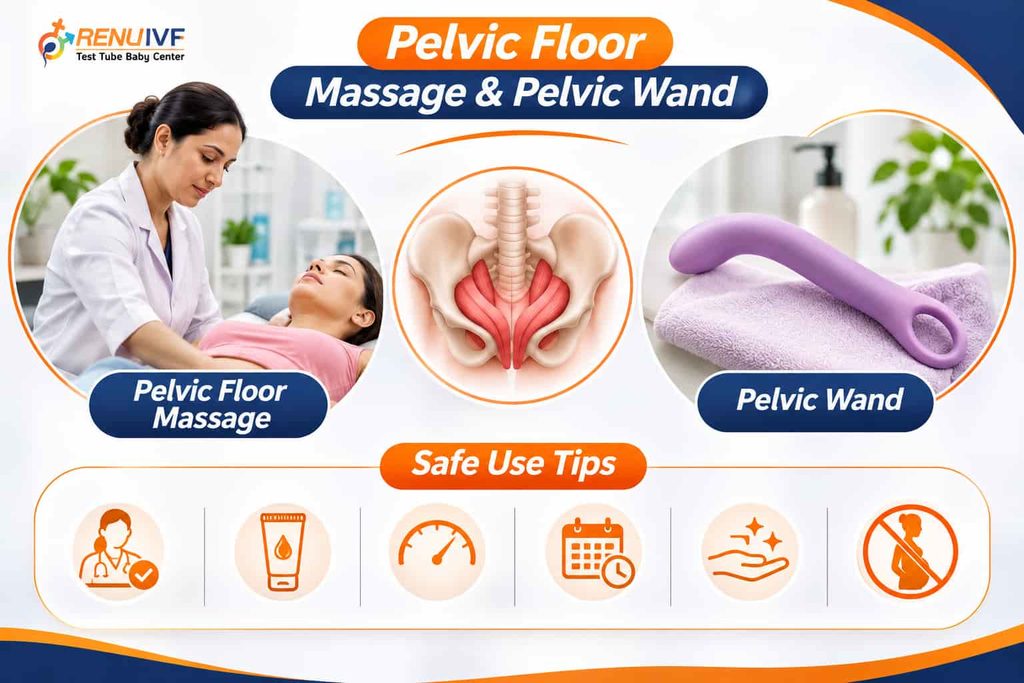
Pelvic floor massage (also called internal myofascial release) is done by a physiotherapist or doctor who is trained in pelvic health. They apply gentle pressure to find tight points, similar to a massage for a stiff shoulder. It is often used for chronic pelvic pain, painful sex, vaginismus and pain with tampons.
What is a pelvic wand?
A pelvic wand is a curved, body-safe tool (usually silicone or smooth plastic) with a handle. It lets a person reach tense trigger points and apply steady pressure. Many women who have been taught by a pelvic floor therapist use it at home between visits.
Safe use tips
• Get a short training from a pelvic physiotherapist before your first use.
• Use plenty of water-based lubricant and go slowly.
• Pressure should feel like a “good ache”, never sharp pain.
• Session time: 5 to 10 minutes, 2 to 3 times per week. Stop if you bleed or feel worse the next day.
• Clean the wand after every use and store it in a clean, dry place.
• Do not use it during pregnancy, with an infection or soon after surgery without medical approval.
Simple external pelvic massage you can do at home
• Lie down with knees bent and a warm pack on your lower belly for 5 minutes.
• Use your palms to make slow clockwise circles around the lower belly for 2 to 3 minutes.
• Massage the inner thighs and the area around the hip bones with gentle pressure.
• Press softly along the sides of the tailbone and lower back.
• Finish with 5 slow belly breaths.
If you have long-lasting pelvic pain, always ask a doctor to rule out conditions such as endometriosis, fibroids, cysts or infection. In some cases a minimally invasive check such as laparoscopy is useful to find the cause.
Vaginal Dilator: Who Needs It and How to Use It
A vaginal dilator is a smooth, graduated tube-shaped device, usually made of medical-grade silicone, that comes in a set of increasing sizes. It is a medical therapy tool, not a toy, and it is very different from Kegel balls.
Who may need a vaginal dilator?
• Vaginismus: Involuntary tightening of the vaginal muscles that makes penetration painful or impossible.
• After pelvic radiation or cancer treatment: To prevent narrowing and scarring.
• After gynecological surgery or reconstruction: To keep the vaginal canal open.
• Menopausal narrowing and dryness: Along with moisturisers or doctor-advised treatment.
• Congenital conditions: For example, some forms of a shortened or absent vaginal canal. Read more in our article on Absent Vagina: Causes, Symptoms and Treatment.
General steps (always follow your own doctor’s plan)
• Choose a quiet, private time and relax with slow breathing.
• Start with the smallest size. Use a generous amount of water-based lubricant.
• Insert slowly, only as far as comfortable. Pause and breathe whenever you feel tension.
• Stay in place for about 10 to 15 minutes. You may gently rotate or move it if your therapist has shown you.
• Practice 3 to 5 times a week. Move to the next size only when the current one feels comfortable.
• Clean after use, and store in a clean container.
Stop and call your doctor if you have heavy bleeding, severe pain, fever or foul discharge. Emotional comfort is also important. Many women need counselling and support alongside the physical therapy, and that is completely normal.
Rectal and Anal Dilators: Medical Uses and Safety
Searches such as rectal dilator, anal dilator and anus dilater are mostly about medical rehabilitation. A rectal dilator or anal dilator is a smooth, graduated, lubricated device used to gently widen and relax the anal canal.
Medical situations where doctors may advise them
• Anal stenosis: Narrowing of the anal canal after surgery or scarring.
• After anal surgery: For example, after fissure, fistula or hemorrhoid procedures, to prevent narrowing, as per the surgeon’s advice.
• Pelvic floor dyssynergia or anismus: When the muscles tighten instead of relaxing during a bowel movement, causing constipation and straining.
• Chronic anal pain from muscle spasm: Sometimes used as a part of pelvic floor therapy.
Safety rules
• Use only on the advice of a doctor, colorectal surgeon or pelvic floor therapist, and follow their size and schedule.
• Use plenty of lubricant, go slowly and never force the device.
• Choose a device with a flared base, so that it cannot slip inside.
• Stop and seek help if there is bleeding, severe pain, fever or a lot of swelling.
• Clean carefully after use. Never share devices.
Vagina Oil Massage and the Best Natural Massage Oil
Vagina oil massage, sometimes called yoni massage, means massaging the outer genital area (the vulva and the perineum) and surrounding tissues with a soothing oil. People use it for relaxation, body awareness, dryness, scar care and comfort. Let us look at it carefully, because the vagina is a sensitive, self-cleaning organ.
Possible benefits of gentle external oil massage
• Helps you relax and become more comfortable with your own body.
• Reduces tension and may ease muscle tightness around the pelvic floor.
• Softens skin that feels dry or irritated.
• Helps with scar tissue care after tears or an episiotomy, after healing and with your doctor’s approval.
• Perineal massage in late pregnancy (from around 34 weeks, if your doctor agrees) may reduce the chance of serious tears in a first vaginal birth.
What is a good natural massage oil?
When you search for oil for yoni massage or a natural massage oil, look for simple, pure, unscented oils. Common choices that are generally well tolerated on the external skin include:
| Oil | Notes |
| Cold-pressed coconut oil | Widely used, soft and soothing. Some people find it irritating or prone to yeast problems, so patch test first. |
| Sweet almond oil | Light and easily absorbed. Avoid if you have a nut allergy. |
| Jojoba oil | Feels close to the skin’s natural oils and is usually gentle. |
| Pure vitamin E or sunflower oil (food-grade, plain) | Mild and cheap options for external use. |
Safety rules for oil massage
• Patch test first on your inner forearm. Wait 24 hours.
• Avoid essential oils, perfumes and colours. These are common causes of irritation and allergy in intimate areas.
• Keep it external. Avoid putting oil deep inside the vagina. Oils can disturb the natural pH and balance of bacteria, and can raise the risk of irritation or infection for some women.
• Oil and condoms do not mix. Oils can weaken latex condoms and diaphragms, and this can lead to breakage and unplanned pregnancy or infection.
• Do not use with itching, unusual discharge, sores, bleeding, pain or an infection. Treat the problem first.
• Wash your hands and clean tools before and after.
If you have a strong smell, itching or unusual discharge, do not cover it with oils. See a doctor. Our article on Vaginal Smell During Pregnancy explains common causes and safe treatment, and White Discharge with Blood lists warning signs you must not ignore.
You may also like: Pads vs Tampons vs Menstrual Cups, which is safer? for more on everyday intimate care.
Kegels in Pregnancy, After Delivery and at Menopause
During pregnancy
Gentle Kegels, combined with relaxation and the “drop”, help prepare the pelvic floor for the demands of labour. Do not overdo them. In labour, the muscles have to relax and open. If your pregnancy has complications, check your plan with your doctor. Our guide to What is High Risk Pregnancy? explains when extra care is needed, and you can read about our High Risk Pregnancy Care in Kanpur.
After delivery
You can often begin very gentle pelvic floor contractions within the first days after a normal delivery, as long as there is no pain and your doctor or midwife agrees. After a C-section, wait until you feel comfortable. Avoid Kegel balls or weights until your postnatal check-up and until bleeding has stopped. If you notice a bulge, heaviness, or leaking, see a gynecologist. Learn more in our post Uterine Prolapse Treatment: Prolapse में Uterus ना निकलवाएं.

Perimenopause and menopause
When estrogen falls, vaginal tissues become thinner and drier, and pelvic floor muscles can weaken. Kegels, moisturisers, vaginal estrogen (if advised), and healthy habits can work together. See our guide on Perimenopause: Symptoms, Age and How to Prepare.
Kegel Exercises for Men
Men have a pelvic floor too. Kegels may help with bladder control after prostate surgery, and may help some men with erection firmness and control of ejaculation. The method is similar: find the muscles you use to hold back gas, squeeze, hold, release. If a couple is also facing difficulty in conceiving, the male partner should be assessed too. Read about our Male Fertility Care services.
Kegel Exercises and Fertility: The Honest Answer
We often get asked, “Will Kegels help me get pregnant?” The honest answer is no, Kegels do not directly improve ovulation, egg quality or sperm quality. Pregnancy depends on ovulation, open tubes, healthy sperm and a receptive uterus.
But a healthy pelvic floor supports a comfortable sex life, which makes timing intercourse easier, and it helps your body in pregnancy and recovery after delivery. If you have been trying to conceive for a year (or six months if you are over 35) without success, it is time to get tested. Our Fertility Counselling and Assessment can find out what is going on. Painful sex should also be checked early, as conditions like endometriosis can affect both comfort and fertility.
When to See a Doctor
Please book a consultation if you notice any of these:
• Pain during sex, tampon use or a pelvic examination.
• Leaking urine or stool that disturbs your daily life.
• A feeling of heaviness, dragging or a bulge in the vagina.
• Difficulty emptying your bladder or bowels.
• Bleeding after sex, between periods or after menopause.
• Unusual discharge, bad smell, itching or burning that does not go away.
• Pelvic pain that lasts more than a few weeks.
• No improvement after 8 to 12 weeks of regular Kegel practice.
At Renu IVF, our gynecology and fertility team led by Dr. Renu Singh Gahlaut provides careful examination, clear advice and treatment tailored to you. You can learn more about us or explore more articles in our Gynecological Health section.
Frequently Asked Questions (FAQs)
Q. What are Kegel exercises?
Kegel exercises are repeated squeezes and relaxations of the pelvic floor muscles. They strengthen the support around the bladder, uterus and bowel, and may improve bladder control and sexual function.
Q. How long do Kegel exercises take to work?
Most women notice a change in 4 to 6 weeks, and a stronger effect by 3 months, if they practice every day with the right technique.
Q. What are the main benefits of Kegel exercises for women?
They can reduce urine leakage, support the pelvic organs, speed up recovery after childbirth, improve bowel control and support better sexual satisfaction.
Q. Do Kegel exercises really help with sex?
Yes, for many women. Better muscle tone, blood flow and body awareness can improve arousal, sensation and orgasm. The effect varies from person to person, and Kegels do not treat pain during sex.
Q. How many Kegels should I do in a day?
A good target is 8 to 10 repetitions, three times a day, with a hold of up to 10 seconds. Do not overdo it. Rest and full relaxation are part of the training.
Q. Are Kegel balls safe?
They are generally safe when made of medical-grade silicone, used for short sessions, kept clean and avoided during pregnancy, infection, pain or soon after delivery. When in doubt, ask your gynecologist first.
Q. Are Kegel weights better than normal Kegels?
They add resistance and feedback, which some women like. Studies suggest that well-performed plain Kegels can work just as well. Weights are optional.
Q. Can Kegel exercises tighten the vagina?
Kegels can improve the strength and tone of the pelvic floor muscles that support the vagina. They do not change the natural size of the vaginal canal permanently. Avoid any “tightening” gel or home mixture.
Q. Can Kegels be harmful?
Yes, if done wrongly or in excess. An already tight pelvic floor can become more painful. If you have pain, stop and get examined.
Q. What is a pelvic wand used for?
A pelvic wand helps release tight trigger points in the pelvic floor. It is mostly used for pelvic pain, tightness and painful sex, ideally after training from a pelvic physiotherapist.
Q. When is a vaginal dilator needed?
It is mostly used for vaginismus, narrowing after radiation or surgery, and some congenital conditions, usually under medical guidance.
Q. Is it safe to use an anal or rectal dilator?
Only when advised by a doctor for a specific medical reason, such as anal stenosis or pelvic floor dyssynergia. Use lubricant, never force it, and stop if there is bleeding or severe pain.
Q. Is vagina oil massage safe?
Gentle external massage with a plain, unscented oil is generally safe for most people after a patch test. Avoid deep internal use, essential oils, and use with latex condoms. Do not use it if you have an infection.
Q. Can I do Kegels during pregnancy?
Yes, gentle Kegels with proper relaxation are usually recommended, unless your doctor advises otherwise. Do not use Kegel balls or weights during pregnancy without medical approval.
Q. Do Kegels improve fertility?
No. They do not directly improve ovulation or sperm quality. They support pelvic health, comfort and recovery. If you are not conceiving, get a fertility assessment.
Conclusion
Kegel exercises are a simple, free and powerful habit for bladder control, pelvic support, better recovery after childbirth and a more confident intimate life. The key is right technique, regular practice and balance between strength and relaxation. Tools such as Kegel balls, weights, cones, a pelvic wand or a vaginal dilator can help in the right situation, but they are not necessary for everyone, and they should never replace medical advice. Gentle pelvic stretches, a healthy lifestyle and safe, natural care will support your results.
Your pelvic health matters at every age. If something feels wrong, do not wait and do not feel shy. A short consultation can save you months of discomfort.
| Book a Consultation at Renu IVF, KanpurLed by Dr. Renu Singh Gahlaut (MS Gold Medalist, FICOG, IVF Specialist & Laparoscopic Surgeon), our team offers gynecology, pelvic health and fertility care with privacy and compassion.Call: +91 63935 77649 | +91 95170 88055Email: info@renuivf.comAddress: In front of C-13, New Azad Nagar, Kalyanpur, Kanpur, Uttar Pradesh 208017Timings: Mon to Sat 9 AM to 7 PM | Sunday 9 AM to 2 PMBook an Appointment | Contact Us | Visit renuivf.com |