


Fallopian tubes are two thin tubes attached to the uterus, one on each side. Their job is simple but important after ovulation, the egg travels into the tube, and this is usually the place where the egg and sperm meet. Once fertilisation happens, the early embryo moves down into the uterus to implant. When one or both tubes become narrow, damaged, or completely blocked, this natural pathway gets disturbed. This is why blocked fallopian tubes are considered one of the important causes of infertility, especially when both tubes are affected. But blocked tubes do not mean pregnancy is impossible it depends on which tube is blocked, where the blockage is, how severe it is, and whether other fertility factors are also present.
What Does “Blocked Fallopian Tube” Actually Mean?
A blocked tube simply means there is an obstruction somewhere along its path near the uterus, in the middle, or near the ovary end. Sometimes the tube is not fully closed but is badly scarred or narrowed. In some women, the tube fills up with fluid this is called hydrosalpinx. If an infection sits on top of this fluid buildup, pus can also collect inside the tube, causing further swelling and damage.
One important thing to understand: a tube can look present on an ultrasound and still not work properly. This is exactly why specific fertility tests are needed instead of just assuming everything is fine.
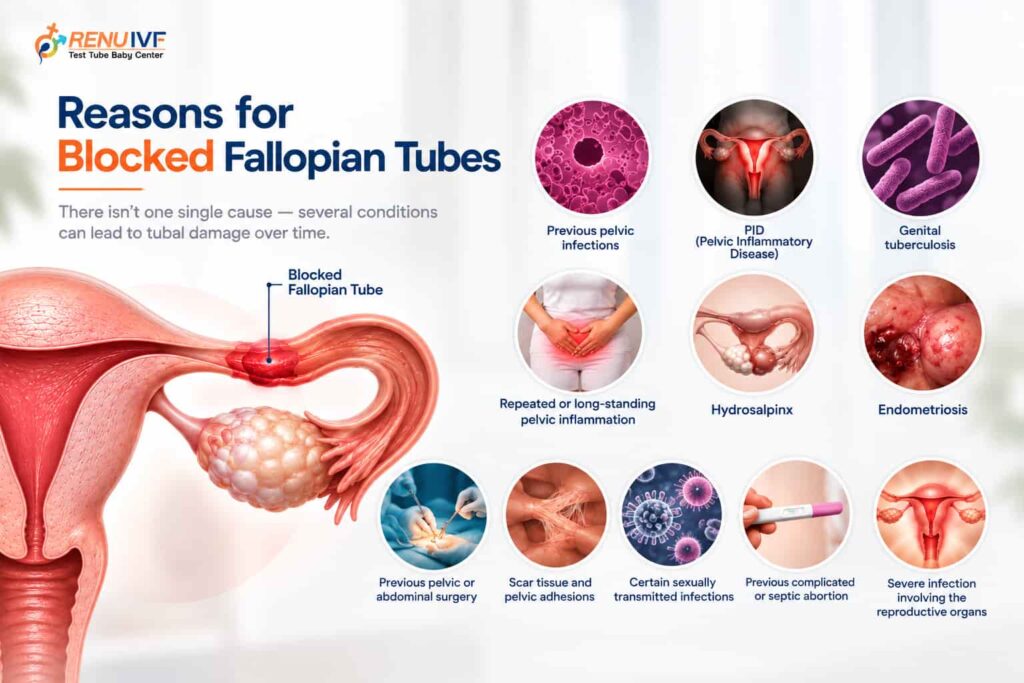
Reasons for Blocked Fallopian Tubes
There isn’t one single cause several conditions can lead to tubal damage over time.
- Previous pelvic infections
- PID (Pelvic Inflammatory Disease)
- Genital tuberculosis (an important cause seen in Indian patients)
- Repeated or long-standing pelvic inflammation
- Hydrosalpinx
- Endometriosis
- Previous pelvic or abdominal surgery
- Scar tissue and pelvic adhesions
- Certain sexually transmitted infections
- Previous complicated or septic abortion
- Severe infection involving the reproductive organs
Tuberculosis and Tube Blockage
TB is usually linked with the lungs, but it can also affect the uterus and fallopian tubes this is called genital TB. In India, this is a real and important cause of tubal damage, and it often goes unnoticed because genital TB doesn’t always show clear symptoms. Many women only find out during an infertility work-up, after the tube has already developed scarring or a “beaded” appearance from long-standing inflammation.
Can PID Cause Blocked Fallopian Tubes?
Yes. PID is an infection and inflammation of the reproductive organs, and if it isn’t treated properly or continues for a long time, it leaves behind scar tissue that narrows or blocks the tube. Some symptoms that may point towards a pelvic infection include:
- Abnormal vaginal discharge
- Pelvic or lower abdominal pain
- Pain during intercourse
- Burning sensation while urinating
- Fever in some cases
- Irregular bleeding
- Pelvic tenderness
It’s worth knowing that many women with tubal damage never had obvious symptoms the damage was picked up only during infertility testing.
Can Endometriosis Affect the Fallopian Tubes?
Endometriosis can cause inflammation, scarring, and adhesions around the pelvic organs. This can restrict how freely the tube and ovary move, even if the tube itself is technically open. So endometriosis and infertility are linked not just through blocked tubes, but through overall pelvic health being affected.
Symptoms of Blocked Fallopian Tubes
The tricky part about blocked tubes is that they often cause no symptoms at all. Most women find out only when they struggle to conceive. Some possible signs or related history include:
- Difficulty conceiving despite regular attempts
- History of PID or pelvic infection
- History of genital tuberculosis
- Chronic pelvic pain
- Pain during intercourse
- History of endometriosis
- Previous pelvic surgery
- Previous ectopic pregnancy
- Hydrosalpinx seen on ultrasound

Having one of these doesn’t confirm a blockage proper testing is needed for that.
HSG Test for Fallopian Tube Blockage
HSG (Hysterosalpingography) is the first and most important test to check if the tubes are open. A dye is passed through the cervix into the uterus, and X-ray images show whether the dye flows freely through the tubes and spills out at the end. If it doesn’t, a blockage is suspected and the exact location matters for planning treatment.
| Location | What it Means |
| Cornual / Proximal blockage | Blockage close to where the tube joins the uterus |
| Mid-tubal blockage | Blockage in the middle part of the tube |
| Distal blockage | Blockage near the ovary end of the tube |
| Hydrosalpinx | Tube is swollen and filled with fluid |
HSG is very useful, but it doesn’t answer everything — sometimes further evaluation is needed.
HSG vs Laparoscopy: What’s the Difference?
HSG is an imaging test done through X-ray. Laparoscopy is a minor surgical procedure where a camera is inserted to directly look at the pelvic organs, including the outer surface of the tubes. Laparoscopy is often combined with hysteroscopy hysteroscopy looks inside the uterus, while laparoscopy looks at the tubes, ovaries, and surrounding structures from outside.
| Investigation | Main Purpose |
| HSG | Checks uterine cavity and whether dye passes through the tubes |
| Ultrasound | Evaluates uterus, ovaries, and detects hydrosalpinx |
| Hysteroscopy | Examines the inside of the uterus |
| Laparoscopy | Directly examines the pelvic organs and outer tube surface |
| Tubal cannulation | Used for select proximal (cornual) blockages |
Treatment for Blocked Fallopian Tubes
There’s no single treatment that fits every patient it depends on where the blockage is, how severe it is, the woman’s age, ovarian reserve, and the sperm parameters of the partner.
| Type of Blockage | Possible Treatment |
| Cornual/proximal blockage | Tubal cannulation (hysteroscopic approach) |
| Mid-tubal or distal blockage / adhesions | Laparoscopic surgery in select cases |
| Hydrosalpinx | Management of the fluid-filled tube; may need removal before IVF |
| Severely damaged or non-functional tube | IVF |
It’s important to understand: the goal isn’t just to make the tube “look open” on a scan. A tube can be surgically opened and still not function well enough to transport an egg or embryo which is why, in many severe cases, laparoscopy and hysteroscopy alone are not enough, and IVF becomes the more reliable path.
When is IVF Recommended for Blocked Tubes?
IVF becomes especially relevant when both tubes are badly damaged. In IVF, eggs are retrieved directly from the ovaries using ultrasound guidance, fertilised with sperm in the lab, and the resulting embryo is placed directly into the uterus completely bypassing the tubes. This means even if the tubes cannot be repaired, pregnancy is still very much possible.
An important point on hydrosalpinx and IVF: if a tube is filled with fluid (hydrosalpinx), that fluid can leak into the uterus and reduce IVF success rates, because it can be harmful to the embryo. In many such cases, doctors recommend removing or blocking the affected tube before starting IVF, to give the embryo the best chance of implanting.
Can You Get Pregnant With One Blocked Tube?
Yes if the other tube is healthy and ovulation, sperm health, and other fertility factors are normal, natural pregnancy is still possible with just one working tube. If both tubes are completely blocked, natural conception through the tubes isn’t possible, but IVF remains a reliable option.
A Word on Ectopic Pregnancy Risk
If a tube is damaged or partially open especially after PID, genital TB, or a tubal surgery there is a higher chance of the pregnancy implanting inside the tube itself instead of the uterus. This is called an ectopic pregnancy, and it needs urgent medical attention. This is why women with a history of tubal damage should get an early pregnancy scan to confirm the pregnancy is correctly placed in the uterus.
Watch the Video
To understand in Hindi why tubes get blocked, how HSG detects it, when laparoscopy or hysteroscopy help, and how IVF works around blocked tubes, watch this video by Dr. Renu Singh Gahlaut:
“Tube Blockage की वजह से Pregnancy नहीं हो रही? जानिए कारण, HSG Test, Laparoscopy और IVF”
Key Points to Remember
- Blocked fallopian tubes are an important, but not the only, cause of infertility.
- PID, genital TB, and endometriosis are among the common reasons for blocked fallopian tubes.
- Blocked tubes often cause no obvious symptoms.
- HSG is the first-line test to check tubal patency.
- Laparoscopy and hysteroscopy can help in select cases, but severely damaged tubes may not regain normal function even after surgery.
- Hydrosalpinx can reduce IVF success and may need treatment before IVF.
- IVF bypasses the tubes entirely and is a reliable option when tubes are severely damaged.
- Treatment should always be individualised based on age, ovarian reserve, and overall fertility health.
Conclusion
Blocked fallopian tubes can feel overwhelming when you’re trying to conceive, but it is not the end of the road. Understanding the reason for blockage whether it’s PID, genital TB, endometriosis, or scar tissue and getting the right tests done, like HSG and where needed laparoscopy or hysteroscopy, helps in choosing the correct treatment path. And even when tubes are severely damaged, IVF offers a proven way to bypass the problem entirely. If you are facing infertility and are looking for the right guidance, Renu IVF, a trusted infertility hospital in Kanpur, can help evaluate your specific condition and guide you to the treatment that’s right for you.